Beautiful, Beautiful Texas

Beauty is in the eye of the beholder, and between you and me, there are miles and miles of it in the state of Texas.

I remember well in my college years the 525-mile drive from Aggieland back to my hometown of Nazareth in the Texas Panhandle. It wasn’t for the faint of heart nor bladder, and keep in mind that was back in the days before smart phones and portable DVD players. Thank goodness growing up there acclimated me to long stretches of nothingness and having to drive many a mile to get to the nearest grocery store, shopping mall or, heck, even another town with actual people.

Possibly as a result, I’m well versed in both self-entertainment and resiliency, not to mention fiercely proud of and loyal to the area, probably to a fault. Where most people only see barren, flat and boring, I see wide open spaces, endless horizons, room for a view and to breathe, and acres upon acres of rugged, untamed, abundant beauty precisely as nature intended.

Palo Duro Canyon, exhibit A in Texas Panhandle natural beauty, as captured here complete with a rainbow by Open Skies Photography’s Richard Douglass. It is the second-longest canyon in the United States behind the Grand Canyon and one of several located in the so-called “land of the inverted mountains,” labeled as such because the area is relatively flat until you reach the long and steep canyons, highlighted by Palo Duro and Caprock Canyons to the south. (Credit: Richard Douglass.)

I really didn’t grasp until college that the area we affectionately referred to as West Texas growing up wasn’t truly West Texas, despite the fact that it was home to the institution formerly known as West Texas State University (present-day West Texas A&M University) and that our New Mexico state champion 16-and-under Amateur Athletic Union (AAU) basketball team was the Wes-Tex Sandies. To this day, West Texas is the one area of the state that I haven’t explored, and a such, it remains at the top on my short list.

Until that day, however, I have a dream and the luxury of vicarious living through pictures, from those regularly posted on McDonald Observatory’s Facebook page to the following beauts captured by fellow Aggie Glen Vigus.

I first met Glen during a past professional life in the Texas A&M College of Architecture — mine in communications and his in the now-world-famous Viz Lab, which he’s been a member of since 1998. Like so many others in the Texas A&M Department of Visualization, Glen is incredibly talented and perpetually perched on the cutting edge, from his print and digital photography to his educational efforts and insight that I would describe as a delightful mix of “how-to meets follow-me!” Although I don’t get to see him in-person much anymore, I’m routinely privy to his artistry and creativity through Facebook. So are you, thanks to his generosity of spirit in agreeing to share his Terlingua Ranch album and the related backstory for the Texas A&M Science blog.

Not unlike a Jerry Jeff Walker song, I told Glen that I think it offers the perfect blend of geography, geology and earth science with sides of astronomy and atmospheric sciences thrown in for the good educational measure that’s so important during the summer months.

I’ll let Glen take it from here — both the words and the wordless. On that latter front, like any good storyteller, I think he saved the best for last.

* ~ * ~ * ~ * ~ *

“Years ago, my dad purchased land on the Terlingua Ranch. I never knew why he was so excited about this place until I saw it. Early one morning (4 a.m.), I accompanied my dad, brother-in-law and nephew on a 10-hour drive to Terlingua. The main purpose of our journey was to survey and mark my dad’s property. It is a different world in this part of Texas. It’s isolation and natural beauty are something to behold. I’m looking forward to the next visit … I just wish it wasn’t so far away.”

Check out Day 2 of Glen’s waltz across West Texas: Big Bend National Park.

Marking Time

Ever wonder what mathematicians do on vacation? In Texas A&M professor Wolfgang Bangerth’s case, he kicked off summer 2015 by hiking through history related to another of his disciplinary specialties: geophysics.

A widely respected expert in computational mathematics and mathematical modeling, Bangerth is the author of the software program ASPECT (Advanced Solver for Problems in Earth’s Convection). His code is helping geodynamics researchers around the world visualize the Earth’s interior and related processes, thanks to funding assistance from a major facility in California at the epicenter of geodynamics research.

Earlier today, Bangerth found himself at the site of one of the worst geological disasters in U.S. history, Mount St. Helens in Washington State. Roughly one month after the 35th anniversary of the historic eruption, Bangerth toured the area, posting these incredible photographs on Facebook and agreeing to share them via the Texas A&M Science blog.

“What a treat,” Bangerth writes, “A seven-hour hike through the devastation area and then halfway up Mount St. Helens. (Additional treat: Total number of people encountered in the first six hours: 1. In fact that equals the total number of mammals encountered during this time.)”

In addition to the photos and captions, Bangerth — ever the educator — offered to expound on the science as follows:

“So here’s the story: Mount St. Helens is one of the chain of Cascade volcanos along the U.S. West Coast that exist because the Pacific (or, more exactly, the Juan De Fuca plate) subducts beneath the North American plate. They take with them millions of years of sediments, entrapped water, etc., and this leads to melting of material when they get to certain depths, and this melt then comes up a couple of 100 miles inland of the subduction zone.

“In 1980, magma rising up bulged out the side of the volcano. After an earthquake, this whole bulge collapsed in a gigantic landslide. Liberated of the pressure of the overlying rock, two enormous explosions then ripped apart most of the mountain within seconds of the landslide. There is a fantastic video of this created from a sequence of 10 or 15 pictures and also another series here.

“What you see in my pictures are the remains of the volcano (1,300 feet shorter than it was before, with its enormous gash on one side) and the valley below the landslide and miles downstream from there — in some places up to 700 feet of debris, ash and the results of several later pyroclastic flows. The deep incisions are streams that have eroded this loose material.

“The landscape is largely barren since it had, of course, not a single living organism left after the 1980 event, and is only slowly re-growing. Along the streams there are man-high trees these days, but elsewhere you only find bare gravel and sand — some covered by hardy mosses and lichens — and in many places lots of miniature bluebonnets and some Indian paintbrushes. There are ants and a few insects, but generally few vertebrates. I did see a small number of birds, including a pair of hummingbirds. By and large, it’s a huge contrast from the densely forested areas around the mountain (and how it looked before the event, as seen in older pictures).”

When Research Gets Wild

Scientists often go to great lengths for their research, but sometimes it gets downright risky.

Grace Smarsh ’14 is a Ph.D. candidate who has been working in the lab of Dr. Michael Smotherman, Texas A&M University biologist and a leading expert on bat behavior. Grace spent a total of 17 months during a three-year period in Tanzania studying the songs of its native heart-nosed bat to probe how their vocal ranges adapt to different social interactions. While on her quest to observe the winged creatures, Grace had to learn to coexist with the land-dwellers of the African bush, from the tiniest of insects to some pretty large cats.

Here’s Grace, discussing some of her encounters and how she coped with her rank in the animal kingdom.

Analyze This

In this day and age when an organization’s communications efforts are considered only as good as the tracking metrics put in place to validate them, I am most decidedly old school. While I get that analytics have their place and are here to stay as a valuable strategic tool, I firmly believe even the best metric can never trump good old-fashioned gut instinct.

In essence, when it comes to quality communications, you know it when you see it. In the case of the Texas A&M Division of Research, I routinely do.

Because the Texas A&M College of Science has the largest amount of fundamental research funding on campus, our two communications offices often have quite a bit of agenda overlap and, therefore, lots of opportunities for collaboration in reaching our broader marketing and communications goals.

Director of Communications and Public Relations Susan Wolff and her entire team’s collegiality knows no bounds. Believe me, I’ve extensively tested them — team and bounds — especially during the past few belt-tightened years. Thankfully, individually and collectively, this group subscribes to a singular purpose: providing an invaluable service role for campus units in need of central resources or signal amplification, from governmental relations and federal-funding radars to general societal awareness. Texas A&M Science has been one of the biggest beneficiaries of their goodwill, punctuated in both b-roll and stand-alone pieces for feature stories and news releases from their videographers, sundry retweets and elevated online placements from their social media and web developers, and on-the-fly assistance for professors in need of video or artistic services from their graphic designers and illustrators.

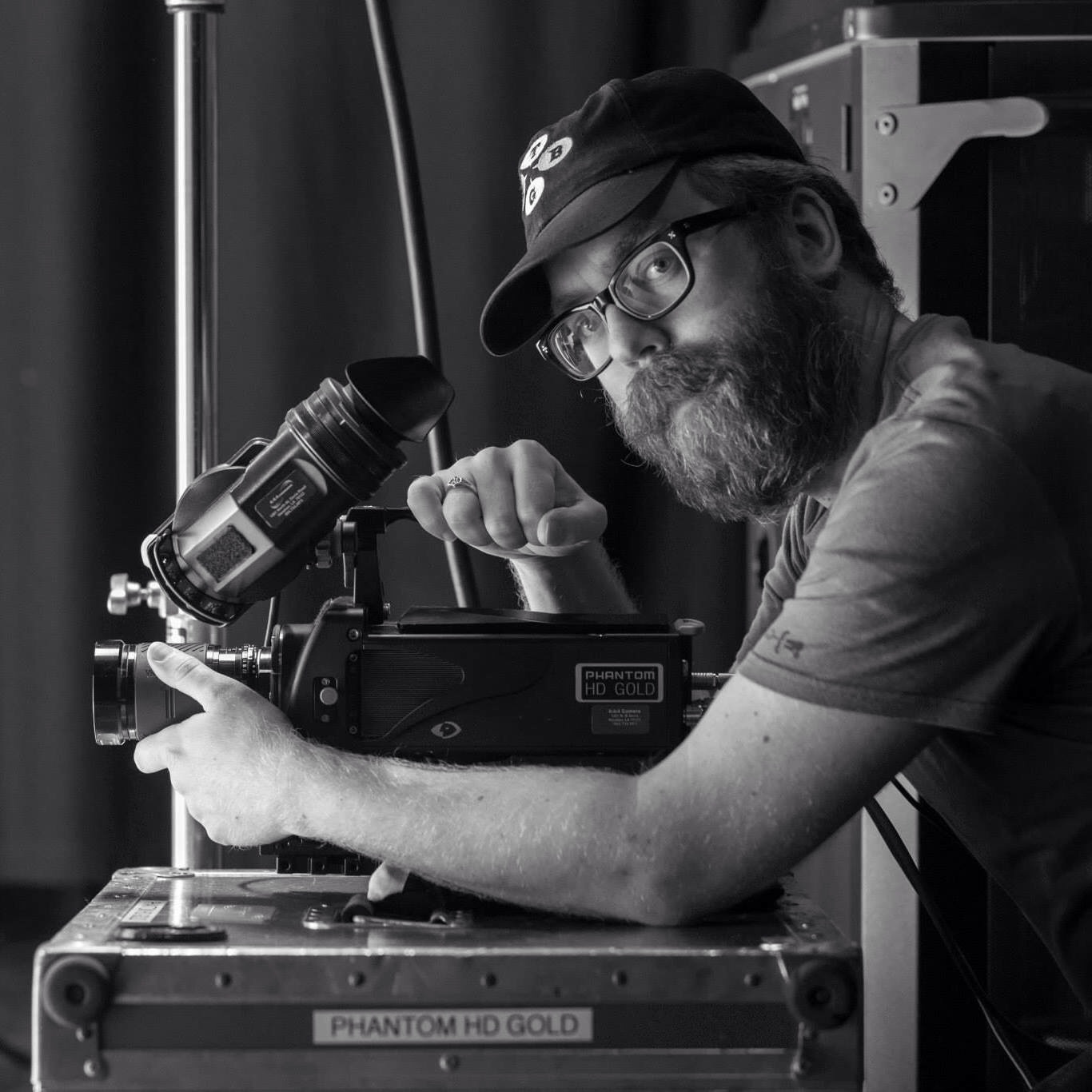
Jeff Gustafson, in his element. (Credit: Amy Richards.)

Jeff Gustafson, in his element. (Credit: Amy Richards.)

The first scenario is how I came to meet Jeff Gustafson in spring 2013 as the videographer in charge of a memorable and most fruitful shoot in Texas A&M chemist Karen Wooley’s laboratory. Admittedly, even prior to that March 7 shoot, I was intrigued by two things: He was a graduate student in the Department of Visualization’s master’s of visualization sciences degree program, and he preferred the nickname “Goose.”

True to form, I arrived on set just as Goose was wrapping up color and lighting testing with Susan, who was serving as Dr. Wooley’s stand-in. He moved fluidly about the tight scene, pausing between equipment adjustments and final checks to introduce himself, punctuating that first impression with a warm smile and a firm handshake. For the most part, I was able to contain myself and simply observe, but in what amounted to a moment of foreshadowing, I did spontaneously extend the shoot when I blurted out an extemporaneous follow-up question after what was supposed to be the final one in the two-hour session.

That day, Goose graciously kept the cameras rolling. In the subsequent days, neither he nor any other member of the Good Ship Research Communications has stopped humoring me in a variety of ways big and small. The resulting videos — oil-absorbing nanoparticles and anti-biofouling polymer coatings, among others — speak well enough for themselves, but for me, the proof is in the many projects in between that day’s final shot/cut and the present.

Which brings me to this sweet bonus — a stylized compilation of cuts from shoots in various Texas A&M Science labs by Goose and fellow videographers Eric Burke and Bhakti Duran, complete with some editorial nudges from Susan. The timing, the touches, the colors, the precision, the overall synergy and synchronicity . . . I am absolutely blown away.

My gut says it’s a perfect mix of art and science. Susan and her crew simply call it a gift to Texas A&M Science. Fitting, considering that’s precisely the word I would use to describe them with regard to this campus and its communications.

Lead, follow or get out of the way. Good communicators know it’s a delicate balance of all three. Here in Texas A&M Science, I’m privileged to lead, follow and get out of the way of some of the very best.

An artistic take on detecting dark matter, developed for a related 2014 press release by Division of Research Communications graduate assistant illustrator Rachel Wang. (Credit: Rachel Wang.)

An artistic take on detecting dark matter, developed for a related 2014 press release by Division of Research Communications graduate assistant illustrator Rachel Wang. (Credit: Rachel Wang.)

Mountain Majesty

So many among our faculty are such excellent storytellers. If not for their pesky day jobs, they could make a fine living as writers. I like to think this blog helps fulfill a dual purpose, enabling them to dabble in trivial pursuits if not possible second careers while bringing what I consider to be valuable behind-the-scenes perspective on any number of interesting subjects.

When it comes to astronomy, particularly anything happening in Chile, I’ve learned from pleasant experience to go straight to Nick Suntzeff. Nine times out of 10, he was either involved and/or present and, true to 3-sigma-level result verification form, he always has a good story.

The following is one that recaps his professional and personal history with Cerro Pachón, previously seen on this blog in his photographs taken on location in Chile. He originally posted said story on his Facebook page on Monday (April 13) and has agreed to let me cross-promote it here for the benefit of a broader audience.

Such a rich culture treasure! The mountain and its backstory’s not half bad, either.

* ~ * ~ * ~ * ~ *

“Back in the late 1980s and early ’90s, Cerro Pachón was the mountain I studied for future observatories as part of my job as staff astronomer at CTIO [Cerro Tololo Inter-American Observatory in Chile]. We had to haul the equipment up by mule and establish a small observatory to measure the site quality — seeing, laminar layers, wind speeds, temperature measurements. It now hosts the Gemini 8-meter telescope, the SOAR 4-meter telescope, and starting tomorrow [April 14] with the inauguration ceremonies, the Large Synoptic Survey Telescope, which will be a revolutionary 6-meter telescope that will digitize the sky every three nights.

Artist's rendering of the Large Synoptic Survey Telescope. (Credit: National Science Foundation).

Artist’s rendering of the Large Synoptic Survey Telescope. (Credit: National Science Foundation).


“The mountain is spectacular, as you can see in the video. We could camp on top of the mountain easily because for some reason, there is a year-round spring that runs about 100 feet below the summit.


“The spring is there, I was told by the geologists who did the boring, because of the tremendous hydrostatic pressure from the Andes and the South American trench. They were very surprised, though, that the spring was year-round. Someone was going to do a careful chemical analysis of the water to see where it was coming from, but I don’t know if they ever did this.

“John Irwin did the detailed site surveys in the 1960s and early ’70s, and he helped me understand the mountains there. You can still see the cement pad he put on Pachón between Gemini and LSST, partially buried in rock. It is just on the other side of the road from the spring. … He hated Pachón because he did the survey there during a cold part of the year, and the wind is horrendous on Pachón (which also makes the seeing better than on Tololo). He couldn’t wait to finish the work on Pachón and go someplace more hospitable.

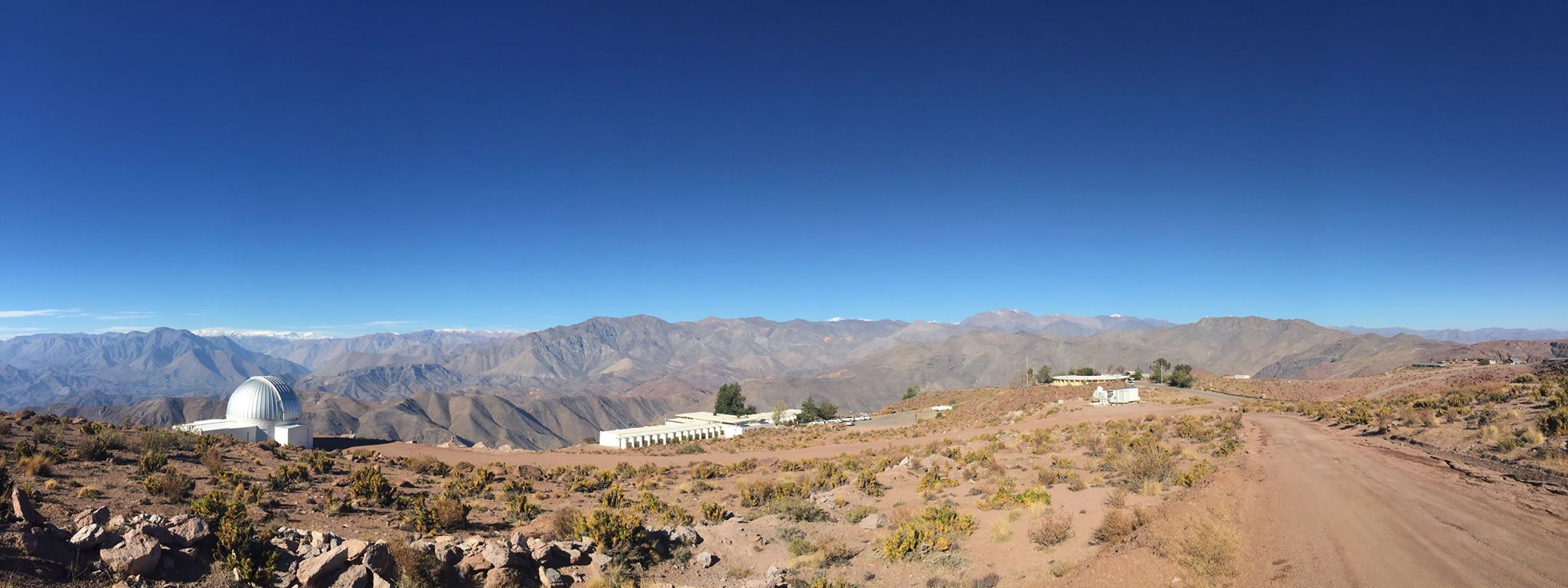
Pachón in the distance, taken from the dormitories at Cerro Tololo Inter-American Observatory (CTIO). Pachón is the flat top mountain at the right, sort of at the end of the road in front. Gemini is in the middle of that mountain, with SOAR to the left and LSST on the right edge of that ridge.

Pachón in the distance, taken from the dormitories at Cerro Tololo Inter-American Observatory (CTIO). Pachón is the flat top mountain at the right, sort of at the end of the road in front. Gemini is in the middle of that mountain, with SOAR to the left and LSST on the right edge of that ridge.


“The broader site is called Cerro Peñon, which means ‘rocky peak’ in Spanish. Pachón means something like ‘skirt,’ according to an Aymará woman from the north of Chile. It also means ‘hairy’ or ‘lazy’ in Chilean slang. I was told that many peaks are called Pachón because the rockfall from the cliffs forms a base and the cliffs, made of columnar andesite, look like the pleated skirts worn by the women of the high Andes.

“Being on a mountain, alone at the telescope, is a magical experience. The sky is like nowhere else. So many stars! If you hold your hand close to the ground, you can see a shadow — the sky is so bright with stars. And maybe that night, you will find something in the sky no one has ever seen or understood before.”

Cerro Tololo mountain, as viewed from the Large Synoptic Survey Telescope (LSST) site.

Cerro Tololo mountain, as viewed from the Large Synoptic Survey Telescope (LSST) site.

Driven by Nature

Cross-country road trips present the perfect opportunity to let your mind wander. The possibilities (much like the road) are endless, particularly if you’re a scientist.

Meet Dwight Bohlmeyer ’84, who earned both a B.S. in marine biology at Texas A&M University at Galveston in 1984 and an M.S. in genetics from Texas A&M University in 1989. A former department head for the Division of Natural Science (2009-2014) and a longtime biology instructor (1997-2014) at Blinn College’s Bryan campus, he recently joined the Texas A&M Institute for Quantum Science and Engineering, where he manages the Salter Farm Educational Research Program.

Dwight and I met this past fall by way of Monarch butterflies and related marketing opportunities. He’s a glutton for all things STEM education, and in addition to having a keen eye for photography, he has the science background to make it beneficial beyond the beauty. If you follow us on Facebook, chances are you’ve probably seen some of his work.

In fact, it was via Facebook that I first learned about his latest project, a daily nature photography challenge to capture five species a day throughout 2015 for a total of 1,825 species by December 31. He dreamed it up as a rather unique New Year’s resolution while filling mental space during his return trip to College Station from Missouri, where he was visiting family for the holidays.

Even though I know these things are all about stretching one’s limits (which I like to think I accomplish by default as a full-time working mother of three), I think Dwight’s really outdone himself here and that the results will be well worth following. And we can all do just that at FIVEx365, the WordPress blog he’s set up to help document his results and keep him accountable like the disciplined scientist he is. He even has rules, which he outlines in the first entry.

And to think, all this time, I’ve been jamming out to mixed CDs and XM Radio during my extended travels. Get the picture?

A cold and rainy start to 2015, beautifully illustrated by Dwight Bohlmeyer using a canna lily as both his artistic and scientific medium. See more of his work at FIVEx365. (Credit: Dwight Bohlmeyer)

A cold and rainy start to 2015, beautifully illustrated by Dwight Bohlmeyer using a canna lily as both his artistic and scientific medium. See more of his work at FIVEx365. (Credit: Dwight Bohlmeyer)

2014 In Review

‘Tis the season for all things recap. Case in point: This morning’s inbox fodder featured a nifty end-of-year report (thank you, WordPress.com stat monkeys!) on the Texas A&M Science blog. In case you don’t care to sift through the entire thing available here, I’ll hit the high points as I see them.

/home/wpcom/public_html/wp-content/blogs.dir/b3f/54023201/files/2014/12/img_2046.jpg

In summary, 2014 blew 2013 out of the water. Thirty-four published posts, 5,872 views and 3,235 visitors, compared to 19 posts, 977 views and 523 visitors in 2013. And our top all-time viewing day — 332 on November 25.

To be fair, however, 2013 started a half-year behind, given that the blog didn’t officially launch until June. Fitting, then, that the original post I wrote back in 2013 to pitch the overall blog concept (Heart of the Matter) was the only one from the previous year to grace 2014’s Top 10:

1. A Bittersweet Benchmark (486)
2. The Beauty of Rare Creatures and Social Networking (466)
3. Light My Fire (259)
4. All Work and No Play (240)
5. Winning Teams (206)
6. Life Forces and Legacies (152)
7. You Are Enough (129)
8. Heart of the Matter (97)
9. Angel in Flight (91)
10. Tradition in Action (85)

Seven of those posts topped 100 views, with five exceeding 200. By comparison, only one post logged three-digit-viewing numbers in 2013: the perhaps-coincidentally-titled By the Numbers with 242. The top feeder was Facebook, followed somewhat surprisingly by search engines.

/home/wpcom/public_html/wp-content/blogs.dir/b3f/54023201/files/2014/12/img_2045.jpg

I’ve always enjoyed seeing new countries show up on the world viewing map, and we certainly broke lots of new international ground in 2014 as word (pun intended) has continued to spread. Current reach: 73 countries, which sounds amazingly cool, to me! Not surprisingly, the United States accounts for most of our views (5,323), but can you guess which country is second (170) as the only other that cracked triple digits?

All good news and good fun befitting this blog, which has become one of my favorite self-assignments if not general writing exercises. While in my admittedly old-school book, new media will never trump nor entirely replace traditional media, it sure makes for an enjoyable alternative and accompaniment, ideally for reader and writer.

On behalf of Texas A&M Science, I sincerely thank each of you for being part of this continuous, ever-evolving experiment. Here’s to more stories, additional insights and broader perspectives in 2015!

Oh, and I almost forgot — that No. 2 viewing country? Brazil. Go, GMT!

Light My Fire

I’ve been to my fair share of External Advisory & Development Council meetings during the past decade, but this one took the cake. Well, make that melted dark chocolate.

Each fall meeting marks the addition of a few new members — names and faces that I try my best to mentally file along with the customary group of longtime favorites I so enjoy seeing on a biannual basis. While newcomers are always recognized at some point in the meeting, I don’t recall any of them previously being allowed to make short presentations as part of the induction process.

Based on last month’s experiences, let’s just say the bar’s been raised on what I personally hope is a new tradition.

Each meeting typically is broken into morning and afternoon sessions, separated by one break per session as well as lunch. When we returned from said lunch, I immediately spotted an array of products stacked against the base of the speaker podium — the first indication we were in for a treat on top of the delicious cheesecake we’d just been served as dessert. Beyond the fact that they looked slightly similar to the MREs (meals ready to eat) I’d seen in a previous work life in which one of my supervisors was ex-military, I quickly dismissed them as the venue possibly peddling some new coffee samples or something equally innocuous.

Mistake No. 1.

As Lynntech’s Tony Ragucci, the first of two new members in attendance, took to the podium to briefly describe his company and related work, I couldn’t help but notice as a wait-staff member methodically went seat by seat, row by row to distribute individually prepackaged toothpicks. Mildly intriguing, but then again, we’d just finished lunch, so. … Back to the presentation at hand.

Lynntech's Tony Ragucci presents his company's research capabilities and focus areas, which span an impressive array of science and engineering disciplines and deliverables.

Lynntech’s Tony Ragucci presents his company’s research capabilities and focus areas, which span an impressive array of science and engineering disciplines and deliverables.

Too late! I’d glanced to my left, toward the end of our row of tables, where I zeroed in on four small plates with sliced bananas and strawberries?!? Granted, EADC Chair Dr. John Beckerdite ’76 was seated there, so perhaps he had merely requested an extra dessert or two, which wouldn’t be out of the question, right?

By this point, my spidey senses were beyond tingling. Thankfully, Dr. Ragucci was hitting a most interesting stride, so I immersed myself in learning all that I could about condensed matter physics and some pretty sophisticated materials science and engineering, along with related fabrication. Mind sated, curiosity abated. Although he couldn’t disclose the company’s clients by name nor discuss specific information about the proprietary projects and products, that merely added myth to the mystery for me. After all, exclusivity is one of the council’s biggest draws, and it comes bundled with a palpable sense of curiosity that permeates the entire room.

During the lunch break prior to Ragucci's presentation, RBC Technologies' Adam Laubach clearly had been busy, as evidenced by the products assembled in front of the speaker's podium.

During the lunch break prior to Ragucci’s presentation, RBC Technologies’ Adam Laubach clearly had been busy, as evidenced by the products assembled in front of the speaker’s podium.

After Dr. Ragucci concluded his presentation, Dr. Beckerdite introduced our second new member, RBC Technologies’ Adam Laubach. He began to talk about batteries, a subject I could readily identify with not as a scientist but as a parent responsible for three kids ages 11 and under and, more importantly, keeping a steady supply of AA, AAA, 9-volt, C and D batteries on hand at any given moment as well making sure that all cell phones and electronic devices are charged.

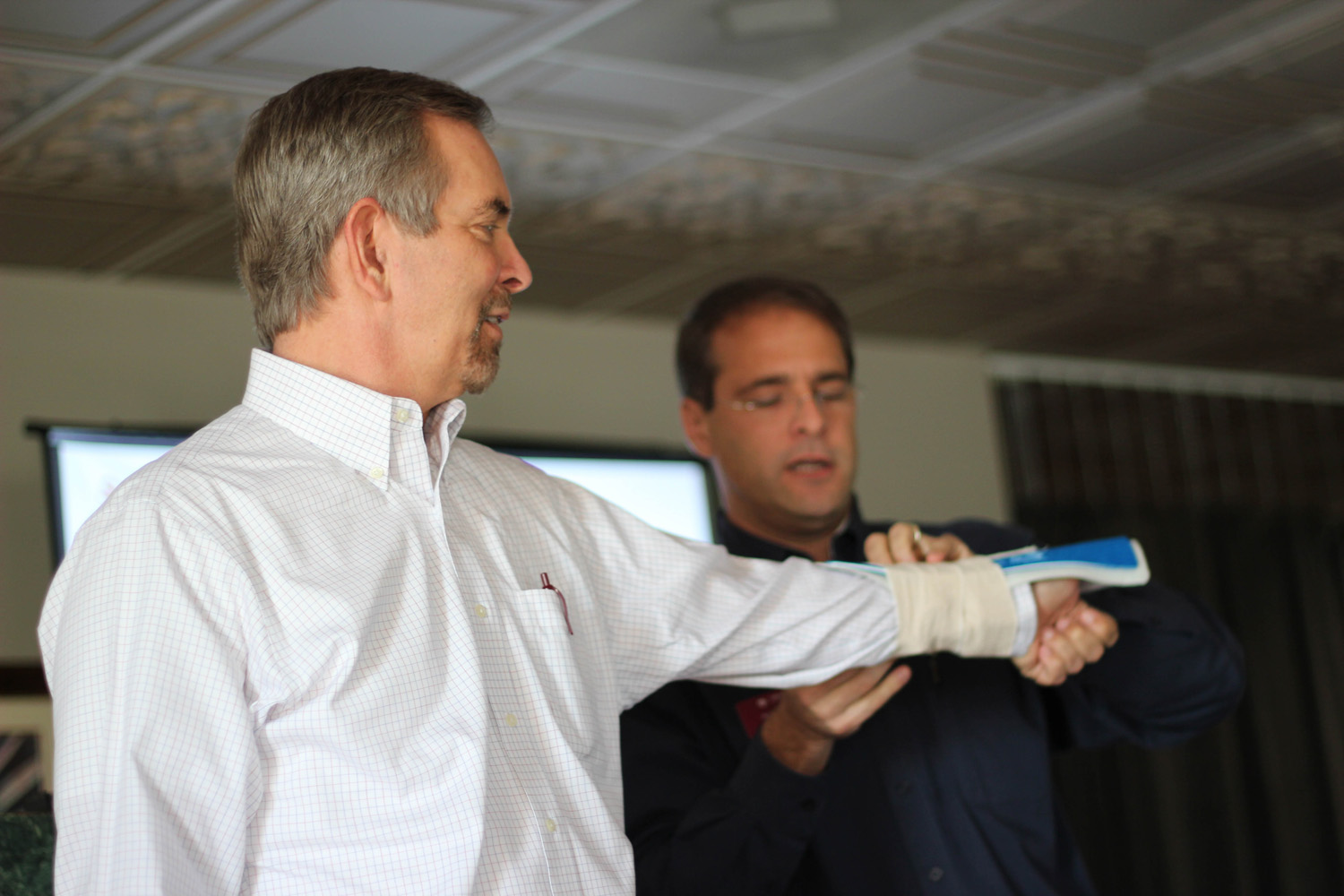
RBC Technologies' Adam Laubach explains his company's Safe Heat product line featuring the Rapid Splint.

RBC Technologies’ Adam Laubach explains his company’s Safe Heat product line featuring the Rapid Splint.

I’m pretty sure the entire room was as surprised as I was when Mr. Laubach and Dr. Beckerdite began distributing via the first person in each row a variety of rectangular-shaped items adorned with shiny, bright-orange packaging. After polling the group to see if anyone was in orthopedics, he then asked each row to peel back and remove an adhesive strip from the first item — a thin, roughly 3-inch X 12-inch board resembling the look and feel of spongy corrugated cardboard. And to wait for a couple minutes as the product heats up (wait, what?!?)

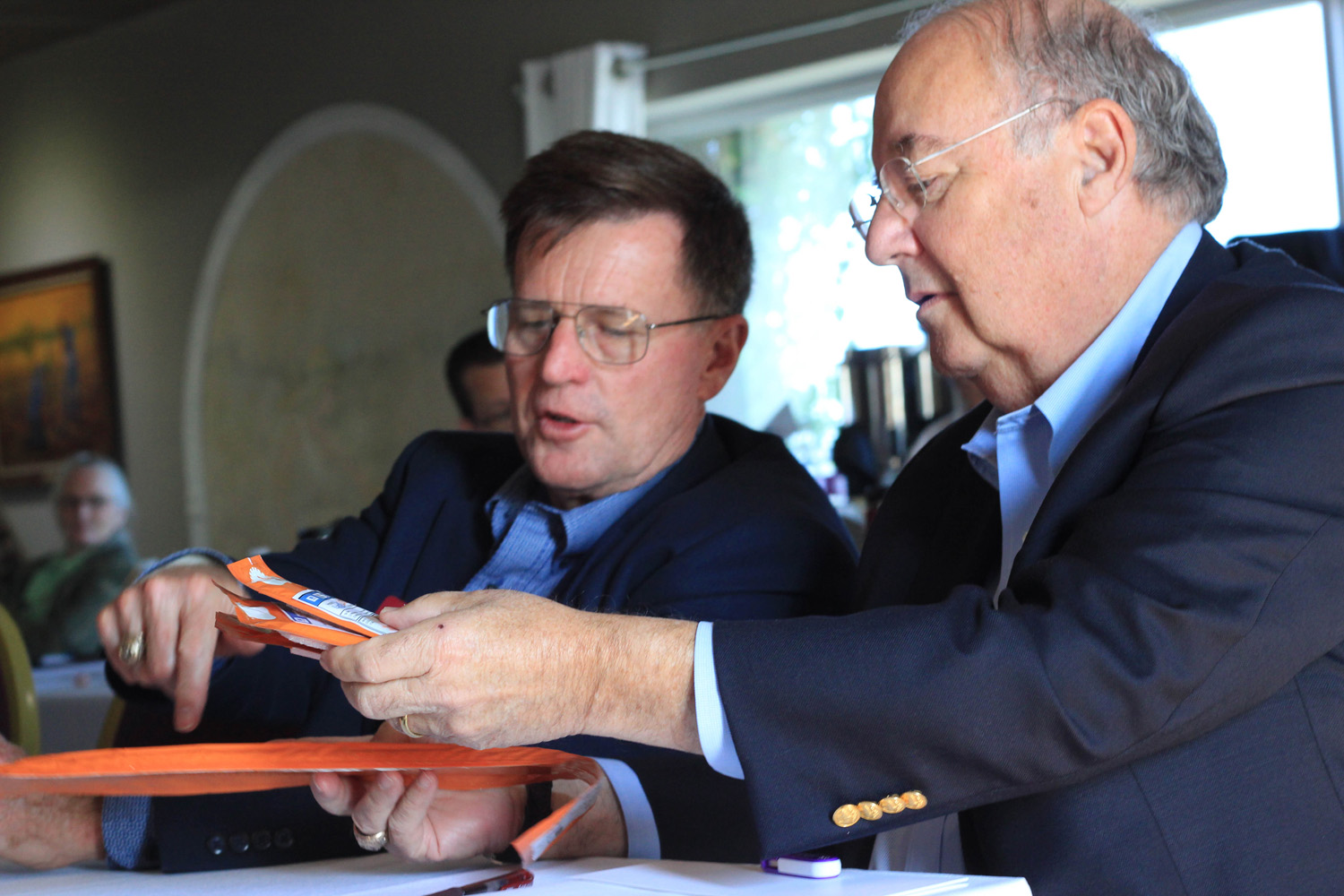
(From left:) EADC members Dr. Donald Fleming, Jr., Col. USMC (Ret) '74 and Albert Gallatin '61 inspect their row's allotment of RBC products.

(From left:) EADC members Dr. Donald Fleming, Jr., Col. USMC (Ret) ’74 and Albert Gallatin ’61 inspect their row’s allotment of RBC products.

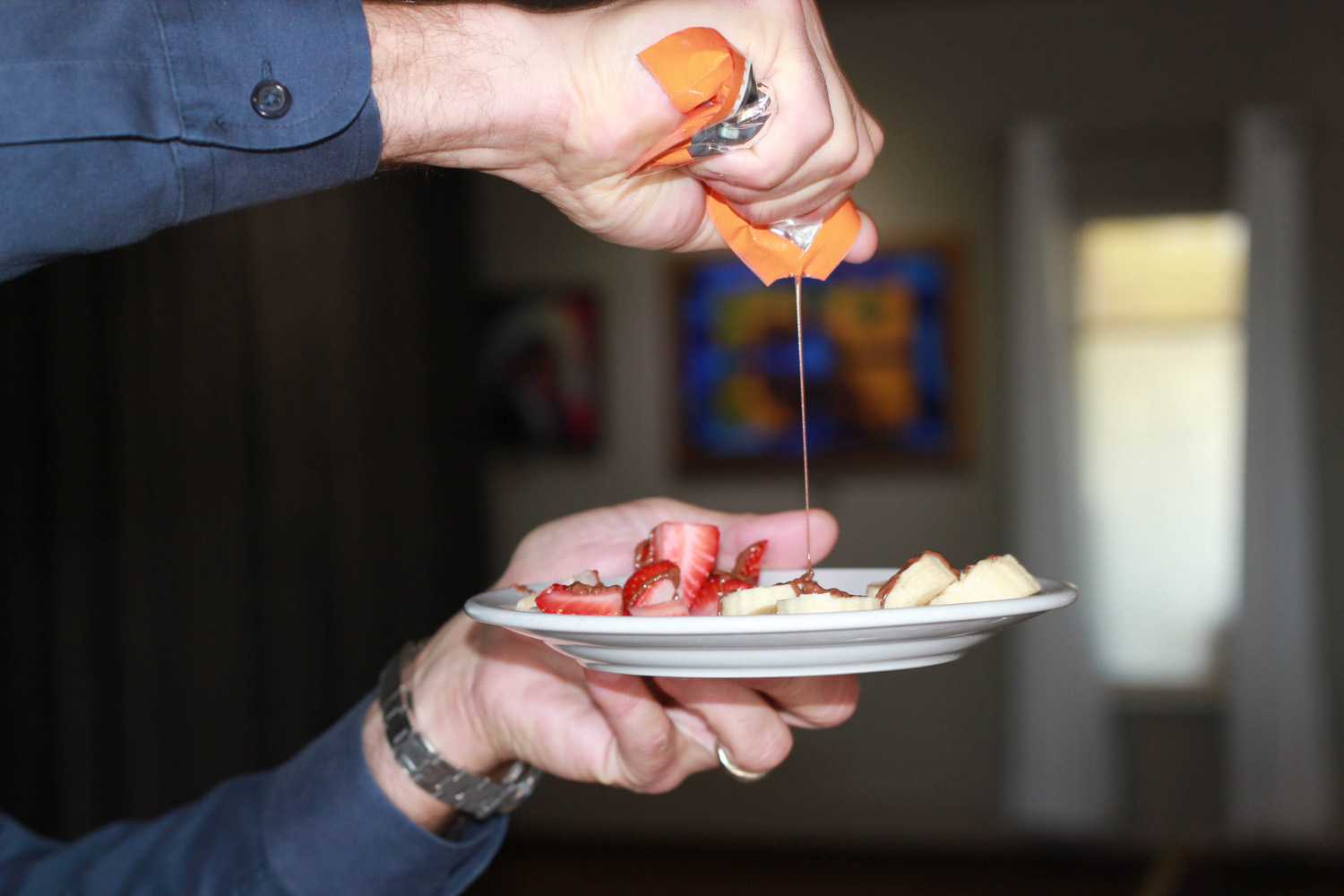
Long story short, he then proceeded to set Dr. Beckerdite’s pretend forearm fracture, using what in the course of a couple minutes had morphed from a lifeless cardboard wafer into a warm, entirely flexible and moldable splint which hardened as it cooled before our eyes into the equivalent of a rock-solid cast! In true salesman-esque, but-wait! fashion, there was more —- smaller, bright-orange, rectangular packets containing dark chocolate (which, once warmed, we drizzled over the fruit and then used our handy-dandy toothpicks to eat), hand lotion and wet wipes. There was even one for macaroni and cheese, but given that this product still is in the final testing phases, it was empty. The intriguing takeaway there for me is that it’s named after Mr. Laubach’s daughter —- further proof of that softer side of science I’ve always loved.

EADC Chair Dr. John Beckerdite '76, getting his "injury" set by Adam Laubach.

EADC Chair Dr. John Beckerdite ’76, getting his “injury” set by Adam Laubach.

All in all, show and tell -— much less science -— doesn’t get much better than warm comfort food and portable medical supplies. Nor does the fact that, at their core, scientists are humans. One of the best varieties, in my book: those who are highly motivated to improve the future. Sometimes, it’s a direct route. Other times, it involves detours -— years that all too quickly turn into decades of hard work that doesn’t always pan out, save for in the occasional, sobering realization that it’s time for a new direction.

In RBC’s case, they continued to dance with the one that brought them (batteries), secure enough in their extensive knowledge and experience to take two steps back before breaking into what looks to be one heck of a technological tango from here.

Ultimately, those rectangular packages harbor a lot more than some spectacular self-heating technology for a variety of commercial and societal uses. To me, they are a perfect metaphor for science and scientists who, on the surface, often appear pretty ordinary if not downright non-descript. However, given the right catalyst, the sky’s the limit as to where their innate inspirational fire, once activated, will take them and, by default, our world.

As for me, I think a field trip to Science Park at Research Valley (where both Lynntech and RBC are located) definitely is in order. Just in case, I’m bringing a fork.

Laubach serves up one of the day's most popular Safe Heat products -- melted dark chocolate drizzled over sliced strawberries and bananas.

Laubach serves up one of the day’s most popular Safe Heat products — melted dark chocolate drizzled over sliced strawberries and bananas.

Click to see additional photographs from the Fall EADC Meeting, held October 24 at Messina Hof Winery & Resort in Bryan, Texas.

Daydream Believer

“Daydreaming is a short-term detachment from one’s immediate surroundings, during which a person’s contact with reality is blurred and partially substituted by a visionary fantasy, especially one of happy, pleasant thoughts, hopes or ambitions, imagined as coming to pass, and experienced while awake…”

No better day than Sunday to share this visionary fantasy — an absolutely spectacular time lapse called “The Mountain,” shot in 2011 at Spain’s El Teide, the country’s highest point and home to Teide Observatory.

Happy detaching!

Seasonal Natures

Reports earlier this week of the first snowfall in parts of Colorado came bundled for me with a somewhat jolting reminder of something I have thus far left undone. (Yep, I can almost hear my mother, if not my co-workers, laughing.) Funny how Mother Nature has a pesky way of doing that to all mammals, hibernating and otherwise.

In tribute to summer’s last gasp and stockpiling memories to last you all winter, I come bearing humble gifts — additional photographs from Texas A&M Center for Mathematics and Science Education research scientist Dr. Carolyn Schroeder and the 2014 edition of G-Camp, an outreach program for teachers offered through the Department of Geology and Geophysics in the College of Geosciences at Texas A&M University. Because Carolyn truly outdid herself in the way of great photos, I had decided back in July to reserve all floral-related ones for a special album I would post at a later date in order to showcase the more geoscience-specific ones in the previous blog entry. Seems like I blinked and it became September, but hopefully, the better late than never adage applies.

As Carolyn says, the mountain wildflowers (in this case, seen in places ranging from Silver and Yankee Boy Basins near Ouray to the ghost town of Animas Forks northeast of Silverton) were nothing short of stupendous — “everything from mountain bluebells and columbines to different colors of paintbrush, violets, delphiniums, stonecrop, pink elephants and etc. They painted the landscape in broad swaths of color. It is amazing that such loveliness can spring from such a hostile environment, even from just rubble.”

For those who might not want take a tourist’s (albeit a scientist’s) word for it, resident Colorado author Kathy Lynn Harris confirms Carolyn’s scientific analysis in a recent blog entry of her own. To borrow from Kathy’s fantastically picturesque words, “It’s been an especially good wildflower season. Even as September approaches, there are still carpets of white, yellow and lavender mountain daises and large swaths of bright purple fireweed. The sweet scent of pink and violet clover fills the air on our walks.”

I can almost smell the heaven! But enough of my procrastinating — go enjoy your own vicarious walk already, courtesy of another successful collaboration between Mother Nature and science.