By the Numbers

One of the primary perks of my job involves getting to know many Texas A&M Science faculty, staff and students — several of whom I’m privileged to call friends.

In the wee hours of last Friday morning, one of those friends posted what I considered to be a rather intriguing Facebook status update about having 430 exams to grade — her night’s take from a thrice-per-semester event that’s referred to in the Department of Mathematics as a “common exam.”

imageImmediately suspecting calculus, I turned to Google and searched “Texas A&M Math 151.” Success with the first option, which took me to a most helpful departmental link that explained a lot:

“The first year of calculus (Math 151/152) is a prerequisite for most math, physics and engineering courses. In fact, the College of Engineering uses the grades in Math 151 and 152 to help determine who is allowed to enroll in upper level engineering courses. Therefore, it is critical that the Mathematics Department have a common standard across all sections of this course. For these reasons, the Department has implemented a system of three common exams in Math 151 and 152. The final exam will not be of common type. …”

However, as both a writer and someone who had her fair share of trouble with mathematics back in the day, I had to know more. I guess I’m still trying in subtle ways to make up for lost time(s) and to figure out what I could have done differently — well, beyond go to class more and, um, have learned it in high school like my exasperated professor back then so often fervently opined and desperately wished. To be fair, I think if I would have realized then there were people who truly wanted to help me (mercifully, they still do) and that they were putting just as much if not more effort into the class as I was, I would have been a lot better off, if not at least more grateful.

Now that my 40-something self has those answers (thanks to my kind friend in the middle of her grading), I can safely vouch to my former-20-something one that what goes on behind this educational scene definitely is not common. More like nothing short of amazing. Consider the following numbers, for which even I can do the math:

  • 151 — The course, otherwise known as Math 151: Engineering Mathematics I.
  • 68 — Sections offered in Fall 2013 across the Department of Mathematics. My friend is responsible for 12 of those, with between 30-42 students in each.
  • ~2,200 — Aggies currently enrolled in what’s more commonly referred to as engineering calculus.
  • 13 — Instructors teaching those roughly 2,200 students.
  • 23 — Teaching assistants assigned to help those 13 professors and lecturers.
  • 15 — Multiple-choice questions on the exam, which is a combination of scantron/show-your-work options.
  • 7 — Free-response problems.

imageBeyond Math 151/152, the department also offers a Math 141/142 Business Mathematics course characterized by “jumbo-sized” sections of roughly 300 students per section, all taught by seven instructors.

Oh, and did I mention they also offer such resources as Week in Review, Supplemental Instruction services, help sessions and even a summer Personalized Precalculus Program — most of which have been created during the past decade and a half to better help all students, regardless of level of experience and secondary preparation?

All in a day’s work and then some within a college responsible for teaching 20 percent of the total class hours (roughly 1 in 5) taught to all 45,000-plus Aggie undergraduates each semester and — by careful and caring design — set up to pass, not fail, each and every one of those students.

Here’s hoping these 20-somethings realize, truly appreciate and take advantage of those efforts for the absolute services they are long before I did.

If I Had a Million Dollars

As we put the wraps on the first week of a new semester here in Aggieland, there’s a lot of good news beyond the resolution of 2012 Heisman Trophy-winning sensation Johnny Manziel’s future at quarterback.

By all indications, both incoming freshmen and their families have reason to feel secure about their educational investment, thanks to far bigger breaking news than who’s under center this season. In case you haven’t heard, Texas A&M ranks as the top university in Texas (second overall to Rice University, which is private) and fourth in the nation among public institutions for return on investment for a degree, according to AffordableCollegesOnline, a national website that tracks college pricing and, as the name suggests, overall affordability. Matter of fact, after all their algorithms are said and done, that choice to attend Texas A&M could translate to being $1 million richer. Holy future bargaining, Bat Man!

Aggieland_AerialView

Judging from local real estate sales to traffic (vehicle and foot), the secret of Aggieland’s allure appears to be out – or at least well on its way. Another study from SquareFoot.com pegs College Station as the second-fastest-growing college town in the country behind Raleigh, North Carolina, one of three anchors in the coveted Research Triangle. In fact, the home of Texas A&M University is expected to top 100,000 during the next couple of months, and that’s not even taking into account the weekend swell for home football games.

Yep, by all accounts, it’s a good time to be a Texas Aggie. Of course, I thought so 25 years ago when I fell in love with the place my older brother called his collegiate home while I was here for a summer honors program. I applied later that fall, was accepted, enrolled for my freshman year in 1989, and never looked back. Now that I’m still here and raising my own family, I have to admit, it’s one decision in life that I’ve never regretted, let alone even second-guessed. The older I get, the more I realize that’s the kind of peace of mind money can’t buy.

Thanks and gig ‘em, Aggies!

Leaders With Character

As August, the Sunday of summer, dawns hot and humid and another school year is upon us, I can’t help but think back to my own days as a freshman in Aggieland and everything I’ve lived and learned since that time — save obviously the way out of town after graduation, despite the infamous Aggie adage about Highway 6 running both ways. (It does, Mom; and I apologize, both in retrospect and advance.)

An article I received today from a friend reminded me of another classic Aggie-ism:

Q. What do you call an Aggie five years after graduation? A: Boss.

It then dawned on me as I skimmed through Inc.com’s aforementioned best-boss attributes that, by virtue of staying in Aggieland after earning my Texas A&M degree, the majority of my bosses have been Aggies. I’ve learned a lot from each of them, with the good far outweighing the bad. None more so than Dean of Science Joe Newton, my first thought in reading 21st century tips on how to manage like a boss.

Dr. Newton is a rare bird, and not just because he lives in both hemispheres of his brain (while I struggle on good days to function in one) and can flit effortlessly and eloquently from side to side and throughout all neural synapses in between. Admittedly, I’m biased, but I happen to have one extraordinary boss who trusts me enough to let me do the job he hired me to do (not once but twice, but that’s another story altogether.) Novel yet seemingly terrifying concept for some people both ways, not to mention one that speaks volumes in a unit where professional expertise is king. And yes, we have fun doing it!

Dean of Science Joe Newton, being "crowned" by Executive Associate Dean Michael Hall in 2002, when he officially became Dean of the College of Science at Texas A&M University. In January, Dr. Newton celebrated his 15th year of service as a member of the Texas A&M Science Dean's Office.

Dean of Science Joe Newton, being “crowned” by Executive Associate Dean Michael Hall in 2002, when he officially became Dean of the College of Science at Texas A&M University. In January, Dr. Newton celebrated his 15th year of service as a member of the Texas A&M Science Dean’s Office.

In my high school days, Mom once jokingly (at least I think) threatened to get me a copy of the classic poster featuring a pig and the slogan “You are a product of your environment.” Here’s hoping she was right and that I have another 20 years or so to absorb, evolve and enjoy!

Of Forests, Trees and Maroon Roses

Ever find yourself so focused on the little things wrong that you miss the big picture of all that’s right? Easy to do when the day-to-day begins to rule not only the day, but also the week, then the month, then the next month, and so on. Sometimes it takes conscious effort to break this vicious cycle, but thankfully, there’s one routine assignment each year in the late spring/early summer that guarantees I stop and smell the maroon roses (so to speak) representative of Texas A&M Science. And boy, were they particularly fragrant in 2013. Or 2012, I should say.

Each year Texas A&M Science Communications compiles an annual report cataloguing our teaching, research and service efforts across all departments for the previous calendar year. Collectively and per individual tenured/tenure-track faculty member. It’s no small endeavor, with the end result being as weighty as the three-ring binder in which it arrives. One of the first pages within said binder is a foreword from Dean of Science Joe Newton summarizing the highest of the year’s high points — my primary contribution to the larger effort, which mostly involves pinning Dr. Newton down and making him focus on the rear-view mirror even as he’s engrossed in all levels of forward-looking responsibilities as our designated driver. Typically each department head also provides a foreword for each respective unit. All in all, it’s pretty impressive information that definitely goes against the Aggie tradition of humility (arguably the eighth core value!) but speaks volumes about what we value as a college and across the fundamental sciences and professions we represent.

Rather than relegate that summary to the binder for another year, I want to share it here so that you, too, can see it’s been a good year for the roses. Congratulations, Texas A&M Science, but your work here isn’t done. We’ll get more binders ordered…

FOREWORD FROM THE DEAN (2012 Annual Report)

As dean of the College of Science at Texas A&M University, it is my obligation and privilege each fall to take stock of our progress toward our three-part university mission — teaching, research, and service — and to reevaluate our collective commitment to ongoing excellence in all respective phases.

I am pleased to report that the Texas A&M College of Science continues to deliver on its unspoken yet inherent promise to advance discovery and solve real-world problems. In the past year alone, our scientific ingenuity has resulted in hundreds of top-notch graduates and more than $56 million in sponsored research projects that create new knowledge and drive economies around the world. Each year despite all economic indicators to the contrary, those awards steadily continue to increase, both in amount and stature, as testament to the strength of our programs and overall reputation for excellence.

Beyond research funding, the past year marked another major milestone in external fundraising — a landmark $20 million legacy gift by George P. Mitchell ’40 and the Cynthia and George Mitchell Foundation toward the George P. and Cynthia Woods Mitchell Institute for Fundamental Physics and Astronomy that followed their $25 million gift (half of which was credited to Texas A&M) to the Giant Magellan Telescope in 2011.

Our individual teaching, research, and service highlights in 2012 were many and magnified, highlighted primarily by big discoveries and major research-related awards in each department. Two faculty, physicists Marlan Scully and Alexander Finkelstein, were honored for lifetime research achievement — Scully with the Optical Society’s highest award, the Ives Medal/Quinn Prize, and Finkelstein with a Humboldt Research Award. Chemist Oleg Ozerov was recognized with The Welch Foundation’s Norman Hackerman Award for Chemical Research, while fellow chemist David Russell earned the American Chemical Society’s Field/Franklin Award for Outstanding Achievement in Mass Spectrometry. Three faculty received National Science Foundation CAREER Awards (Helmut Katzgraber, Wenshe Liu, Grigoris Paouris),

In other notable accolades, Chemistry’s Sherry Yennello was recognized as a Fellow of the American Association for the Advancement of Science (AAAS), while Karen Wooley was named 2012-14 chair of the Nanotechnology Study Section within the National Institutes of Health Center for Scientific Review. Mathematics celebrated 11 inaugural American Mathematical Society Fellows (Harold Boas, Ronald DeVore, Ronald Douglas, Rostislav Grigorchuk, William Johnson, Peter Kuchment, Gilles Pisier, Frank Sottile, Emil Straube, Clarence Wilkerson, and Guoling Yu, who was named the inaugural holder of the Thomas W. Powell Chair in Mathematics), as well as its first Texas A&M Presidential Professor for Teaching Excellence (Boas).

 In global research breakthroughs, our high-energy physicists were part of international experiments at the Large Hadron Collider and Fermilab that confirmed preliminary proof for what is believed to be the Higgs boson particle. The Dark Energy Camera, for which astronomer Darren DePoy serves as the project scientist, captured and recorded its first images high atop the Blanco Telescope in Chile. First blast occurred at nearby Las Campanas Peak, marking the beginning of site preparation for the Giant Magellan Telescope, which also celebrated successful completion of its first mirror. Chemist Joe Zhou received his second Department of Energy grant in as many years to develop more efficient natural gas storage tanks for passenger vehicles. Our faculty (Alexander Finkelstein, Christian Hilty, Oleg Ozerov, Jairo Sinova, Clifford Spiegelman, Renyi Zhang) also are involved in six of the eight joint research projects encompassed in a $1.5 million campus-wide collaboration with Israel’s Weizmann Institute of Science.

 On a campus achievement front, Physics and Astronomy’s David Lee was selected as a university distinguished professor, Texas A&M’s highest academic honor for faculty. Biologist Michael Benedik was named Dean of Faculties, and a record-tying six faculty received university-level Texas A&M Association of Former Students Distinguished Achievement Awards — Tatiana Erukhimova and Sherry Yennello in Teaching, Kim Dunbar and Nicholas Suntzeff in Research, Marcetta Darensbourg in Graduate Mentoring, and Edward Fry in Administration. Physicists Olga Kocharovskaya and David Toback earned Sigma Xi Distinguished Scientist and Outstanding Science Communicator Awards, respectively. Toback and chemist David Bergbreiter also earned their second University Professorships for Undergraduate Teaching Excellence (UPUTE) appointments. Mathematics’ Sue Geller received the Texas A&M Honors and Undergraduate Research Director’s Award, while chemist Kim Dunbar earned the inaugural Texas A&M Women Former Students’ Network Eminent Scholar Award.

Students shared equally in the accomplishment spotlight, none brighter than Mathematics’ Tanner Wilson, who earned one of two Brown-Rudder Awards presented each year at spring commencement to the top Texas A&M seniors. Allyson Martinez (Biology) and Meng Gao (Physics and Astronomy) earned Phil Gramm Doctoral Fellowships, while Charles Zheng (Mathematics) received an NSF Graduate Research Fellowship. Mathematics major Frances Withrow earned a Pi Mu Epsilon/Society for Industrial and Applied Mathematics (SIAM) Award at MathFest 2012, and physics major Daniel Freeman received the 2012 Outstanding Thesis Award for Undergraduate Research Scholars from Texas A&M Honors. In addition, four graduate students merited Distinguished Graduate Student Awards for their exemplary efforts in research, teaching and mentoring (Michael Grubb and Casey Wade, Chemistry, doctoral research; Wenlong Yang, Physics and Astronomy, master’s research; Scott Crawford, Statistics, doctoral teaching).

One of our most cherished former students and longtime External Advisory & Development Council champions, the late Dr. Robert V. Walker ’45, received a Texas A&M Distinguished Alumnus Award, while Statistics’ Jerry Oglesby ’71 and our own chemist Daniel Romo ’86 were inducted into the college’s Academy of Distinguished Former Students.

From an educational outreach perspective, Chemistry hosted the 25th edition of its award-winning Chemistry Open House and Science Exploration Gallery, while record crowds attended both the Math MiniFair and Physics & Engineering Festival. Dozens of women participated in a three-day, national physics conference hosted by our Educational Outreach and Women’s Programs Office, while the Mitchell Institute unveiled the Physics Enhancement Program (MIPEP) to improve high school physics teaching. The Texas A&M Math Circle also was born to engage and encourage bright middle school students, while Houston-based Halliburton put its name and grant support behind a new “Mathematics All Around Us” outreach program. The Greater Texas Foundation committed $50,000 to round out a $150,000 challenge grant started by another big name in Texas industry, Texas Instruments, to benefit aggieTEACH. Finally our Center for Mathematics and Science Education (CMSE) is helping to lead a new $10 million science and technology educational outreach program funded by NASA.

Last but certainly not least, longtime Dean’s Office staff member Carolyn Jaros retired in May, capping 30 years of service to Texas A&M and to three different deans in the College of Science. Biology also saw the retirements of three dedicated career staffers: Tonna Harris-Haller (associate director, Freshman Biology Program), Jillaine Maes (assistant head of the department), and Vickie Skrhak (business coordinator).

In 2012 as in years past, I thank each of you, not only for another year of great achievement, but also for the continued distinction you bring to both Texas A&M University and the College of Science in your efforts to deliver the highest quality of science education, scholarly research, and technical expertise and service to benefit the world.
Learning to clap again

It’s been nearly a year since I switched careers from journalism to public relations, but the remnants of my old life still pop up now and then.

I recently attended a dinner celebrating the 50th anniversary of the Texas A&M Department of Statistics. The wine had been poured when the audience broke into the first of many bouts of applause throughout the night to congratulate the former students who had flown in from around the country.

For a couple seconds too long, I didn’t clap.

During three and a half years covering Texas A&M as a local journalist, I never clapped while working. Call me silly in my ethical pretensions, but my view is independent journalists are not supposed to be part of the establishment they cover or appear to promote it in any way. And that goes for benign events, too, like awards and graduation ceremonies.

So it’s been a change going from being a journalist to an advocate for the College of Science.

Surprisingly, an easy one.

Although there are key differences between my old role as a journalist and my new one as a writer in the College of Science, there are striking similarities beyond the obvious of each encompassing writing, interviewing and research. I loved telling human-interest stories as a journalist, and I can still tell many of those same stories now. When possible, I tried in my writing to show rather than tell, and I’m as committed to that now. And at their ideal, public relations and journalism are both about ethically and accurately presenting quality information to the public. I had a sense of purpose that my work as a journalist was in service to the taxpayer. I have that same sense now, though for a different reason. Impactful research goes on at this university, and my job is take a crack explaining it so taxpayers have a better understanding of what they are investing in.

So don’t look to me to probe below the surface of university politics. Or fire off a flurry of open-records requests. That’s not my role anymore. My job now is not independent. I am selling something. But luckily, it’s something I believe in, have believed in for years – the research that goes on in American academia, and Texas A&M especially.

And I’ll remind myself that it’s OK to clap about that.

A Stitch in Time

Even after a decade in the College of Science and going on a (slightly shocking, even to me) combined 24 years as a student and communicator at Texas A&M University, I never cease to be amazed by the absolute care and creativity so many of our professors put into their teaching efforts. Take, for instance, Texas A&M Mathematics’ Jill Zarestky, who each fall since 2009 has taught a first-year seminar course, Arts & Crafts & Maths, that explores the relationship between art, mathematics and a variety of crafting and fiber arts techniques, including knitting, crocheting, needlepoint, embroidery, cross-stitch, weaving and quilting.

Zarestky, who has been knitting and teaching mathematics at Texas A&M since 2007, is active with the Brazos Valley Knitting Guild and regularly teaches knitting workshops and classes. This month, she also is a featured artist with the local Arts Council of the Brazos Valley. If you aren’t able to drop by the ACBV’s College Station headquarters to see some of her knitted works on display as part of the Fiber Arts: All Things Fiber exhibit, then check out her related guest post for their blog describing her insight into the connections between knitting and math.

Jill Zarestky, in front of some of her at the current Arts Council of the Brazos Valley exhibition.

Jill Zarestky, in front of some of her work at the current Arts Council of the Brazos Valley exhibition.

The human element: It’s alive and well in Texas A&M Science faculty and in the many personal touches, obvious and subtle, they bring to their classrooms. What valuable life lessons for us all.

Bring your A game, folks, but don’t forget to pack your P (personality) one as well.

Mathematical Modeling in Biology REU

I’m one of of the faculty mentors for the Mathematical Modeling in Biology REU program, which I originally talked about here. Two of our five students are working with me on a project this summer. We are a three-woman dream team!

We are studying mathematical models of how organisms coexist and compete while using the same resources in an ecosystem. There are a variety of ways that organisms use resources. For example, plants need nitrate and phosphate to grow, and without sufficient quantities of both of these nutrients, the plant will die. On the other hand, humans can get energy for daily activities from carbohydrates, protein or fats. If we don’t have carbohydrates, we can substitute some protein or fat and get by; for the sake of providing us with energy, we need any one of these, but we don’t need all. Modeling has been used with multiple organisms using one type of nutrient utilization, but not a lot with multiple organisms having multiple ways of utilizing nutrients. That’s what we are working on.

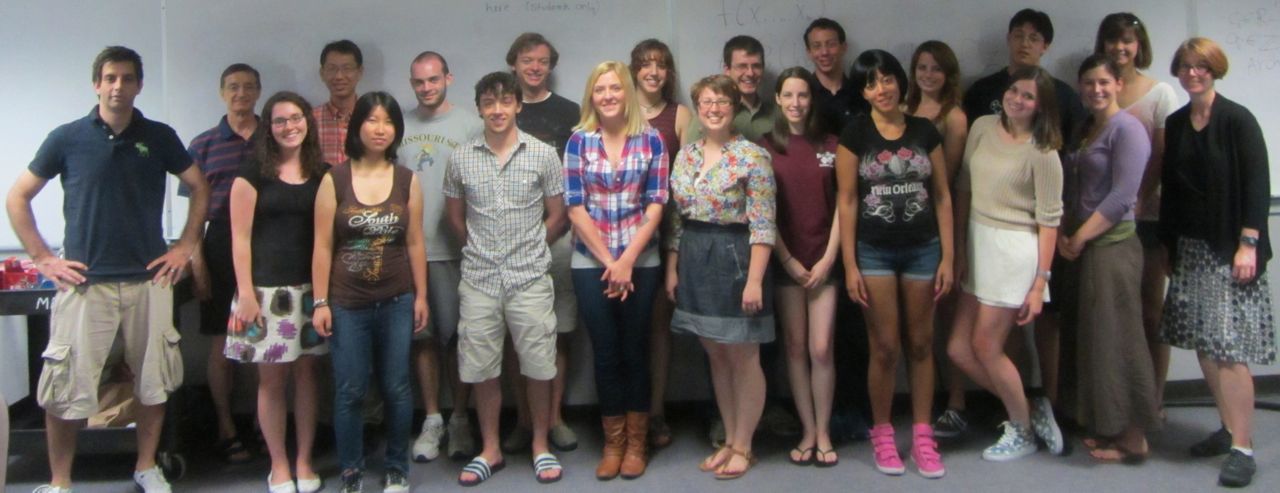
Mathematical Modeling in Biology REU Group

Mathematical Modeling in Biology REU Group

Thus far, we’ve reproduced some results from existing models with a common type of nutrient utilization; in particular, we’ve shown how one organism can outcompete others for the same resources, and how two organisms can coexist even though they both utilize the same resources. We are working on learning some of the background science of how organisms use resources and the equations and mathematics associated with this. We are performing a literature review to familiarize ourselves with what research has been done in the past and has been published recently. We are learning what types of questions scientists are interested in and have answered in the past, and also figuring out where we can make a novel contribution. And, given that we are a mathematics program, it won’t surprise you to learn that we are developing the equations we need to make the modifications required to the model we have so that we can do something new.

The other three students in our program have interesting problems to work on as well. Two are working on mathematical models for how atherosclerosis (hardening of the arteries) occurs and how diet and exercise might improve arterial health. One student is working on mathematical models for controlling invasive species; personally, I am hoping he will find a way to mitigate the spread of fireants.

Heart of the Matter

I got the rare opportunity a few months ago to sit in on a video shoot with one of our fairly new and absolutely dynamic professors in the Department of Chemistry, Karen Wooley. I’ve never been so glad that I for once seized the day, because soon after leaving my usual seat, I found myself sitting on the edge of quite another.

For proper context, I’ve had the privilege of writing a few press releases on Dr. Wooley’s work, but in all cases (mostly due to her busy travel schedule and the basic convenience of mine) those exchanges occurred via email. Suffice it to say in-person is invaluable and that I had no idea what I was missing. To be in her presence is to know the pure joy she radiates — about her science, her students and broader lab group, their shared “ah-ha” moments big and small in the name of curiosity as catalyst of discovery, the overall give-and-take of knowledge generation, being at Texas A&M University, etc.

Karen Wooley (seated at center), enjoying a light-hearted moment with members of her research group between takes during a video/photography shoot in her Texas A&M Chemistry laboratory. (Credit: Robb Kendrick/Texas A&M Foundation.)

Karen Wooley (seated at center), enjoying a light-hearted moment with members of her research group between takes during a video/photography shoot in her Texas A&M Chemistry laboratory. (Credit: Robb Kendrick/Texas A&M Foundation.)

I learned three things in that hour, and to the surprise of a gal who struggled through two years of premed before changing majors to journalism, even a little chemistry in the process:

  1. Karen Wooley enjoys her work, and there’s a lot of it to love. The sheer volume of projects she has going on would make your head spin. And that’s before she rattles off the myriad federal agencies and industry leaders who fund and support it. In short, she believes — in herself, her group, her department/university and her profession’s potential — and that contagious confidence not only shows, it produces results. And more grants. And more breakthrough discoveries. And more excitement. Talk about a pretty picture that needs no storyboard!
  2. Karen Wooley gets frustrated. Newsflash: Scientists are people, too. Even though I know this and try my best to convey it in every story I write, I have to admit I never fully thought about the everyday struggles involved in and incumbent upon being a research group leader. While I joke that I only get to write in my spare time, the same holds true for high-flying chemists, whose responsibilities as de facto CEOs of what amounts to a small corporation likewise take away from their true love — actual bench time. There’s no “i” in team. Nor is there one in “laboratory” or “research.” Interesting parallel.
  3. Karen Wooley has trouble defining success. After nearly a solid hour of providing non-stop detail on the countless projects and personnel that encompass Team Wooley (and revealing that some of the best breakthroughs indeed happen by accident — or, to put it more accurately, under the expert watch of someone with the right combination of experience, knowledge and curiosity necessary to first recognize and then to play out the possibilities), it was a wrap. I saw my window and jumped, rendering Dr. Wooley speechless for the first and only time that afternoon with one spontaneous question: “How do you define success?” Granted, it was neither in the pre-shoot list nor entirely fair. The trite job-interview equivalent of “Where do you see yourself in five years?” which always makes me chuckle as I think of the stock “in-your-job” answer that runs through my mind but for once not out my mouth. For the record, my standard answer is “happy.” And although Dr. Wooley never said as much, she didn’t have to, considering it was obvious to all present in the room.

A wrap, indeed, and all in my ideal kind of day’s work.

Research Experiences for Undergraduates

It’s summertime in Aggieland, and one thing that means is an influx of students from across the United States participating in Research Experiences for Undergraduates (REU) grants at the university. The Math Department is only one of many National Science Foundation-funded REU sites at Texas A&M. The Math department has been running an REU site every summer since the program was started in 1999.  This summer, we have 14 students, 8 women and 6 men, with us for 8 weeks.  Five students are participating in the program in Number Theory, five in Mathematical Modeling in Biology, and four in Algorithmic Algebraic Geometry.  The Algebraic Geometry group is supplemented by two local undergraduates.

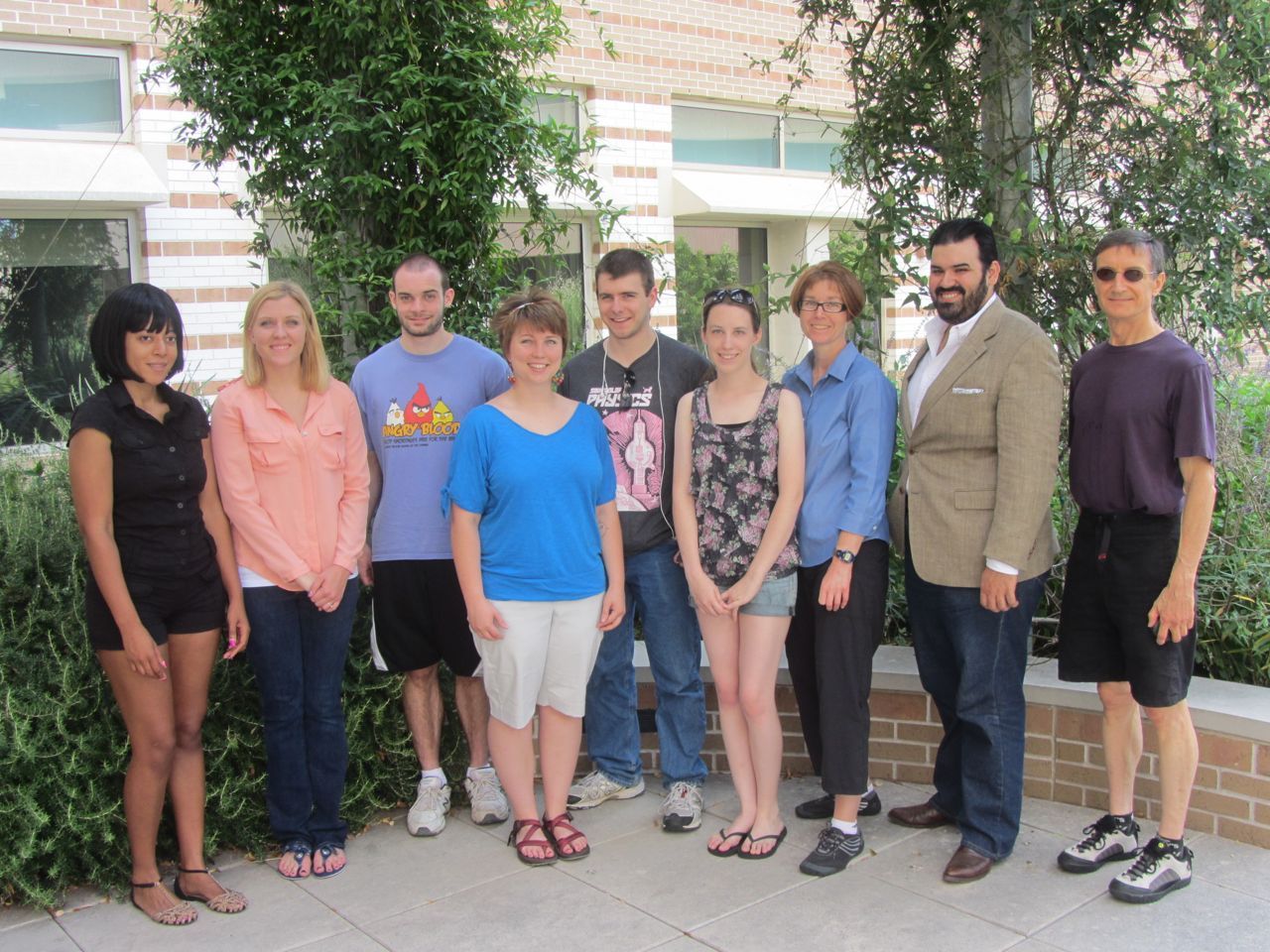
REU students and mentors, summer 2013

REU students and mentors, summer 2013

Students generally have lectures and homework to deal with for the first two weeks of the program. This familiarizes them with the foundational mathematics they will need for the research problems they’ll be working on.  By the middle of the second week, they are given research problems and get started trying to solve them.

This past Friday, the last day of the second week of the program, all the students and mentors in our REU got together for lunch. Students gave short presentations describing their research problems. At the end of the fourth and sixth weeks of the program, we’ll get updates from everyone on their projects. At the end of the eighth week of the program, we have a Minisymposium, where all our REU students present their results.

The Rest of the Stories

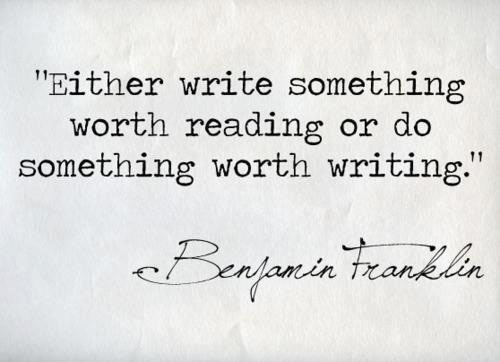
FranklinQuoteEver feel like there’s more to the story when reading an article on a particular topic, person or program in higher education? So do we. In fact, more often than not, we know it for a fact and would love to share that knowledge, except there’s no place for it in the press release.

Behold, this blog! In addition to our usual fare of news and feature stories available on our official website to highlight all the latest breakthoughs, accomplishments and milestones of note for our faculty, staff and students, we will attempt to bring you occasional bonus coverage showcasing other news that’s equally fit to print — from tidbits and testimony, to anecdotes and insights, to stuff that we find just plain interesting. After all, when it comes to motivation, we writers are in it much for the same reasons as our subjects here in Texas A&M Science — curiosity.

In the meantime, chew on this noteworthy nugget: Many of our subjects are just as curious about writing as they are about math and science, and (go figure) they’re equally as good at it. We hear good things come to those who wait, so stay tuned as we add both entries and voices in hopes of broadening your perspective of all things Texas A&M Science!