A Royal Reign in Peril

Texas A&M Center for Mathematics and Science Education (CSME) researcher Dr. Craig Wilson made international headlines once again last week with his dire predictions concerning this year’s Monarch butterfly numbers, which are at an all-time low across the Brazos Valley and nationwide.

Ever the idealist, Craig appeals below to the altruistic nature lover in all of us with a personal pitch that harkens back to another resilient Lone Star State crusader, Lady Bird Johnson, whom we have to thank for one of Texas’ proudest, most beautiful and time-honored rites of spring — Texas wildflowers.

* ~ * ~ * ~ * ~ * ~ * ~ * ~ * ~ *Monarch_Resting

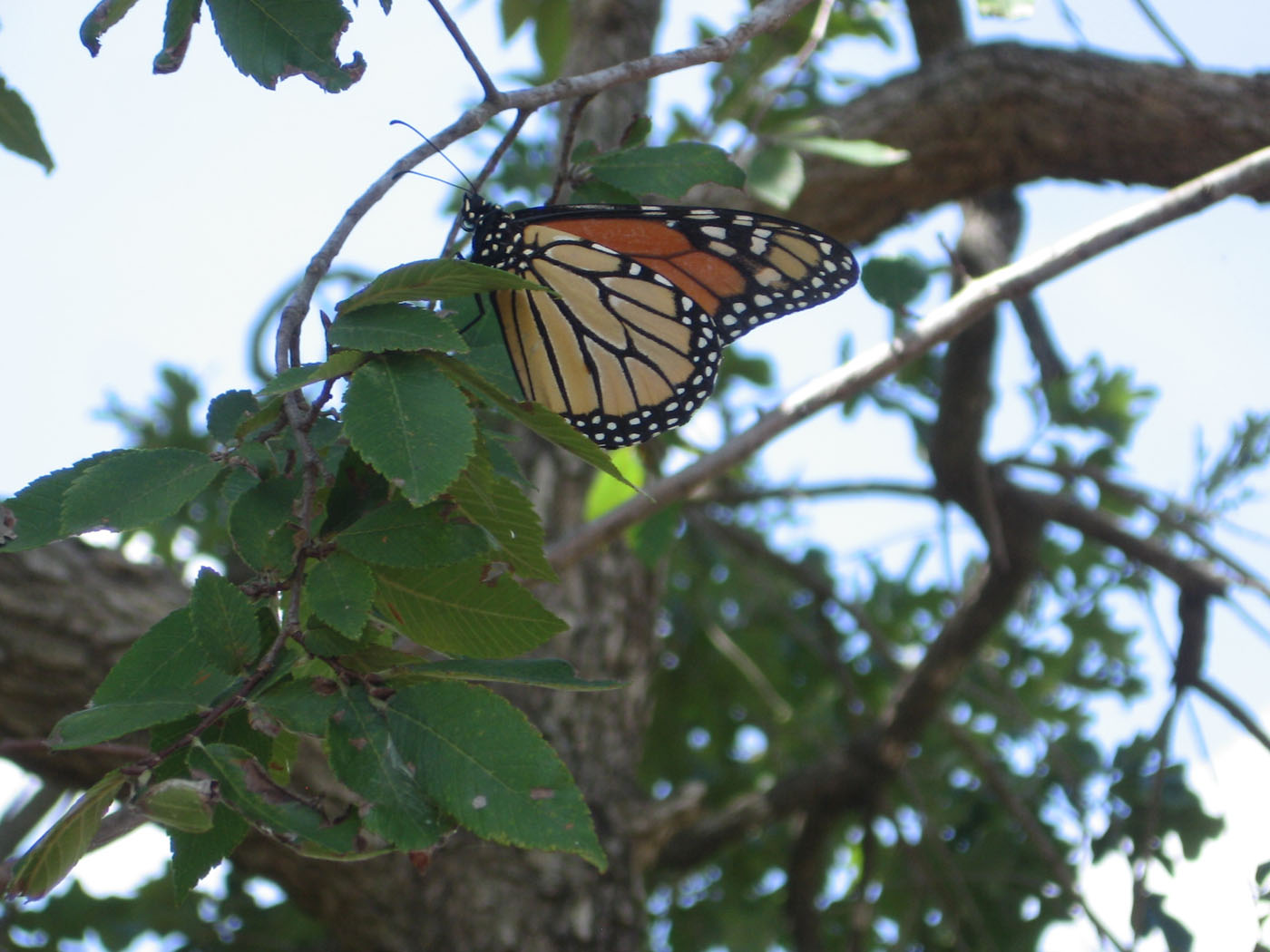
In the fall of 2013, the number of adult Monarchs migrating through College Station that were netted and tagged was one-fifth of the number in 2012, coinciding with the data gathered nationwide showing that numbers were way down. This has been confirmed at the overwintering sites in the state of Michoacan, Mexico, where numbers were at historic lows. The combined areas sheltering Monarchs totalled only 1.65 acres, compared to a high of 45 acres in 1996. We now await the arrival of the first adults of the spring migration north, suspecting that they will be fewer in number. Last year, the first recorded sighting in College Station was on March 19 in the USDA People’s Garden on Holleman Drive that is open to the public.

Monarch Butterflies have reigned supreme amongst insects with a long distance migration that is the marvel of scientists, an increasingly aware population of civilian scientists and the public in general. But their reign is under the severest of threats since records have been kept, with numbers plunging so low that they may have reached a point where recovery may be impossible, in spite of the reproductive resilience of insect species that lay enormous numbers of eggs.

Who or what is to blame? There are a number of culprits. As the adults migrate south, they have to consume large quantities of nectar from wildflowers that are fewer in number because of use of herbicide in large-scale crop farming, especially in the Midwest, the biggest threat. In addition, more land has been brought into cultivation that formerly would have supported wildflowers and other wildlife. Then there is the severe drought and wildfires. Each of these events — individually and in combination — depletes available flowers and their nectar, which the Monarchs drink and then convert into lipids to help the butterflies survive overwintering.

What can be done nationwide? Large-scale farming is not going away, so a practice of leaving some crop acreage free of pesticides (note that this term is inclusive of herbicides and insecticides) needs to be increased. Perhaps interstate wildflower corridors could be established that would extend Lady Bird Johnson’s vision for the verges of Texas nationwide. Likewise, mowing of these same verges should be left until after the wildflowers have bloomed and seeded. This would also help the establishment of milkweed plants that are the sole source of food for Monarch larvae (caterpillars) during the migration north.

What can be done locally? Citizens can plant milkweed and other butterfly attractant plants in their gardens — simple actions viewed by some as futile, but every little bit helps, and it raises awareness. Since last spring, the Cynthia Woods Mitchell Garden (the Texas A&M campus’ first rooftop garden located at the George P. Mitchell ’40 Physics Building and open to the public) has been planted with more than 400 milkweeds, and four Bryan elementary schools also have established Monarch butterfly gardens. Sadly, the harsh winter means that the milkweeds have yet to start growing, so there may not be enough foliage to feed any Monarch caterpillars that do emerge from eggs.

The situation is dire.

THIS JUST IN: There’s an excellent front-page feature story on the subject by John Rangel in today’s Battalion.

Monarch_DamagedWing

What Moves a Monarch Man

A recent Slate.com article reporting the lowest level on record of Monarch butterflies reaching Mexico this year reminded me of a related story Texas A&M Center for Mathematics and Science researcher Dr. Craig Wilson had shared in October prior to agreeing to be a contributing author to this blog. (Incidentally, roughly a month before the Jan. 29 Slate article ran, Craig also had been featured in a PBS piece for his expertise on this very scenario he had forecasted last spring.)

(Credit: Shutterstock.)

(Credit: Shutterstock.)

You see, among oh, so many other things, Craig is a valiant champion of all things nature and educational — subjects he views in constant and quite purposeful tandem. When it comes to butterflies, he is the host and caretaker of his own official Monarch Waystation here in Aggieland, known as the USDA/ARS People’s Garden and created as a outdoor classroom designed to get students interested in science and possible related careers. And last spring, he singlehandedly planted milkweed and other butterfly-friendly varieties in the Department of Physics and Astronomy’s Cynthia Woods Mitchell Garden. Because it’s the right thing to do, for the children and the butterflies.

After watching that PBS clip as 2013 metamorphosized into 2014, I had emailed Craig to tell him I enjoyed seeing that he has a kindred spirit way down south and that I could totally see him (Craig) breathing life into a Monarch here in Texas. His response?

“Funny you should say that, but I revived a frozen Monarch on a playground in El Reno, Oklahoma several years ago and had it flying around a middle school classroom. The kids made a box for it and provided sugar water, and I transported it with me to Corpus Christi, where I had a conference the next week, and released it in a garden there, sending photos back to the students en route. Helping the migration, one Monarch at a time…”

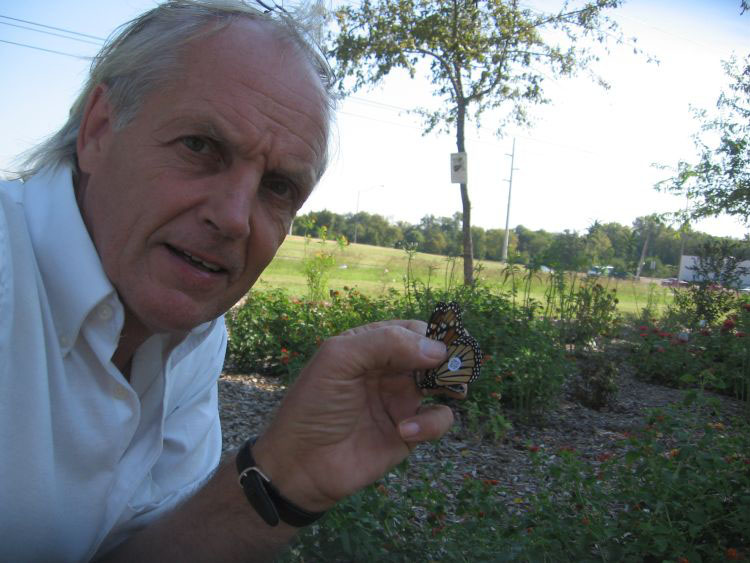
Texas A&M researcher and longtime butterfly enthusiast Craig Wilson recommends taking the long view -- as well as personal steps like planting milkweed -- toward reversing the alarming decades-long decline in overall Monarch numbers.

Texas A&M researcher and longtime butterfly enthusiast Craig Wilson recommends taking the long view — as well as personal steps like planting milkweed — toward reversing the alarming decades-long decline in overall Monarch numbers.

But I digress. I had mentioned having a past story — why don’t I just let Craig tell it in his own inspiring, firsthand words!

* ~ * ~ * ~ * ~ * ~ * ~ * ~ * ~ * ~ *

On Boss’s Day [October 16], we pay homage to our brave and fearless leader. Below is a short essay I wrote in tribute to another Monarch…

From Queen Elizabeth II to other Monarchs including Tim [Scott, Craig’s boss as one of four CMSE co-directors]:

It must be my destiny, to leave one continent behind where I pledged allegiance to a Queen, only to arrive on another where I am again ruled by a Monarch, only this time it is a butterfly.

Last Sunday, I was lucky enough to be invited to a showing of “Flight of the Butterflies” in the IMAX theatre in Austin, Texas where I was enthralled by both the Monarch’s flight and plight, tracing its history through the eyes of a young boy (Urquhart) lying in the pastures above Toronto, Canada, wondering just where they flew, to the discovery near the end of his life that it was to a few acres’ nestling at 10,000 feet in the Sierras that transverse the state of Michoacan in Mexico. The wearing of 3-D spectacles was new to me, but it enhanced the experience beyond my wildest dreams as I felt myself flying with the adult butterflies, munching alongside their caterpillars and dicing with death in the form of crop sprayers, predators and loss of my habitat. But the most wondrous magic for me was to be able to watch the four-year-old girl in front of me, sitting on her father’s lap and reaching out continuously in the total belief that a Monarch would land on her tiny, precious hand. Oh, that everyone could believe.

monarchs-nestingI have been enthralled by Monarchs for several years now and take part in the Citizen Science Project out of Kansas University, through which you can receive individual tags to stick on the hind wing of a migrating Monarch as it flies the 2,000 miles south from Canada in the fall to help track their movements. This is one of the world’s great migrations and, hazardous at the best of times, it has become more so of late due to a multitude of factors ranging from climate change where the extreme heat can dessicate their eggs on the journey north in the spring; wildfires that destroy wildflowers that provide nectar; loss of habitat both in U.S. and Mexico; and, perhaps most drastically, the loss of milkweed plants that are the only food source for their caterpillars.

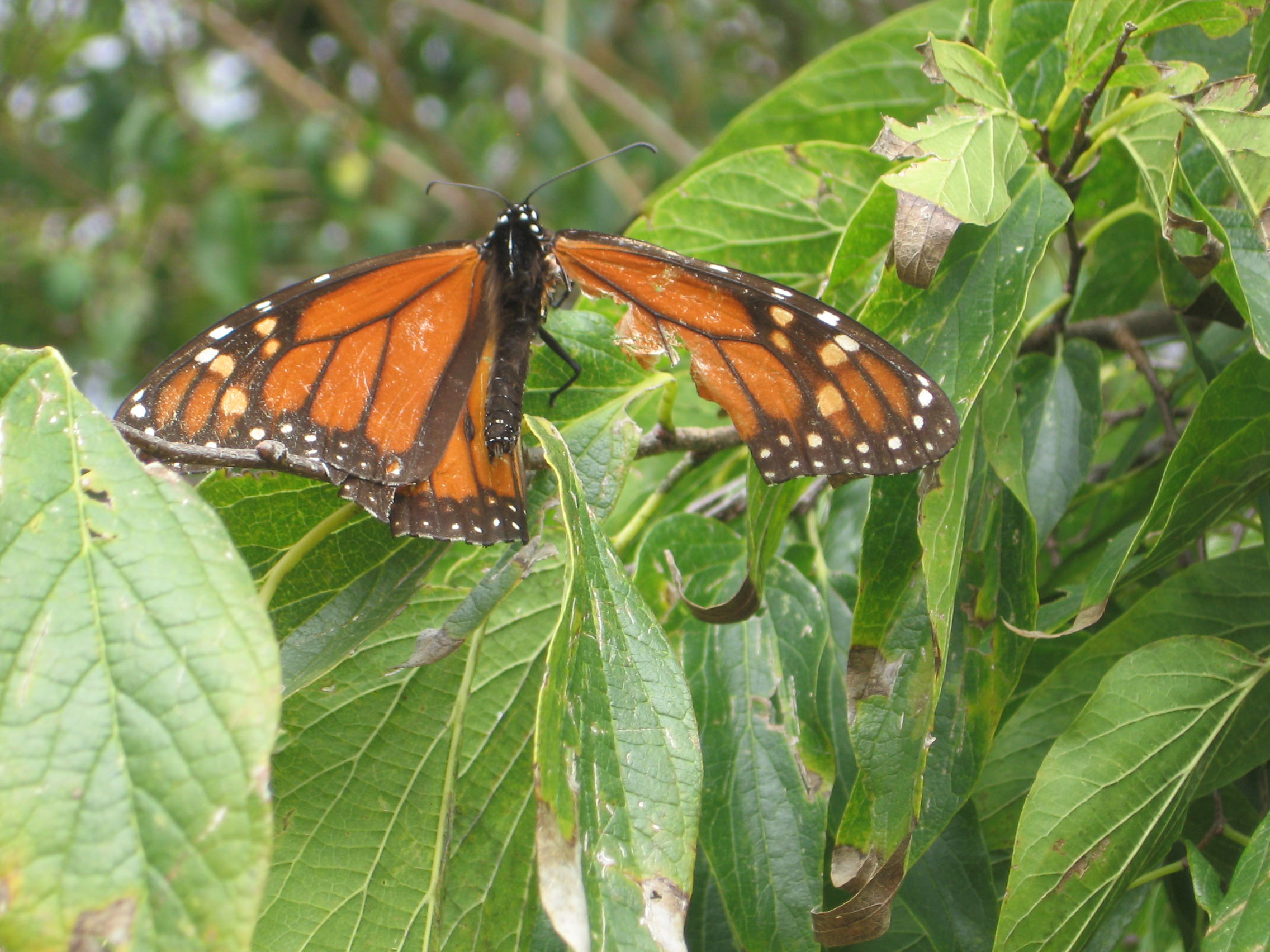
Milkweed search and recovery has become a particular obsession of mine. I can spot a milkweed blooming on a highway verge despite going at 70 mph as I traverse the country. That necessitates a sudden but safe stop and, armed with my trusty sharpshooter, I dig below the deeply seated tuber and carry my prize back to the car to be transplanted into the USDA/People’s Garden in College Station outside my office, where I watched a female Monarch carefully depositing individual eggs on the underside of milkweed leaves yesterday. Two weeks ago, I was able to tag a male and a female — the first to arrive in our garden from Canada on their fall migration — the faded coloration of their wings and less-than-pristine condition suggesting that they did indeed have hundreds of miles on their odometers.

Naively, I do believe that, “If you plant it, they will come” — it being milkweeds that are native throughout the land over which this Monarch, I believe, should rule. It would be sad to see her go the way of George III. Perhaps, taking a literal leaf out of Lady Bird Johnson’s playbook, the north-south interstates could be planted with milkweeds and become corridors to aid the migration, but that requires a degree of cooperation and collaboration we are sorely missing currently. Would it not be ironic if a Monarch could unite this nation?

E pluribus unum…

You Are Enough

HemingwayQuoteDear Student,

You almost walked out on a Team Exercise today because you weren’t prepared, and you didn’t want to freeload. I admire that, but I asked you to stay and to learn, because the point of the Team Exercise isn’t the grade; it’s to help the members of the team to better understand the lesson.

At some point we will all walk in unprepared, and have to ask our team to help us out. That’s why some of the hard stuff is Team Stuff, rather than individual. Because I think that having you work together will cause more learning than if I just preach it at you.

I still felt terrible because you did today. And I questioned myself and what I was doing.

I talked to you for while late this afternoon, and there are other things going on in your life. This class isn’t easy for you, and logistics lately have been difficult. I get the feeling there are other things too. You apologized to me, but no apology is necessary. This is my job. I am here to try to help you learn. I know that other things get in the way. I know how they get in the way. I’ve lived that. I just wish you knew it, too. You are worthy of being here. Worthy of my effort. Worthy of the help from your team. Worthy of being taken seriously. Worthy of help. Maybe worthy of better than I am capable of giving you.

ValueI know that you are the type of person who wants to be the one to help others. If another came to you unprepared, or unable to get something, or struggling, you’d be proud to be the person to help them out. You’d treat all their problems with loving kindness. That loving kindness that you’d so easily give to someone else is the loving kindness I want you to give yourself right now.

Just hang in there. Just keep trying. And seeing the high level of frustration and pain I saw in your face today, just in case, I want to say: If there comes a point where you realize or decide that this is not for you, I want you to know that is okay, too. You are still worthy and worthwhile. Sometimes it feels like we are deep in a dark tunnel with no way to climb out. And I can’t even tell you how to get out, except that you have to just keep at it.

I didn’t have the exact right words to say to you. I can only hope that the ones I had were enough to plant this idea, for it to grow and blossom later. You are enough. Just as you are. Deserving of respect and love and help. If you can’t trust yourself to judge that, I hope you can trust me.

Sincerely,

Dr. Linhart

LoveLeaf

(Credit: Alex Eastman)


Life Forces and Legacies

Last week Texas A&M University hosted a familiar face and cherished friend in one Robert M. Gates, 22nd United States Secretary of Defense and 22nd President of Texas A&M, who was here on campus to discuss his new book, DUTY: Memoirs of a Secretary at War. As expected, Dr. Gates packed Rudder Auditorium and had his audience hanging on his every warm and oftentimes humorous word.

Two Texas A&M presidents removed and two jobs later, Dr. Gates remains a man much revered in Aggieland, if not for progressive plans like faculty reinvestment, then for more student-centric feats like first-year grade exclusion and the university studies degree. (Or, in my case, as the guy at the helm when journalism died, but that’s another subject, one for which I’ve mostly forgiven him. Mostly. And I even understand the dairy center, given that yesterday marked the 29th anniversary of Dad and Mom selling off our own herd and ending our family’s days in the milking pits. In short, it was time for both.)

His visit reminded me of another revered Aggie, George P. Mitchell ’40, who was a big fan of Dr. Gates and his energy when it came to Mr. Mitchell’s alma mater and its future. Understandably there as well, considering Mr. Mitchell invested as big as anyone in those dreams, adding his monetary muscle to fuel the dream for Texas A&M Physics.

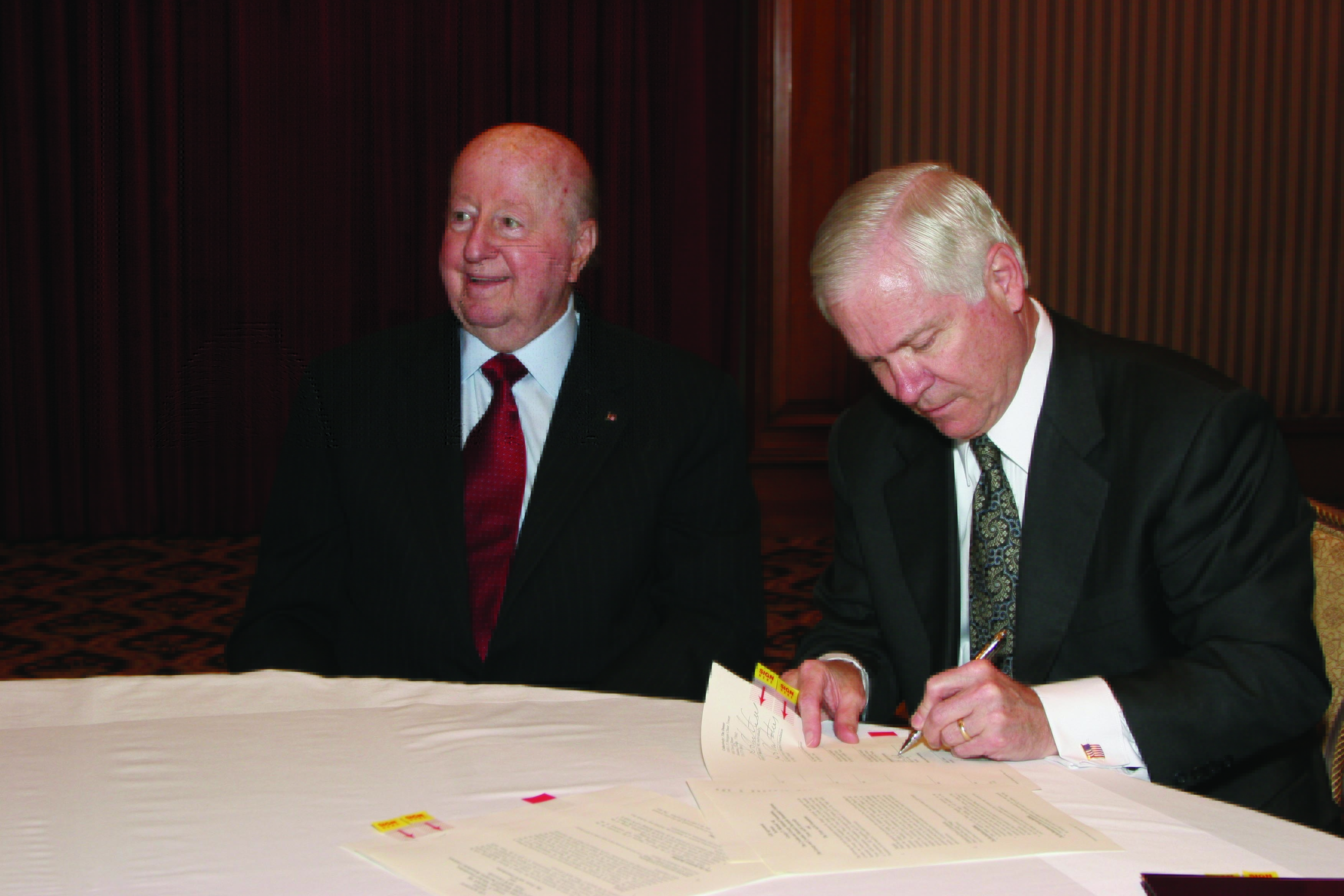
George P. Mitchell '40 and Dr. Robert Gates, signing the historic paperwork to finance construction of two landmark physics buildings at Texas A&M University.

George P. Mitchell ’40 and Dr. Robert Gates, signing the historic paperwork to finance construction of two landmark physics buildings at Texas A&M University.

That admiration was mutual, as evidenced by this quote from Dr. Gates upon hearing of Mr. Mitchell’s death on July 26, 2013:

“George Mitchell was a great man and a great benefactor of Texas A&M University. Through his generosity, dramatic improvements were made possible in many areas, including science research and teaching at Texas A&M, particularly in physics. Thanks to his philanthropy, world-class facilities and significant enhancements for faculty and students alike brought international renown to the university. His gifts also extended to athletics, particularly tennis. Personally, I thoroughly enjoyed working with and learning from him while I was president of the university. He will be greatly missed.”

These two powerful men and their visionary motivations coincided and collided in a
marvelous and near-magical way, creating the best possible hiring world and a climate of excitement and forward momentum that proved so attractive in 2006 as to actually land such an established star as Nick Suntzeff, a 20-year veteran of the U.S. National Optical Astronomy Observatory/Cerro Tololo Inter-American Observatory in Chile, to lead Texas A&M’s new astronomy program.

Thanks in large part to Dr. Gates’ and Mr. Mitchell’s dual dreams, the future is gloriously bright for Texas A&M Physics and Astronomy, Texas A&M University and the overall state of Texas. Despite being gone in vastly different extremes, both will be forever remembered in Aggieland, if not for enabling sweeping recruiting successes and other tangible program-wide gains, then for negotiating two beautiful buildings — architectural showpieces and the first on campus to be built through a unique university-private partnership involving substantial donor funds.

Here’s a bit of the rest of the story on that story, as told by Joe Newton, Dean of Science and inaugural holder of the George P. Mitchell ’40 Endowed Chair in Statistics, who reflects on a pivotal meeting involving Dr. Gates and Texas A&M’s most generous benefactor:

* ~ * ~ * ~ * ~ * ~ * ~ * ~ * ~ *

George P. Mitchell, 1940 Texas A&M University distinguished petroleum engineering graduate, the largest benefactor Texas A&M has ever had, developer of The Woodlands, and the leading figure in hydraulic fracking (among a host of other amazing accomplishments), passed away on July 26 at the age of 94.

Lucky enough to be in the right place at the right time as dean of the Texas A&M College of Science, I was privileged to participate in his philanthropic efforts to build fundamental physics and astronomy at Texas A&M. In the process, he became a friend. I flew on Continental Express with him. I ate at Chick-fil-A with him. Somehow he thought I had power. He would call me to tell me to fix things. Sometimes I even could. His passing has made me very sad. I cannot believe this life force has left us.

George P. Mitchell '40 and Dean of Science Joe Newton at the 2006 Sterling C. Evans Medal ceremony.

George P. Mitchell ’40 and Dean of Science Joe Newton at the 2006 Sterling C. Evans Medal ceremony.

I also had the honor of knowing former Texas A&M President (and CIA Director and Secretary of Defense) Robert M. Gates. These two men came together in Mitchell’s Houston office on Aug. 14, 2005, in a meeting that changed the face of Texas A&M. It was my honor to be there, and I would like to pay tribute to both of them by describing the meeting.

Both men had already played a large role in the development of fundamental physics and astronomy on campus; Gates with his reinvestment program designed to bolster teaching and research efforts by hiring a large number of new faculty, and Mitchell with his philanthropy that created an institute named in his honor, that helped us build a new astronomy program and attract great faculty.

Ed Fry, the department head at the time (and a dreamer of the first order), had developed a remarkably close relationship with Mitchell. Fry thought that Mitchell would be receptive to a request to help fund two buildings on campus. The first would be a “signature building” architecturally to house the Mitchell Institute; the second would for the first time consolidate all of the department’s faculty and classes in one place.

The task of convincing the university to supply the matching funds that Mitchell always required fell largely to me. Mitchell routinely drove a hard bargain, but the driving premise behind his trademark matching requirement was to ensure the maximum benefit of every dollar contributed — his or the university’s — to the broader cause or project. A major component of this particular project was that the department would make no claim on space it would vacate, so that the university would in fact receive a net gain with its matching funds.

After a series of meetings with various university officials, especially Gates, it was agreed that Gates and a few others (including Fry, Texas A&M Foundation President Ed Davis ’67 and College of Science Director of Development Don Birkelbach ’70) would go to Mitchell’s office in downtown Houston to make “the big ask.”

There was a sense of history when we walked into the conference room. Mitchell, as usual, started by asking about projects in which he was interested, including the Giant Magellan Telescope. Then his attorney, Barry Levitt, suggested we talk about the buildings. The rest took perhaps five minutes. Both Gates and Mitchell had great respect for the other. There was a true sense of good will.

Gates began by saying, “I don’t want to insult Ed or Joe, but a physics building has not been one of our top priorities.” In his typical wry manner, Mitchell interrupted Gates with, “Yes, I’ve noticed.” At which point everyone laughed. “But because of all you’ve done,” Gates continued, “we will contribute $2 million toward a building to house the Mitchell Institute, and I have a suggestion for you: I have identified $20 million in cash, and if you agree to the legacy proposal we have prepared for you, we will use the first $20 million of your funds to match what we will do.”

Mitchell responded that there were problems with the proposal, but that perhaps he could do $3 million per year for five years. Gates, without batting an eyelash, countered: “The $20 million really straps me; how about you do 10 years?” Mitchell came right back at him, suggesting, “How about $2 million for 10 years?” After a pause, Gates continued to barter, “$2.5 million for 10 years would split the difference.” Then Ed Fry jumped into the fray with, “It would really help to do it in five years — how about $5 million for five years?” Mitchell said, “Same amount of money, so OK.” The deal was done!

Groundbreaking for the George P. and Cynthia Woods Mitchell Institute for Fundamental Physics and Astronomy and the George P. Mitchell '40 Physics Building. Mr. Mitchell (hard hat), Dr. Gates and Joe Newton are pictured at center, along with several other Texas A&M professors and key administrators.

Groundbreaking for the George P. and Cynthia Woods Mitchell Institute for Fundamental Physics and Astronomy and the George P. Mitchell ’40 Physics Building. Mr. Mitchell (hard hat), Dr. Gates and Joe Newton are pictured at center, along with several other Texas A&M professors and key administrators.

Later, Mitchell’s total contribution for the $82.5 million buildings actually reached just over $36 million.

The rest is history. It took many, many meetings to complete the two beautiful buildings, but I will never forget the day these two legendary men agreed to something that greatly enhanced Texas A&M. Ultimately, with the fundamental work being done in these buildings and the resulting renaissance for Texas A&M physics and astronomy, they have indeed changed the world.

Dean of Science Joe Newton and George P. Mitchell '40 prior to a November 2012 event celebrating his $20 million legacy gift to his namesake George P. and Cynthia Woods Mitchell Institute for Fundamental Physics and Astronomy at Texas A&M.

Dean of Science Joe Newton and George P. Mitchell ’40 prior to a November 2012 event celebrating his $20 million legacy gift to his namesake George P. and Cynthia Woods Mitchell Institute for Fundamental Physics and Astronomy at Texas A&M.
A Bittersweet Benchmark

On January 19, 2008, Texas A&M University lost one of its absolute best absolutely too soon: Presidential Professor John L. Hogg, a beloved chemist, champion of undergraduate education and science outreach, and all-around life force of graciousness and good will.

Last summer on a casual jaunt across campus for an errand, I noticed an unfamiliar maroon bench outside the Texas A&M Chemistry Complex that I’d apparently missed for the better part of five years — not unlike its namesake in the case of so many.

BenchThey say every person has a story, and so does this bench, as told here by longtime Texas A&M Chemistry administrator Ron Carter, associate department head and friend of John Hogg:

Dr. Hogg’s 2008 spring class had just started earlier in the week, and his students were very saddened when they were informed of his passing. Various faculty members stepped in to teach his class and take over his undergraduate advising duties and other roles within the department. While we all handled what had to be done, the students stepped up with their own approach, unbeknownst to anyone that I am aware of to this day. Toward the end of the semester, I received an anonymous telephone call, informing me a memorial gift in the name of Dr. John Hogg had been delivered to the front steps of the Chemistry Building. I went outside, and although no one was in sight, there in the bright sunshine was a shiny maroon memorial bench sitting at the base of the grand staircase leading up the Chemistry Building with an inscription on it honoring the memory of Dr. John Hogg. It was a very overwhelming moment to know his students cared and appreciated him so much that they had come together to purchase a lasting memorial in his honor. We have never received a note or letter from anyone claiming credit for his memorial bench. The Department of Chemistry and the College of Science subsequently provided the funds to have it permanently installed under one of the large oak trees at the main entrance to the Chemistry Building where he once sat and talked with students.

PlaqueSix years later, an anonymous gift as altruistic as the man himself continues to pay quiet but constant tribute regardless of weather or season to the memory and the ongoing impact of the beloved chemist well-known for shouldering many a worthwhile cause of great consequence with precious little fanfare while also counseling generations of Aggies toward career excellence in chemistry and inspiring anyone fortunate enough to enter his orbit along the way.

Between the bench and the stately oaks that shade it, it’s a picturesque metaphor for a man most at peace among his students, his colleagues and his chemistry who is clearly and dearly missed by all three.

As colorful and exciting an individual as his trademark tie-dyed lab coat, Dr. John Hogg and the Chemistry Road Show program he created introduced more than 2,000 people each year to the wonders of chemistry, physics and general science with the help of fire, explosions, weird polymers and super cold materials.

As colorful and exciting an individual as his trademark tie-dyed lab coat, Dr. John Hogg and the Chemistry Road Show program he created introduced more than 2,000 people each year to the wonders of chemistry, physics and general science with the help of fire, explosions, weird polymers and super cold materials.

The Magic Behind Scientists-in-the-Making

Texas A&M Center for Mathematics and Science Education (CMSE) researcher Dr. Craig Wilson offers another guest entry, this one about caterpillars, the magic they weave beyond the silk of their cocoons, and their impact on both science and lifelong learning.

* ~ * ~ * ~ * ~ * ~ * ~ *

Fairy godmothers are not just the sole preserve of Hollywood and Disneyland, for I discovered one in 2003 in Bryan — or more precisely at the USDA/Agricultural Research Service/Southern Plains Area Research Center (ARS/SPARC) in College Station. Theresa Robinson was one of several teachers from surrounding school districts who gave of their free time to attend a USDA/ARS Future Scientists workshop, the inaugural and pilot version of a science teacher professional development activity that has since been expanded nationwide as the USDA/HSINP Future Scientists Program — partly, I am sure, because of the initial success of these first participants with their students and perhaps a healthy dose of magic wiffle dust and the wave of Theresa’s magic wand.

Being a Protestant bigot, I do not use this adjective lightly, but “saintly” Theresa has worked her magic with children and adults alike at Johnson Elementary School in Bryan for more years than she cares to remember. This is ironic because she does care and care she does for the students entrusted to her care, always with a gentle but firm voice and an uncanny understanding of what each child needs. By contrast, I look out and see a sea of faces differentiated by color and aspect, treating all the same as I did on December 5, when I was invited to make a presentation to all 78 fifth graders.

Craig Wilson, director of the USDA-sponsored Future Scientists Program, works with students at Johnson Elementary School in Bryan, Texas. Through the initiative, Wilson introduces students to a vast array of scientific research projects and principles, not to mention potential careers in science.

Craig Wilson, director of the USDA-sponsored Future Scientists Program, works with students at Johnson Elementary School in Bryan, Texas. Through the initiative, Wilson introduces students to a vast array of scientific research projects and principles, not to mention potential careers in science.

They were a captive audience, but I was the one held captive by their naïve enthusiasm and joyous excitement as experiments exploded around them, eliciting questions that are the life blood of science. Sadly, that blood flow is too often cut off or stifled in our schools as being demanding of too much time. But not in Theresa’s class. With a wave of her imaginary wand, a hush descends out of the educational chaos, at which point the inquisitive child is encouraged to articulate the question that may be that rare and magical question, the one for which we do not have an answer and for which all should strive to seek an answer. That is science.

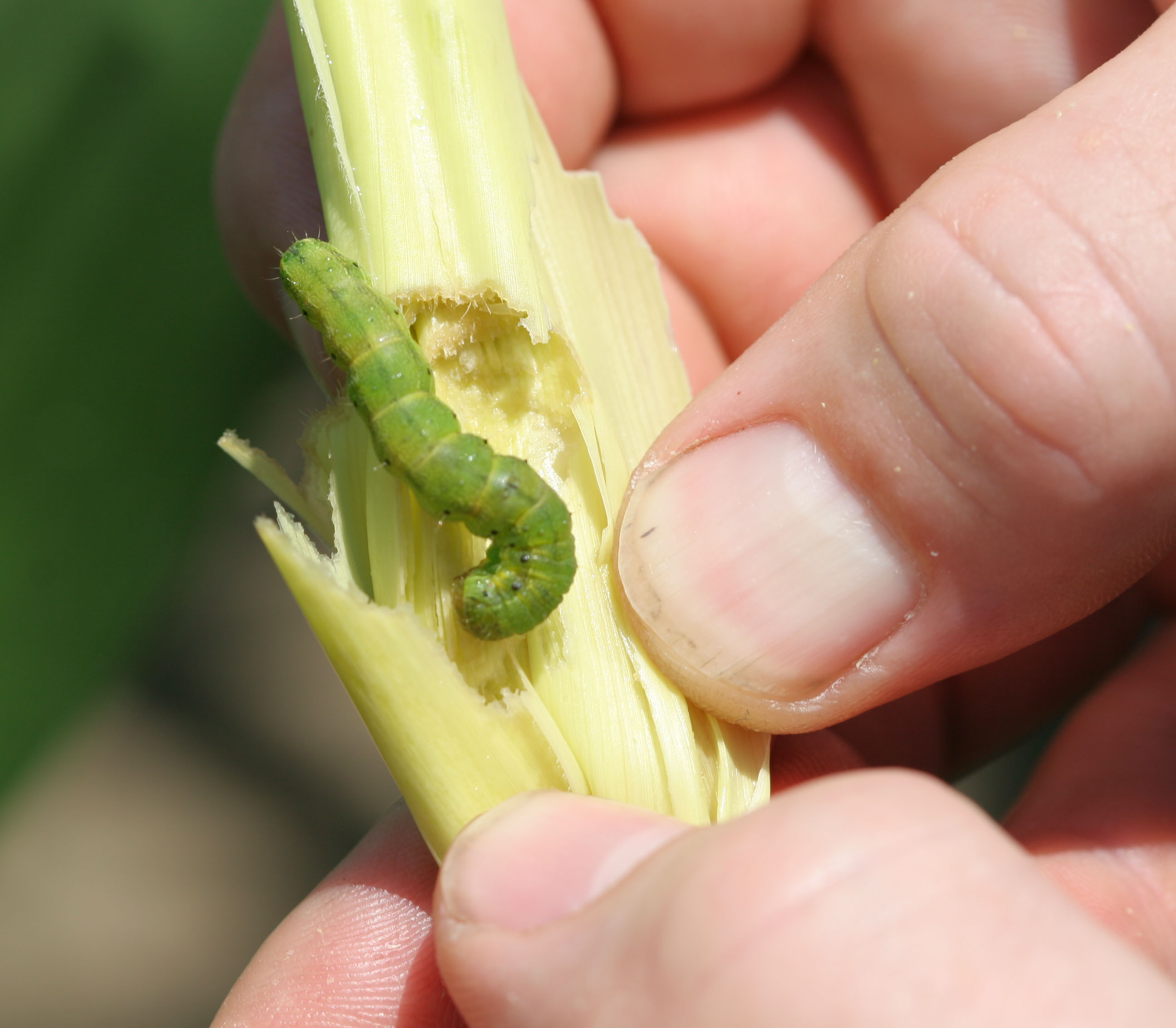
It struck me that I have worked with Theresa for 10 years now and that she has had her students conduct research on the corn earworm caterpillar (Helicoverpa zea), provided free of charge by the scientists at SPARC each of those years. The current audience of students was not even born when we started, but Johnson Elementary seems to be ahead of the curve or already around it by maintaining contact with their alums and inviting them back to a “Breakfast for Seniors” event six years after they walk out the doors of their elementary school for what they thought was the last time. At the most recent breakfast, more than half of those attending are poised to pursue some type of science at college.

earwormTime is relentless, as is the battle to nurture future scientists and to stem the ever-widening gap between the general population and our environment in which a seemingly simple question like, “Where do seeds come from?” results in the answer, “From a seedling.” We have a problem but, one fairy godmother in Bryan is continuing to sow seeds not of doubt but of aspiration that are taking root to grow future scientists who both question and reason. Disney should cast her in a movie where she may cast her spell over a wider audience desperately in need of a magical elixir of observational and questioning skills to benefit the planet.

Salagadoola mechicka boola bibbidi-bobbidi-boo. Put ’em together and what have you got? Bippity-boppity-boo … A Scientist!

* ~ * ~ * ~ * ~ * ~ * ~ *

P.S. As an aside, another teacher from that Class of ’03 was from a tiny rural school in Gauze. One of her fifth-grade boys who studied the corn earworm has been employed at SPARC as a biological technician (insects) for two years and is at Blinn College studying entomology with plans to transfer to Texas A&M.

Click here to read a past feature story on the Future Scientists Program.

History Worth Repeating

THIS JUST IN: This rest-of-the-story stuff is a universally (pardon the pun) appealing thing.

One of the absolute kingpins of this genre is award-winning author and Guggenheim Fellow Richard Panek, who penned the masterful 2011 book, The 4% Universe: Dark Matter, Dark Energy, and the Race to Discover the Rest of Reality – a detailed, behind-the-scenes story of the 2011 Nobel Prize-winning discovery that the universe’s expansion is accelerating. In the book, Panek saw fit to give due credit to (among others) Texas A&M astronomer Nick Suntzeff for his early work in Chile that essentially began the field of supernova cosmology.

Yesterday, in his Last Word On Nothing blog entry, Panek shares some vintage Nick Suntzeff – precisely the kind of trademark insight Nick is known for and to which I referred in this very blog last week.

History disease. The one chronic condition we could all be so fortunate to contract, sooner rather than later. Wonder if it’s contagious, not to mention as essential to groundbreaking research as masking tape and aluminum foil?

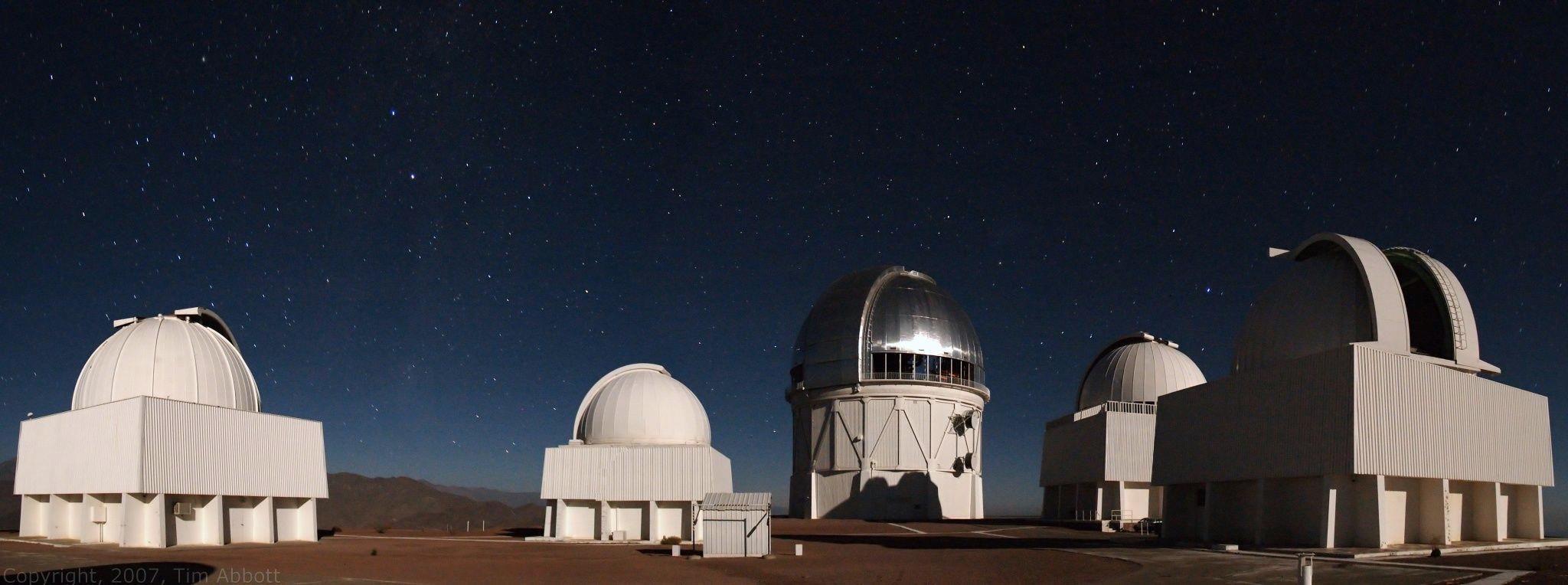
Cerro Tololo Inter-American Observatory (CTIO), Nick Suntzeff's astronomical home for 20 years prior to coming to Texas A&M. (Credit: Tim Abbott, CTIO.)

Cerro Tololo Inter-American Observatory (CTIO), Nick Suntzeff’s astronomical home for 20 years prior to coming to Texas A&M. (Credit: Tim Abbott, CTIO.)

For some additional history on Nick, check out one of the historically significant things he did as an undergraduate at Stanford that continues to educate and inspire to this day.

Yeah, he built that. But here’s how he described his contribution to elite higher education institutional history to me when I originally stumbled across the information:

“It seems not too long ago, a friend and I had no idea what we were doing, but a really supportive physics professor let us believe we could build the thing. He really was the key to this project. It is fun to see it still there at Stanford. I was amused to find out that it is well known as a romantic place on warm evenings. That is, romantic for couples, not astronomers who would be up in the dome cursing whatever is not working and drinking way too much coffee while squinting at a flickering screen and listening to totally forgettable ’60s classic rock. Not a pretty picture.”

Beats the hell outta befriending black widows, in my opinion.

Senses of Wonder

From time to time, Texas A&M Center for Mathematics and Science Education (CMSE) researcher Dr. Craig Wilson emails us about his adventures, experiences and related insights gleaned as both a scientist and a keen observer of life. Anyone who has had the pleasure of meeting (much less working) with Craig will attest to the fact that to know him is to learn from him — a delightful process definitely worth sharing. Given such, we’re pleased and honored that he has agreed to be added to the blog, Here’s hoping you enjoy his musings as much as we do!

* ~ * ~ * ~ * ~ * ~ * ~ *

Most people look but do not actually see. I stress powers of observation when working with teachers and students, explaining that observation in science means using all of their five senses and then asking questions. We need to take full advantage of the gifts we are given at birth that enable us to emerge from the womb as scientists but with an inherent ability to be artistic if we choose to develop those talents. Neither is mutually exclusive, although our education system tends to encourage a divide between left and right brain, science and art, academic and non-academic, success and failure.

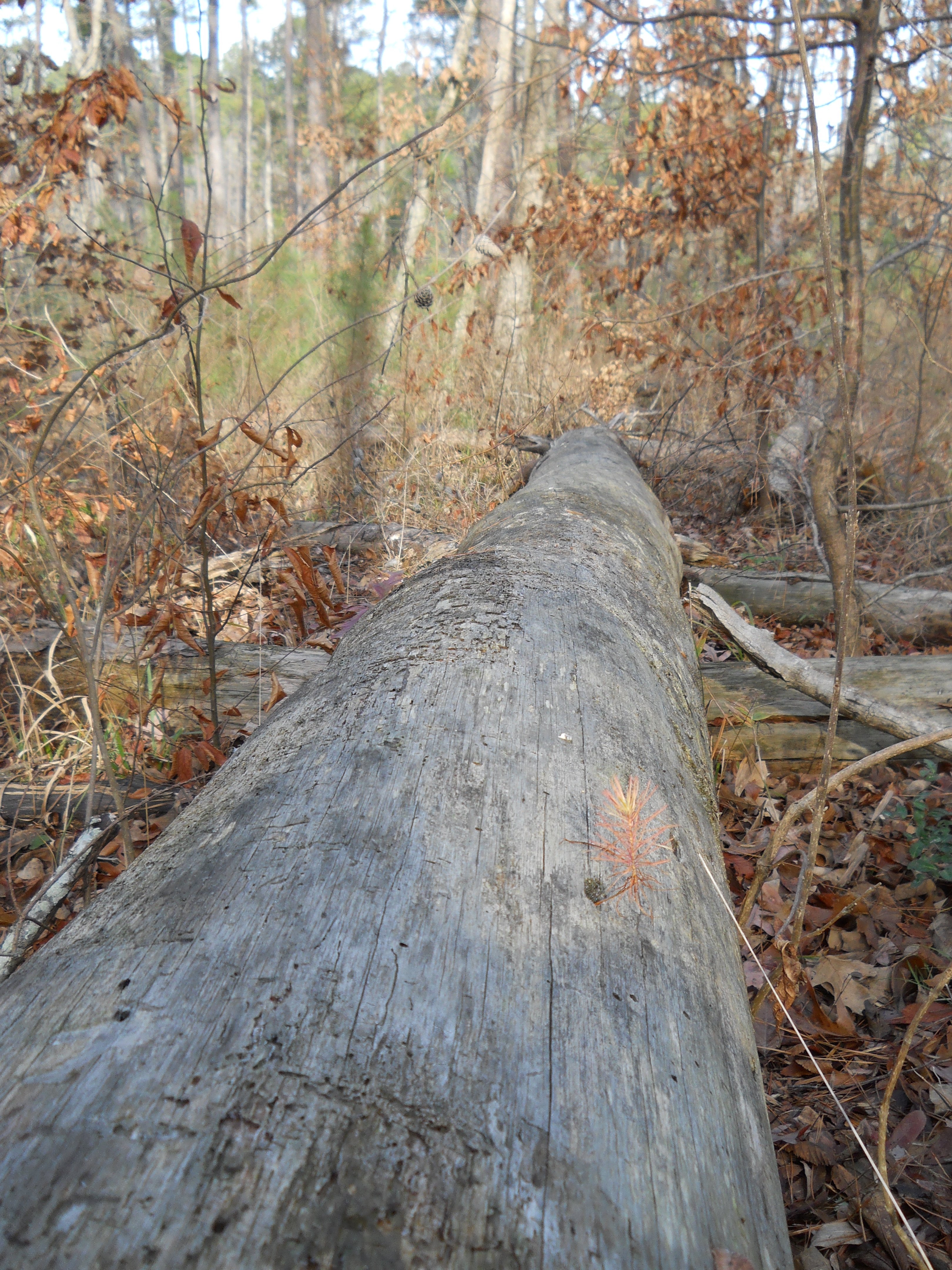
A downed 100-foot yellow pine tree on Craig Wilson's East Texas property, complete with a new pine seedling emerging from a woodpecker hole in the foreground.

A downed 100-foot yellow pine tree on Craig Wilson’s East Texas property, complete with a new pine seedling emerging from a woodpecker hole in the foreground.

For example, if you make the effort to observe it, a rose by any other name would smell as sweet, would prick your finger when you touch it, would look glorious because of its vibrant colors, would taste as delicate as its petals you may eat and would sound as quiet as a whisper as it sways in a gentle breeze, if you had the auditory powers of the greater wax moth. This moth is capable of sensing sound frequencies of up to 300 kHz – the highest recorded frequency sensitivity of any animal in the natural world.

Humans are only capable of hearing sounds of 20 kHz maximum, dropping to around 12-to-15 kHz as we age. But, do we actually listen? I have lain down in the prairie grasses of The Badlands in South Dakota to hear the wind passing through and over them. I have been fortunate to sit on beaches of the Indian, Atlantic and Pacific Oceans and a few days ago, the Caribbean, to hear waves crash or roll gently on shore, each with a distinctive sound.

We can all touch people by our actions, but when we touch or feel, we cannot match catfish that are probably the most finely tuned creatures on Earth, as their smooth skin gives them a heightened sense of touch, and they are rumored to be able to detect earthquakes days in advance. When I have actually felt the most is when I was privileged to hold each of our children as soon as they were born in Serowe, Botswana, for each touched my heart in return.

Craig Wilson, during his descent through the cloud forest at the base of Mt. Kilimanjaro that inspired the following Haiku: Why Climb Trees? Why? To touch the sky! Why? For all the world to see... One must climb a tree!

Craig Wilson, during his descent through the cloud forest at the base of Mt. Kilimanjaro that inspired the following Haiku:
Why Climb Trees?
Why? To touch the sky!
Why? For all the world to see…
One must climb a tree! 

Bloodhounds have the keenest sense of smell of any dogs, as their noses are 10-to-100 million times more sensitive than a human’s. That said, it always intrigues me that when humans encounter certain smells, these odors can trigger a memory perhaps from our youth — for example, the inside of a damp tent that transports me back in time to a hillside in Wales where sheep had invaded our tents while we were away climbing Idwal Slabs. Can a dog do that?

For eyesight, I pick the dragonfly, possibly the most formidable aerial hunter among insects whose eyes are so big that they cover almost the entire head and provide a full 360-degree field of vision. These eyes are made up of 30,000 visual units called ommatidia, each one containing a lens and a series of light sensitive cells. Their eyesight is superb, whereas humans look but rarely see what may be obvious just a few feet in front of them. For example, I can walk down a street in Mayaguez, Puerto Rico and see glorious concrete buildings from the early 1900s with ornate friezes three stories up with ferns growing from cracks but never, ever glance in a shop window to see merchandise.

The average person has about 10,000 taste buds. That number may seem like a lot, but it pales in comparison to, yet again, the catfish that has taste buds not only in its mouth but all over its body, numbering more than 100,000, with some large catfish having as many as 175,000. While in Mayaguez, I tasted pasteles (pork dumplings) for the first time, but I prefer the taste of freedom that my job allows, enabling me to interact with incredible people from friends to research scientists to students with special needs.

DreamFinally, a question for you! Does the seldom-used common sense (7th Sense) negate the existence of extra sensory perception (ESP) or the 6th Sense? I wonder?

If you have a few spare moments, this video appealed to me.

Got a Little Story for Ya, Ags

As a writer, I do so love a good story and those who wield both the appropriate subject matter and the flair for its proper delivery.

One of the best absolute naturals in all above respects is Texas A&M astronomer Nick Suntzeff, who I describe to people as a marketer’s dream for good reason. Beyond his ease with media representatives, administrators and officials, and external visitors and general audiences, he’s also a master at breaking down the subject at hand and explaining why it matters. And in going the extra mile.

I offer a recent example — a follow-up email to Battalion reporter John Rangel, thanking him for a recent story:

John,

I would like to congratulate you on the article in The Batt on the most distant galaxy. You nailed the science and gave a feeling for the excitement of the discovery. Great job!

By the way, there are some points to this discovery that you, as an engineering student, may enjoy. It is difficult to define what is distance in astronomy because the universe is expanding, and the grid by which we measure distances is also stretching at the same time. So for me the best way to understand distance is just what you did — give it in units of how much time it took for light to get here compared to the age of the universe. However, you will see some articles refer to the distance to this object as 30 billion light years or so. This is the way astronomers would measure it, but this distance is not intuitive. Imagine we are in our galaxy in the early universe and we are looking at this distant galaxy. It would be very close to us because the universe is so small. Imagine putting a 3-D grid on this early universe and put our galaxy at one corner and the distant galaxy at another corner. Now run the universe forward to today. The universe has stretched a lot (expanded, if you will). Our galaxy and the other one are still at those corners, but the grid has expanded by a factor of 9 now. That short distant that separated us and that galaxy has now stretched into about 30 billion light years — the co-moving distance we call it. So you will also hear astronomers quote distances that are greater than the age of the universe.

How can something be farther away than the age of the universe (in today’s time) and we can still see it? Well, the weird thing is that we will never see that galaxy when it is today age — 13.8 billion years old. We can only see it now, but as the universe evolves, the galaxy will actually disappear from our universe or perhaps more to the point — will disappear from our vision.

The other point is that although galaxies appear to be moving away from us and this appears as a Doppler shift, it is actually not a Doppler shift. It is space stretching. Nothing is actually moving. The motion looks like a velocity and a Doppler shift, but there is no kinetic energy involved. If there were, galaxies near the edge of the universe would have a ridiculous amount of energy because they are moving close to the speed of light.

Edwin Hubble, who discovered the expansion of the universe, was careful never to call this apparent expansion a velocity — he called it a cosmological redshift which is what astronomers should also call it, and if they don’t, well I will go kick their butts.

Anyway, sorry for the long email about your great article.

cheers, nick

I don’t know about John Rangel, but for this writer, the initial interview is typically a formative experience. I remember well my first trip to Dr. Suntzeff’s Texas A&M campus office — a veritable time capsule spanning the high points of astronomical history as well as his career, which includes 25 years at Cerro Tololo Inter-American Observatory in Chile. I was interviewing him for a piece on Albert Einstein’s cosmological constant — Einstein’s self-described “biggest blunder” which he predicted in 1917 as the proverbial glue holding together the theory of a never-changing universe that Edwin Hubble’s 1929 discovery of the universe’s expansion later debunked. (Incidentally, in a Kevin Bacon-esque six-degrees-of-separation constant, Hubble served as mentor to Allan Sandage, who in turn is the one who encouraged Dr. Suntzeff to focus on Type Ia supernovas — specifically their brightness — to measure precise distances, which is how Dr. Suntzeff came to help discover dark energy and roughly 75 percent of the universe. But that’s a whole ‘nother story!)

After posing a basic equation-type question to gauge my level of astrophysical knowledge (essentially negative infinity), Dr. Suntzeff took great pains to explain not only the equation and the basic physics behind it, but also each and every piece in his collection, in addition to the actual research I was there to discuss. And so began an educational relationship across subsequent visits and stories, typically supplemented with emailed anecdotes and other means of follow-up insight about astrophysics and oh, so much more that has always served to enlighten or entertain. (Ask him sometime about saving Alan Alda’s life while down in Chile or about being school mates with Robin Williams — yes, that Robin Williams — or about the time he made international headlines for discovering nothing! Yeah, I have hundreds of these, as does he.)

Bottom line, it all goes to prove my long-held theory that most professors first and foremost are born educators and — big surprise — people, too. Their areas of expertise are vitally important, but somehow lost amid all that focused excellence and relentless drive is their intrinsic motivation and passion for knowledge generation, big-picture dreams and doing what they love and want you to love, too. Or at the very least understand in some tangible way.

Trust me, it’s a great story well worth the time it takes to read. Even better if you get the chance to hear it in person.

Nick Suntzeff claims no one believes that he knew Robin Williams in high school and that the two hung out together, but this image from the Redwood High School 1969 Yearbook offers actual proof from the days long before fame for both or the invention of Photoshop! Redwood is located in Larkspur, California.

Nick Suntzeff claims no one believes that he knew Robin Williams in high school and that the two hung out together, but this image from the Redwood High School 1969 Yearbook offers actual proof from the days long before fame for both or the invention of Photoshop! Redwood is located in Larkspur, California.

A Stitch in Time

Even after a decade in the College of Science and going on a (slightly shocking, even to me) combined 24 years as a student and communicator at Texas A&M University, I never cease to be amazed by the absolute care and creativity so many of our professors put into their teaching efforts. Take, for instance, Texas A&M Mathematics’ Jill Zarestky, who each fall since 2009 has taught a first-year seminar course, Arts & Crafts & Maths, that explores the relationship between art, mathematics and a variety of crafting and fiber arts techniques, including knitting, crocheting, needlepoint, embroidery, cross-stitch, weaving and quilting.

Zarestky, who has been knitting and teaching mathematics at Texas A&M since 2007, is active with the Brazos Valley Knitting Guild and regularly teaches knitting workshops and classes. This month, she also is a featured artist with the local Arts Council of the Brazos Valley. If you aren’t able to drop by the ACBV’s College Station headquarters to see some of her knitted works on display as part of the Fiber Arts: All Things Fiber exhibit, then check out her related guest post for their blog describing her insight into the connections between knitting and math.

Jill Zarestky, in front of some of her at the current Arts Council of the Brazos Valley exhibition.

Jill Zarestky, in front of some of her work at the current Arts Council of the Brazos Valley exhibition.

The human element: It’s alive and well in Texas A&M Science faculty and in the many personal touches, obvious and subtle, they bring to their classrooms. What valuable life lessons for us all.

Bring your A game, folks, but don’t forget to pack your P (personality) one as well.