You almost walked out on a Team Exercise today because you weren’t prepared, and you didn’t want to freeload. I admire that, but I asked you to stay and to learn, because the point of the Team Exercise isn’t the grade; it’s to help the members of the team to better understand the lesson.
At some point we will all walk in unprepared, and have to ask our team to help us out. That’s why some of the hard stuff is Team Stuff, rather than individual. Because I think that having you work together will cause more learning than if I just preach it at you.
I still felt terrible because you did today. And I questioned myself and what I was doing.
I talked to you for while late this afternoon, and there are other things going on in your life. This class isn’t easy for you, and logistics lately have been difficult. I get the feeling there are other things too. You apologized to me, but no apology is necessary. This is my job. I am here to try to help you learn. I know that other things get in the way. I know how they get in the way. I’ve lived that. I just wish you knew it, too. You are worthy of being here. Worthy of my effort. Worthy of the help from your team. Worthy of being taken seriously. Worthy of help. Maybe worthy of better than I am capable of giving you.
I know that you are the type of person who wants to be the one to help others. If another came to you unprepared, or unable to get something, or struggling, you’d be proud to be the person to help them out. You’d treat all their problems with loving kindness. That loving kindness that you’d so easily give to someone else is the loving kindness I want you to give yourself right now.
Just hang in there. Just keep trying. And seeing the high level of frustration and pain I saw in your face today, just in case, I want to say: If there comes a point where you realize or decide that this is not for you, I want you to know that is okay, too. You are still worthy and worthwhile. Sometimes it feels like we are deep in a dark tunnel with no way to climb out. And I can’t even tell you how to get out, except that you have to just keep at it.
I didn’t have the exact right words to say to you. I can only hope that the ones I had were enough to plant this idea, for it to grow and blossom later. You are enough. Just as you are. Deserving of respect and love and help. If you can’t trust yourself to judge that, I hope you can trust me.
Judging from a quick scan of the morning headlines and my Facebook, Twitter and Google+ news feeds, it’s a pretty universal fact that last night’s Super Bowl was a wee bit disappointing. While it’s true the Denver Broncos’ high-octane, option-loaded offense didn’t quite measure up to Seattle’s stifling Legion of Boom nor the pregame billing of an epic battle between league-leading No. 1s on opposite sides of the ball, I was confident from the kickoff, given that we had Aggies on both squads and therefore would emerge victorious. (Yay, 12th Man — the real one!)
But leave it to self-described math geeks to liven up an otherwise lame game with a little game within the game, described here in excerpts from Texas A&M Mathematics’ Amy Austin’s related post last night on Facebook:
* ~ * ~ * ~ * ~ * ~ * ~ * ~ * ~ *
AUSTIN: So me and my geeky friend just calculated how fast that Seahawk player was running when he just scored that most recent touchdown.
14.3 mph.
AUSTIN (admitting a little further into the comments that she was the instigator, if not the geek🙂 Well, it was me that wondered aloud how fast he was running. So the friend I was talking on the phone with is the one that took out her calculator. She’s the geek. Not me. 😉
ANOTHER FRIEND (drawn in:) What was your formula…..no, forget I asked!
AUSTIN: Good old distance equals rate times time. And of course we had to convert from yards to miles and seconds to hours.
* ~ * ~ * ~ * ~ * ~ * ~ * ~ * ~ *
Just goes to show that math and science not only are fun but also all around us, if we so choose to recognize and embrace what clearly can be a challenge just as exciting as sports. Possibly even more so on otherwise disappointing nights such as these.
#winning
Yep, now that I actually look, there are the obvious plus, minus and equals signs right there in the laces. What else do you see? (Credit: Torsten Bolten, Wikimedia Commons)
Another guest entry from Texas A&M Center for Mathematics and Science Education (CMSE) researcher Dr. Craig Wilson about the importance of seizing not only our days but as many fleeting moments as possible — rather appropriate as we close in on closing out another trip around our Sun:
* ~ * ~ * ~ * ~ * ~ * ~ *
Life is ephemeral…
Just what does that mean?I still retain a dictionary, but nowadays most people turn or click toWikipedia, which defines ephemeral things (from the Greek word εφήμερος or ephemeros, literally “lasting only one day”) as transitory and existing only briefly. Typically the term is used to describe objects found in nature, although it can describe a wide range of things.
So, it was refreshing and thought-provoking to hear this definition offered by a Native American tribal elder when I recently attended the “closing circle” at the American Indian Science and Engineering Society (AISES) National Conference in Denver, Colorado. Dried sage leaves were burning and smoking (smudging) and cleansing the gathering that, rather incongruously, had attendees seated in a circle of chairs arranged inside a hotel conference room rather than outdoors under an expansive blue sky with the snowcapped Rockies as a backdrop. Nevertheless, once “smudged,” the speaker was allowed to hold the sacred eagle feathers and thus the floor, whereupon the elder said that, “The Plains Indians consider life to be like the fresh breath of a buffalo on a cold morning.” No book nor the Internet could have put it better, and so I immediately became a fan of oral history and the power of a good story — in my case spoken by preference.
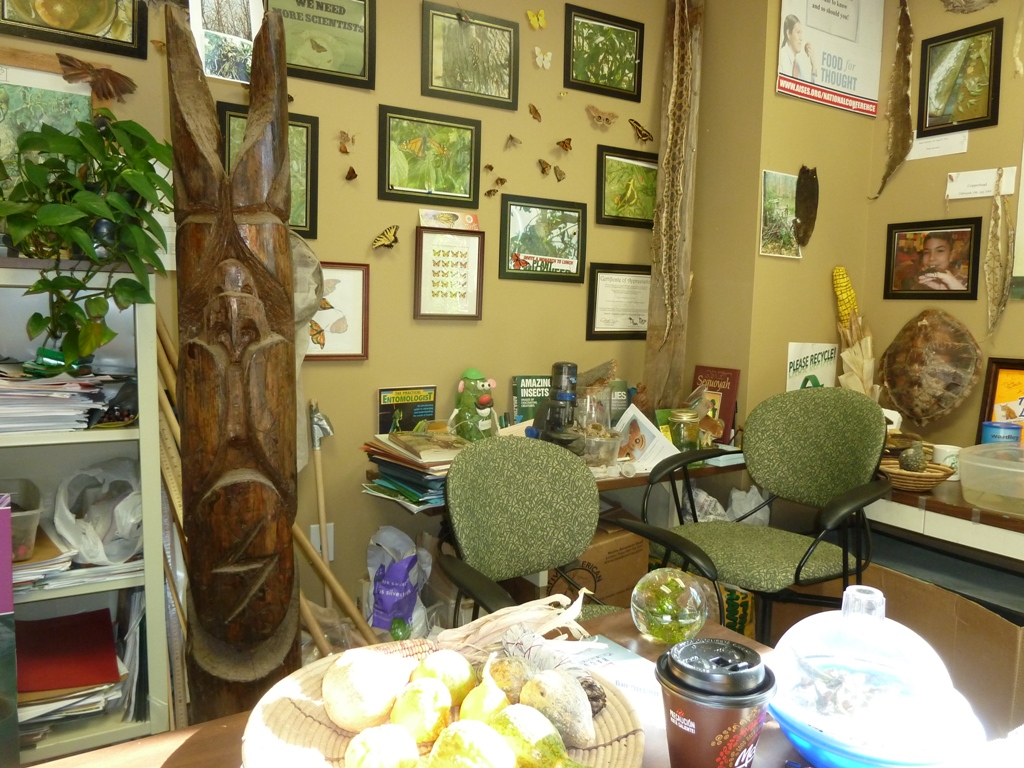
A totem pole carved by an itinerant woodcarver Craig Wilson befriended from Washington State nearly 20 years ago graces his USDA/ARS office. Wilson says he treasures the man’s generous gift, given that members of this particular artisan’s clan of 7th- and 8th-generation First Nations carvers have work in the collections of the Smithsonian and the Royal BC Museum in Victoria, British Columbia.
I have taken to using the phrase “we only pass this way once” (with apologies to any Buddhists and Hindus in my audience) to try to impress on imressionable young minds that they should not be spectators in life but active participants who should try to squeeze out every last drop of juice or aqua viva that is held therein. They should participate. That is, of course, easy for me to say, as I have the luxury in my job of time for thought, while most folks have their noses to the grindstone or, nowadays, to an Ipad/device screen, their thumbs flashing across a miniature keyboard as if their life depended upon reacting or being proactive by text rather than active. There is no thought of taking time out to smell the roses. Why look at or smell an actual rose when you can click on a link and learn that there are Banksianae — white and yellow roses from China — in fact roses from most every continent, of every color, and that they all trace their roots back to slightly more than 100 species? Smell one? What would be the purpose of that?
With that thought in present day, I took myself out of the Howard Johnson — formerly a parochial house for priests and monks — and walked a few hundred yards to the town square in Mayaguez, Puerto Rico where I am currently working. I was there the day before and was immediately struck by the fact that something was missing, different, perhaps untoward. I immediately realized that the fountains had been silenced, the gloriously sparkling pool surrounding the imposing bronze statue in the center of the square emptied and stilled. A magical exercise had been lost to me, given that I have a habit when seated by moving water to focus my eyes on one drop and then to follow its every movement upward and down until it is lost to me, at which point I pick up another water molecule’s path and so on. It is mesmeric. You should try it.
Christopher Columbus statue and fountain in the town plaza in Mayaguez, Puerto Rico.
So instead, I took in my surroundings, where a diminutive, suntanned older lady was sweeping leaves off the marbled square with a passion and effort that was both impressive and disturbing in that she was like an automaton of Autumn only employed when the leaves fall and desperate to have the square leaf-free as if it were a leaf-free zone. That took my eyes skywards to see how much work remained, gauged by the remaining foliage, but then I spotted a humming bird flitting from leaf to leaf, breakfasting on insects to bring up its protein count while burning off the calories from nectar collected elsewhere. Native Americans explain that our Earth is covered by a dark blanket into which the humming bird had pierced holes that are the stars. That sounds good to me and to hell with The Big Bang Theory although it does make me laugh!
My thoughts have drifted as usual, this time like smudging smoke, but I leave you with this analogy from the same tribal elder who said, “The Woodland Indians consider life to be like the flash of a firefly in the darkened forest.”
Don’t look now, folks, but science is on the rise, according to Merriam-Webster, which has crowned a new word king for 2013: science.
Rather than settling for the more traditional (not to mention highly subjective) pulse measurement of popular culture method, officials at Merriam-Webster went with metrics a little nearer and dearer to our disciplinary hearts: analytics gleaned from actual online searches at Merriam-Webster.com. The word with the greatest increase in look-ups — a whopping 176 percent, mind you — was science.
We have arrived, but now, the real work toward maximizing this opportunity begins — in true finals week fashion with a pop quiz: What are your ideas on how to get people hooked on science and related lifelong learning? Inquiring minds clearly want to know.
From time to time, Texas A&M Center for Mathematics and Science Education (CMSE) researcher Dr. Craig Wilson emails us about his adventures, experiences and related insights gleaned as both a scientist and a keen observer of life. Anyone who has had the pleasure of meeting (much less working) with Craig will attest to the fact that to know him is to learn from him — a delightful process definitely worth sharing. Given such, we’re pleased and honored that he has agreed to be added to the blog, Here’s hoping you enjoy his musings as much as we do!
* ~ * ~ * ~ * ~ * ~ * ~ *
Most people look but do not actually see. I stress powers of observation when working with teachers and students, explaining that observation in science means using all of their five senses and then asking questions. We need to take full advantage of the gifts we are given at birth that enable us to emerge from the womb as scientists but with an inherent ability to be artistic if we choose to develop those talents. Neither is mutually exclusive, although our education system tends to encourage a divide between left and right brain, science and art, academic and non-academic, success and failure.
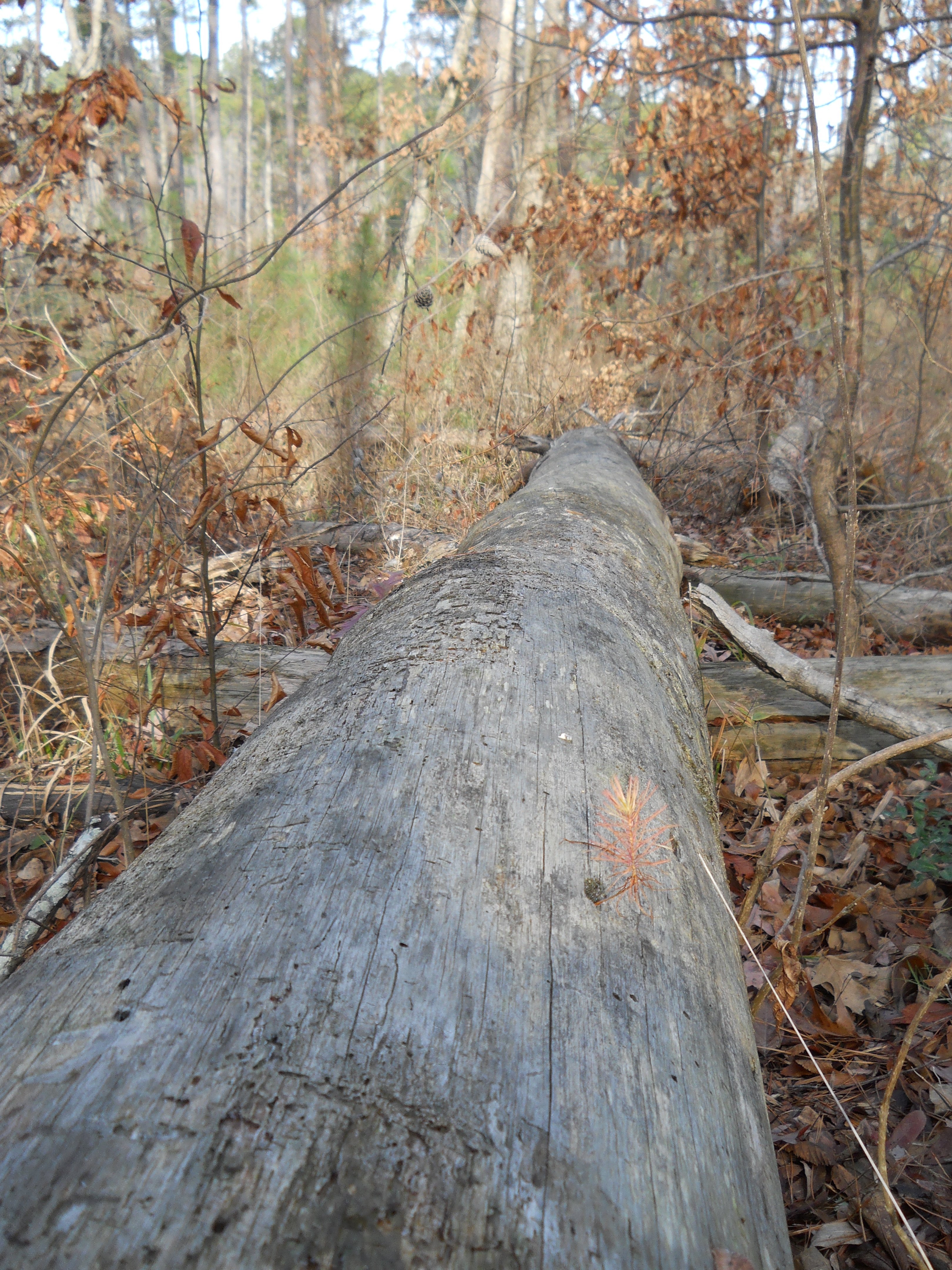
A downed 100-foot yellow pine tree on Craig Wilson’s East Texas property, complete with a new pine seedling emerging from a woodpecker hole in the foreground.
For example, if you make the effort to observe it, a rose by any other name would smell as sweet, would prick your finger when you touch it, would look glorious because of its vibrant colors, would taste as delicate as its petals you may eat and would sound as quiet as a whisper as it sways in a gentle breeze, if you had the auditory powers of the greater wax moth. This moth is capable of sensing sound frequencies of up to 300 kHz – the highest recorded frequency sensitivity of any animal in the natural world.
Humans are only capable of hearing sounds of 20 kHz maximum, dropping to around 12-to-15 kHz as we age. But, do we actually listen? I have lain down in the prairie grasses of The Badlands in South Dakota to hear the wind passing through and over them. I have been fortunate to sit on beaches of the Indian, Atlantic and Pacific Oceans and a few days ago, the Caribbean, to hear waves crash or roll gently on shore, each with a distinctive sound.
We can all touch people by our actions, but when we touch or feel, we cannot match catfish that are probably the most finely tuned creatures on Earth, as their smooth skin gives them a heightened sense of touch, and they are rumored to be able to detect earthquakes days in advance. When I have actually felt the most is when I was privileged to hold each of our children as soon as they were born in Serowe, Botswana, for each touched my heart in return.
Craig Wilson, during his descent through the cloud forest at the base of Mt. Kilimanjaro that inspired the following Haiku: Why Climb Trees? Why? To touch the sky! Why? For all the world to see… One must climb a tree!
Bloodhounds have the keenest sense of smell of any dogs, as their noses are 10-to-100 million times more sensitive than a human’s. That said, it always intrigues me that when humans encounter certain smells, these odors can trigger a memory perhaps from our youth — for example, the inside of a damp tent that transports me back in time to a hillside in Wales where sheep had invaded our tents while we were away climbing Idwal Slabs. Can a dog do that?
For eyesight, I pick the dragonfly, possibly the most formidable aerial hunter among insects whose eyes are so big that they cover almost the entire head and provide a full 360-degree field of vision. These eyes are made up of 30,000 visual units called ommatidia, each one containing a lens and a series of light sensitive cells. Their eyesight is superb, whereas humans look but rarely see what may be obvious just a few feet in front of them. For example, I can walk down a street in Mayaguez, Puerto Rico and see glorious concrete buildings from the early 1900s with ornate friezes three stories up with ferns growing from cracks but never, ever glance in a shop window to see merchandise.
The average person has about 10,000 taste buds. That number may seem like a lot, but it pales in comparison to, yet again, the catfish that has taste buds not only in its mouth but all over its body, numbering more than 100,000, with some large catfish having as many as 175,000. While in Mayaguez, I tasted pasteles (pork dumplings) for the first time, but I prefer the taste of freedom that my job allows, enabling me to interact with incredible people from friends to research scientists to students with special needs.
Finally, a question for you! Does the seldom-used common sense (7th Sense) negate the existence of extra sensory perception (ESP) or the 6th Sense? I wonder?
If you have a few spare moments, this video appealed to me.
Ever feel like there’s more to the story when reading an article on a particular topic, person or program in higher education? So do we. In fact, more often than not, we know it for a fact and would love to share that knowledge, except there’s no place for it in the press release.
Behold, this blog! In addition to our usual fare of news and feature stories available on our official website to highlight all the latest breakthoughs, accomplishments and milestones of note for our faculty, staff and students, we will attempt to bring you occasional bonus coverage showcasing other news that’s equally fit to print — from tidbits and testimony, to anecdotes and insights, to stuff that we find just plain interesting. After all, when it comes to motivation, we writers are in it much for the same reasons as our subjects here in Texas A&M Science — curiosity.
In the meantime, chew on this noteworthy nugget: Many of our subjects are just as curious about writing as they are about math and science, and (go figure) they’re equally as good at it. We hear good things come to those who wait, so stay tuned as we add both entries and voices in hopes of broadening your perspective of all things Texas A&M Science!