The Write Stuff

As another school year winds down for K-16 students across the country, I find myself pondering such altruistic, open-ended concepts as limitless potential and freedom of/in choice. At the same time, I’m doing my best to encourage my own children to close out these last few weeks in style by pressing through and persevering, when I know all they want to do is turn it in and get on with summer.

My oldest is a lot like me, particularly when it comes to his love of reading and writing. On a recent trip home from school, we were discussing the concept of writing books for a living, which he says he wants to do and thinks I should, too. (In his defense, we watch a lot of “Castle” — yes, for the writing/storylines more so than the eye candy for both sexes.) I love that he’s naïve enough to believe that anything you set your mind to, you can achieve. I love that he sees all the beauty where all I see are the obstacles which I like to label (perhaps too easily and conveniently) reality. Most of all, I love his boundless enthusiasm and unshakable belief in his mom. It’s in his DNA on both sides.

At one point in our conversation, he said to me, “But, Mom, think about it — you could write about what you love!” A heady thought, I suppose, particularly for a kid who’s told what to do and how to do it in the majority of his classes. Ever the practical realist, I replied, “Yes, but then there’s the ultimate question: Would it sell?” (Forgive me, Jonas Eriksson, but one of us has yet to write that bestseller, much less start that college fund. Uh, let’s not mention that to the aspiring author, please.) He agreed that was a critical point to consider, and then, just as quickly as the traffic signal turned from red to green, we shifted our focus to another, more pressing issue — the homework he had due for the next day and rest of the week.

Somewhere lost in the mental shuffle was what I should have told him and will. That I do write about what I love, because writing is what I love. That therein lies the beauty of writing and true love of words — it’s a passion so often and so fluidly fulfilled, regardless of topic, medium or deadline. Much like “Green Eggs and Ham,” I’ve found that I like words in a blog. I do, I do like them in a press release or magazine-length feature. I even like them in 140 characters or less, with or without hashtags, and as status updates. And who could resist headlines?!? For me, the variety is the challenge and appeal as much as the subject matter. Which, for the past decade or so has been science, so I’ve got my work more than cut out for me — and I wouldn’t have it any other way.

Words have the power to educate, encourage and inspire. Yep, it’s official: A quarter century or so removed from having to declare a major, I’m still sold on my decision. Here’s hoping he can say the same at my age — and that I’m still around, not only to see it but more so to write about it using whatever the latest technology of the moment is by then.

Credit: Hal Schade.

(Credit: Hal Schade.)

Moon Dance

By now, I’m reasonably certain you’ve all seen just about all there is to see in the way of beautiful photographs depicting the recent total lunar eclipse. So wonderful that so many not only witnessed one of astronomy’s rare treats but also took the time to document it for posterity. In my case, it was with an iPhone camera to appease sleeping children and more than a little curiosity — theirs and mine. Technological innovation and one’s inner scientist make for a powerfully motivating combination!

But just in case you missed what I’d consider to be among the cream of the crop, here’s a double-shot of Lone Star State perspective, from wildflowers to Aggies. Everything’s bigger in Texas, if not better!

After staying out till 6 a.m. on April 15, photographing the different phases of the eclipse over a spectacular field of bluebonnets near Ennis, Texas, Mike Mezeul II created this fabulous composite that was making the rounds on Facebook, among other places. Prints are available at http://tinyurl.com/nkazyum. (Credit: Mike Mezeul II.)

After staying out till 6 a.m. on April 15, photographing the different phases of the eclipse over a spectacular field of bluebonnets near Ennis, Texas, Mike Mezeul II created this fabulous composite that was making the rounds on Facebook, among other places. Prints are available at http://tinyurl.com/nkazyum. (Credit: Mike Mezeul II.)

With a lot of forward planning and a solid nap the prior afternoon, Matai Chiang Wilson ’13 was able to stay up all night to photograph the five-hour-long eclipse as it occurred in conveniently clear skies over the Clayton W. Williams Jr. ’54 Alumni Center on the Texas A&M University campus. To see more of Wilson’s work, go to https://www.facebook.com/matai.c.wilson?fref=ts. (Credit: Matai Chiang Wilson.)

With a lot of forward planning and a solid nap the prior afternoon, Matai Chiang Wilson ’13 was able to stay up all night to photograph the five-hour-long eclipse as it occurred in conveniently clear skies over the Clayton W. Williams Jr. ’54 Alumni Center on the Texas A&M University campus. To see more of Wilson’s work, go to https://www.facebook.com/matai.c.wilson?fref=ts. (Credit: Matai Chiang Wilson.)

Game-Changing Gambles

The Giant Magellan Telescope picked up Texas-sized momentum last month with a $50 million pledge from the University of Texas. Although it wasn’t our announcement, I found myself nearly as excited as I was on July 22, 2011, when I received the following email from Texas A&M astronomer Nick Suntzeff:

Shana, I don’t know if we can announce this yet, but this is a huge achievement! Ask Darren about when this can be made news.

The following news, relayed by Darren DePoy, from the latest GMT Board meeting included the following:

“The GMT1 primary mirror is now at 50nm rms figure. The goal is ~30nm (I think), but even at this level it is the best figured/polished large aspheric optic ever made and probably could be used as is. This is extremely good news!”

This is fantastic! The technology developed by Roger Angel has worked, and we now have a green light to start the other mirrors.

This made my day!

cheers nick

(Credit: Giant Magellan Telescope Organization.)

(Credit: Giant Magellan Telescope Organization.)

I’m definitely no scientist, but I’ve always found the GMT’s design beautifully intriguing and absolutely genius because of its originality and flexibility. The scientists behind it had the forethought (no doubt because they knew just how hard a financial sell it would be) to make it operational in stages, allowing for results (pretty sweet ones) even if it never raises enough funds to be fully completed. The fourth mirror represents that critical stage — the turning point. With UT’s pledge, it’s as good as cast, ensuring that, even if the worst comes to pass, the world at least will have more than leftover parts and a shell of a dream (see Texas Superconducting Super Collider) to show for all the hard work and previous investment.

In January, the GMT cleared two major hurdles, passing both its detailed design review and being approved to enter the construction phase. Of course, approval is one thing; having the financing to do so is quite another.

They say timing is everything, and Texas’ bold move couldn’t have happened at a better one. I can’t help but think of George P. Mitchell ’40 and how happy he would be to finally see the day when his home state got off the dime (figuratively and literally), following his own $33.25 million lead in that vital international leadership regard as he saw it.

Mitchell believed in the GMT when few else beyond the project’s originators did. Thank goodness for people like him — an individual not only with the financial wherewithal but also the vision to see the GMT’s potential just as clearly as the scientists behind it. Truly remarkable and heady stuff. And all the more fitting that it’s a pledge from one of his home institutions that likely puts it over the construction hump. Whoop!

So many said it would never get this far. And that such a risky design relying on not one but seven parabolic mirrors that put the double-capital Ps in precision polishing (in addition to being unprecedentedly huge) would never work.

I think as the GMT enters construction, its marvel will become more apparent. It’s hard to fundraise in the abstract, long-term, but once the project’s partners have a tangible object and definable, measurable progress underway, it will be far easier to visualize the possibility-laden bandwagon onto which these institutions are imploring donors as well as global science to jump.

Oh, and that first mirror and all its precision-polishing-representing-pioneering-scientific-achievement glory that Dr. Suntzeff was so ecstatic about in his email? It’s named for Mr. Mitchell. Oh, the places it will go and things it will help see!

The Giant Magellan Telescope's first two mirrors, pictured last August within the University of Arizona's Steward Mirror Lab. Known as GMT1 and GMT2, they are named for George P. and Cynthia Woods Mitchell, respectively. GMT1/"George" (left) is packaged and ready to head to Chile -- a feat of logistics and exercise in trust by any stretch! Each of the GMT's seven mirrors will travel by truck down Interstate 10 to a port in California, then via ship to a port near Las Campanas, Chile, and finally via another truck up a mountain in the Atacama Desert near the existing twin Magellan telescopes. By comparison, the mirrors for those are 6.5 meters in diameter, while each GMT mirror measures 8.4 meters.

The Giant Magellan Telescope’s first two mirrors, pictured last August within the University of Arizona’s Steward Mirror Lab. Known as GMT1 and GMT2, they are named for George P. and Cynthia Woods Mitchell, respectively. GMT1/”George” (left) is packaged and ready to head to Chile — a feat of logistics and exercise in trust by any stretch! Each of the GMT’s seven mirrors will travel by truck down Interstate 10 to a port in California, then via ship to a port near Las Campanas, Chile, and finally via another truck up a mountain in the Atacama Desert near the existing twin Magellan telescopes. By comparison, the mirrors for those are 6.5 meters in diameter, while each GMT mirror measures 8.4 meters. (Credit: Joe Newton.)

The Right to Wonder

Wise words from author William C. Martin from his bestselling book, The Parent’s Tao Te Ching: Ancient Advice for Modern Parents. And not just for children and their parents, either.

To me, he’s describing science in a nutshell here. Uncannily like the opening sentence in the About section of this blog. Small world/wonder.

Oh, and did I mention that before he became a writer, Martin got his bachelor’s in engineering from the University of California at Berkeley?

Let’s be curious out there, folks. And encourage others, regardless of age, to do the same.

image

“Do you have agendas for your children that are more important than the children themselves? Lost in the shuffle of uniforms, practices, games, recitals, and performances can be the creative and joyful soul of your child. Watch and listen carefully. Do they have time to daydream? From their dreams will emerge the practices and activities that will make self-discipline as natural as breathing.”

A Royal Reign in Peril

Texas A&M Center for Mathematics and Science Education (CSME) researcher Dr. Craig Wilson made international headlines once again last week with his dire predictions concerning this year’s Monarch butterfly numbers, which are at an all-time low across the Brazos Valley and nationwide.

Ever the idealist, Craig appeals below to the altruistic nature lover in all of us with a personal pitch that harkens back to another resilient Lone Star State crusader, Lady Bird Johnson, whom we have to thank for one of Texas’ proudest, most beautiful and time-honored rites of spring — Texas wildflowers.

* ~ * ~ * ~ * ~ * ~ * ~ * ~ * ~ *Monarch_Resting

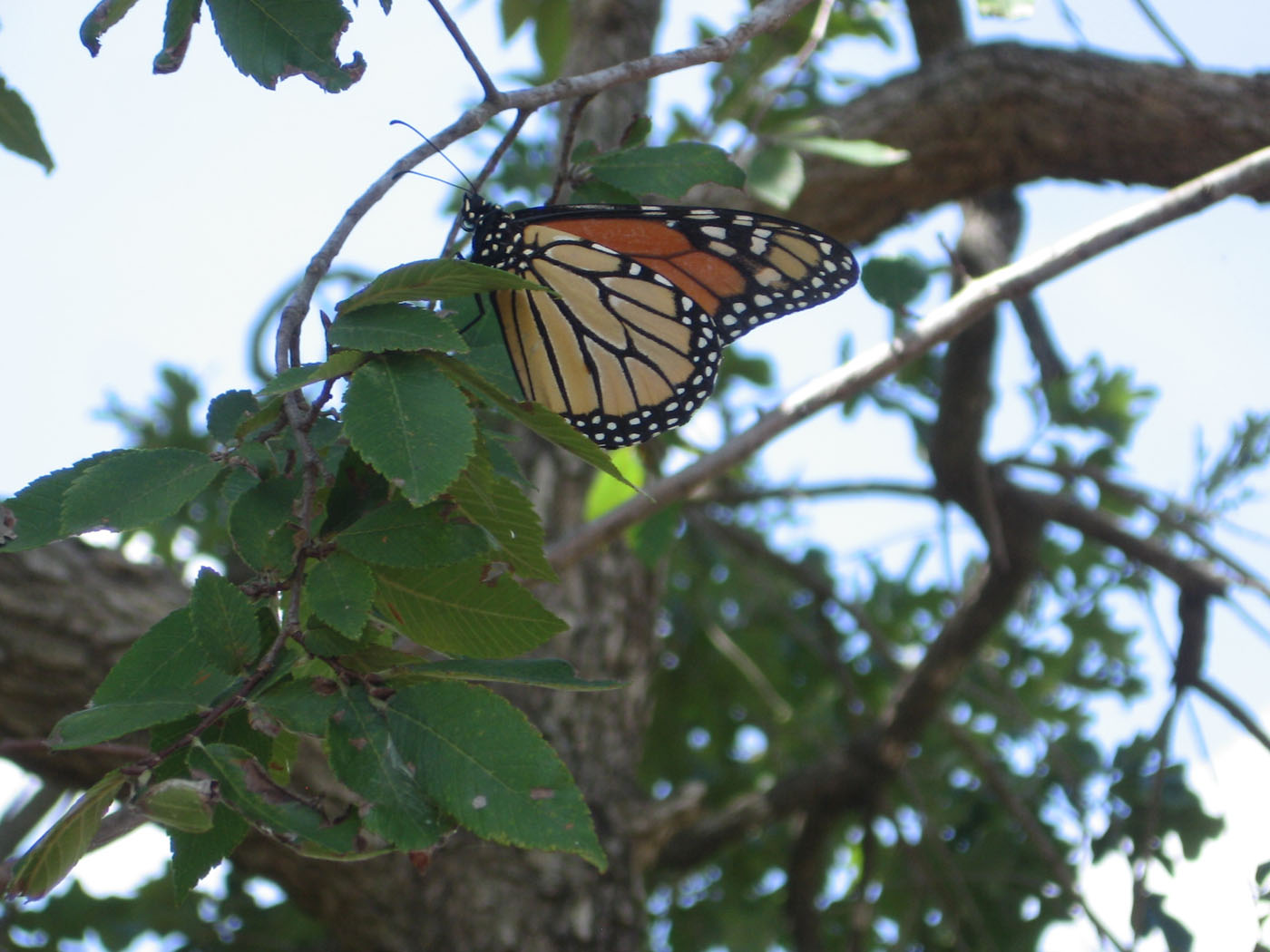
In the fall of 2013, the number of adult Monarchs migrating through College Station that were netted and tagged was one-fifth of the number in 2012, coinciding with the data gathered nationwide showing that numbers were way down. This has been confirmed at the overwintering sites in the state of Michoacan, Mexico, where numbers were at historic lows. The combined areas sheltering Monarchs totalled only 1.65 acres, compared to a high of 45 acres in 1996. We now await the arrival of the first adults of the spring migration north, suspecting that they will be fewer in number. Last year, the first recorded sighting in College Station was on March 19 in the USDA People’s Garden on Holleman Drive that is open to the public.

Monarch Butterflies have reigned supreme amongst insects with a long distance migration that is the marvel of scientists, an increasingly aware population of civilian scientists and the public in general. But their reign is under the severest of threats since records have been kept, with numbers plunging so low that they may have reached a point where recovery may be impossible, in spite of the reproductive resilience of insect species that lay enormous numbers of eggs.

Who or what is to blame? There are a number of culprits. As the adults migrate south, they have to consume large quantities of nectar from wildflowers that are fewer in number because of use of herbicide in large-scale crop farming, especially in the Midwest, the biggest threat. In addition, more land has been brought into cultivation that formerly would have supported wildflowers and other wildlife. Then there is the severe drought and wildfires. Each of these events — individually and in combination — depletes available flowers and their nectar, which the Monarchs drink and then convert into lipids to help the butterflies survive overwintering.

What can be done nationwide? Large-scale farming is not going away, so a practice of leaving some crop acreage free of pesticides (note that this term is inclusive of herbicides and insecticides) needs to be increased. Perhaps interstate wildflower corridors could be established that would extend Lady Bird Johnson’s vision for the verges of Texas nationwide. Likewise, mowing of these same verges should be left until after the wildflowers have bloomed and seeded. This would also help the establishment of milkweed plants that are the sole source of food for Monarch larvae (caterpillars) during the migration north.

What can be done locally? Citizens can plant milkweed and other butterfly attractant plants in their gardens — simple actions viewed by some as futile, but every little bit helps, and it raises awareness. Since last spring, the Cynthia Woods Mitchell Garden (the Texas A&M campus’ first rooftop garden located at the George P. Mitchell ’40 Physics Building and open to the public) has been planted with more than 400 milkweeds, and four Bryan elementary schools also have established Monarch butterfly gardens. Sadly, the harsh winter means that the milkweeds have yet to start growing, so there may not be enough foliage to feed any Monarch caterpillars that do emerge from eggs.

The situation is dire.

THIS JUST IN: There’s an excellent front-page feature story on the subject by John Rangel in today’s Battalion.

Monarch_DamagedWing

Dakotalapse

“We fail in even the simplest of all scientific observations — nobody looks up anymore.” – Neil deGrasse Tyson

I came across this incredible time-lapse video by Randy Halverson while doing research for a story. Mesmerizing doesn’t quite do it justice. In fact, I’m not sure I have the words that would. Sit back and enjoy, preferably while watching in full-screen mode. You’ll thank me later.

The vimeo link includes some great background information from Mr. Halverson as well as appropriate credits.

Beyond that, um, wow. I’ll say it again, backwards. Wow. Totally blown away.

What Moves a Monarch Man

A recent Slate.com article reporting the lowest level on record of Monarch butterflies reaching Mexico this year reminded me of a related story Texas A&M Center for Mathematics and Science researcher Dr. Craig Wilson had shared in October prior to agreeing to be a contributing author to this blog. (Incidentally, roughly a month before the Jan. 29 Slate article ran, Craig also had been featured in a PBS piece for his expertise on this very scenario he had forecasted last spring.)

(Credit: Shutterstock.)

(Credit: Shutterstock.)

You see, among oh, so many other things, Craig is a valiant champion of all things nature and educational — subjects he views in constant and quite purposeful tandem. When it comes to butterflies, he is the host and caretaker of his own official Monarch Waystation here in Aggieland, known as the USDA/ARS People’s Garden and created as a outdoor classroom designed to get students interested in science and possible related careers. And last spring, he singlehandedly planted milkweed and other butterfly-friendly varieties in the Department of Physics and Astronomy’s Cynthia Woods Mitchell Garden. Because it’s the right thing to do, for the children and the butterflies.

After watching that PBS clip as 2013 metamorphosized into 2014, I had emailed Craig to tell him I enjoyed seeing that he has a kindred spirit way down south and that I could totally see him (Craig) breathing life into a Monarch here in Texas. His response?

“Funny you should say that, but I revived a frozen Monarch on a playground in El Reno, Oklahoma several years ago and had it flying around a middle school classroom. The kids made a box for it and provided sugar water, and I transported it with me to Corpus Christi, where I had a conference the next week, and released it in a garden there, sending photos back to the students en route. Helping the migration, one Monarch at a time…”

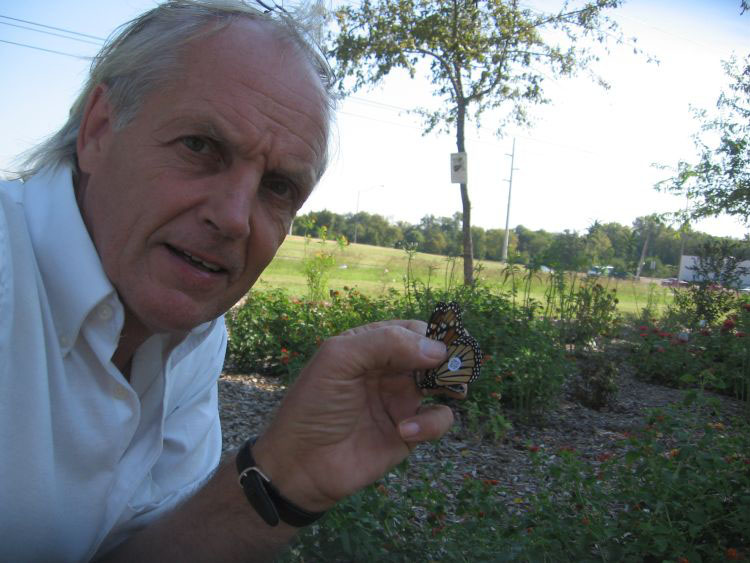
Texas A&M researcher and longtime butterfly enthusiast Craig Wilson recommends taking the long view -- as well as personal steps like planting milkweed -- toward reversing the alarming decades-long decline in overall Monarch numbers.

Texas A&M researcher and longtime butterfly enthusiast Craig Wilson recommends taking the long view — as well as personal steps like planting milkweed — toward reversing the alarming decades-long decline in overall Monarch numbers.

But I digress. I had mentioned having a past story — why don’t I just let Craig tell it in his own inspiring, firsthand words!

* ~ * ~ * ~ * ~ * ~ * ~ * ~ * ~ * ~ *

On Boss’s Day [October 16], we pay homage to our brave and fearless leader. Below is a short essay I wrote in tribute to another Monarch…

From Queen Elizabeth II to other Monarchs including Tim [Scott, Craig’s boss as one of four CMSE co-directors]:

It must be my destiny, to leave one continent behind where I pledged allegiance to a Queen, only to arrive on another where I am again ruled by a Monarch, only this time it is a butterfly.

Last Sunday, I was lucky enough to be invited to a showing of “Flight of the Butterflies” in the IMAX theatre in Austin, Texas where I was enthralled by both the Monarch’s flight and plight, tracing its history through the eyes of a young boy (Urquhart) lying in the pastures above Toronto, Canada, wondering just where they flew, to the discovery near the end of his life that it was to a few acres’ nestling at 10,000 feet in the Sierras that transverse the state of Michoacan in Mexico. The wearing of 3-D spectacles was new to me, but it enhanced the experience beyond my wildest dreams as I felt myself flying with the adult butterflies, munching alongside their caterpillars and dicing with death in the form of crop sprayers, predators and loss of my habitat. But the most wondrous magic for me was to be able to watch the four-year-old girl in front of me, sitting on her father’s lap and reaching out continuously in the total belief that a Monarch would land on her tiny, precious hand. Oh, that everyone could believe.

monarchs-nestingI have been enthralled by Monarchs for several years now and take part in the Citizen Science Project out of Kansas University, through which you can receive individual tags to stick on the hind wing of a migrating Monarch as it flies the 2,000 miles south from Canada in the fall to help track their movements. This is one of the world’s great migrations and, hazardous at the best of times, it has become more so of late due to a multitude of factors ranging from climate change where the extreme heat can dessicate their eggs on the journey north in the spring; wildfires that destroy wildflowers that provide nectar; loss of habitat both in U.S. and Mexico; and, perhaps most drastically, the loss of milkweed plants that are the only food source for their caterpillars.

Milkweed search and recovery has become a particular obsession of mine. I can spot a milkweed blooming on a highway verge despite going at 70 mph as I traverse the country. That necessitates a sudden but safe stop and, armed with my trusty sharpshooter, I dig below the deeply seated tuber and carry my prize back to the car to be transplanted into the USDA/People’s Garden in College Station outside my office, where I watched a female Monarch carefully depositing individual eggs on the underside of milkweed leaves yesterday. Two weeks ago, I was able to tag a male and a female — the first to arrive in our garden from Canada on their fall migration — the faded coloration of their wings and less-than-pristine condition suggesting that they did indeed have hundreds of miles on their odometers.

Naively, I do believe that, “If you plant it, they will come” — it being milkweeds that are native throughout the land over which this Monarch, I believe, should rule. It would be sad to see her go the way of George III. Perhaps, taking a literal leaf out of Lady Bird Johnson’s playbook, the north-south interstates could be planted with milkweeds and become corridors to aid the migration, but that requires a degree of cooperation and collaboration we are sorely missing currently. Would it not be ironic if a Monarch could unite this nation?

E pluribus unum…

You Are Enough

HemingwayQuoteDear Student,

You almost walked out on a Team Exercise today because you weren’t prepared, and you didn’t want to freeload. I admire that, but I asked you to stay and to learn, because the point of the Team Exercise isn’t the grade; it’s to help the members of the team to better understand the lesson.

At some point we will all walk in unprepared, and have to ask our team to help us out. That’s why some of the hard stuff is Team Stuff, rather than individual. Because I think that having you work together will cause more learning than if I just preach it at you.

I still felt terrible because you did today. And I questioned myself and what I was doing.

I talked to you for while late this afternoon, and there are other things going on in your life. This class isn’t easy for you, and logistics lately have been difficult. I get the feeling there are other things too. You apologized to me, but no apology is necessary. This is my job. I am here to try to help you learn. I know that other things get in the way. I know how they get in the way. I’ve lived that. I just wish you knew it, too. You are worthy of being here. Worthy of my effort. Worthy of the help from your team. Worthy of being taken seriously. Worthy of help. Maybe worthy of better than I am capable of giving you.

ValueI know that you are the type of person who wants to be the one to help others. If another came to you unprepared, or unable to get something, or struggling, you’d be proud to be the person to help them out. You’d treat all their problems with loving kindness. That loving kindness that you’d so easily give to someone else is the loving kindness I want you to give yourself right now.

Just hang in there. Just keep trying. And seeing the high level of frustration and pain I saw in your face today, just in case, I want to say: If there comes a point where you realize or decide that this is not for you, I want you to know that is okay, too. You are still worthy and worthwhile. Sometimes it feels like we are deep in a dark tunnel with no way to climb out. And I can’t even tell you how to get out, except that you have to just keep at it.

I didn’t have the exact right words to say to you. I can only hope that the ones I had were enough to plant this idea, for it to grow and blossom later. You are enough. Just as you are. Deserving of respect and love and help. If you can’t trust yourself to judge that, I hope you can trust me.

Sincerely,

Dr. Linhart

LoveLeaf

(Credit: Alex Eastman)


The Name of the Game

Judging from a quick scan of the morning headlines and my Facebook, Twitter and Google+ news feeds, it’s a pretty universal fact that last night’s Super Bowl was a wee bit disappointing. While it’s true the Denver Broncos’ high-octane, option-loaded offense didn’t quite measure up to Seattle’s stifling Legion of Boom nor the pregame billing of an epic battle between league-leading No. 1s on opposite sides of the ball, I was confident from the kickoff, given that we had Aggies on both squads and therefore would emerge victorious. (Yay, 12th Man — the real one!)

But leave it to self-described math geeks to liven up an otherwise lame game with a little game within the game, described here in excerpts from Texas A&M Mathematics’ Amy Austin’s related post last night on Facebook:

* ~ * ~ * ~ * ~ * ~ * ~ * ~ * ~ *

AUSTIN: So me and my geeky friend just calculated how fast that Seahawk player was running when he just scored that most recent touchdown.

14.3 mph.

AUSTIN (admitting a little further into the comments that she was the instigator, if not the geek🙂 Well, it was me that wondered aloud how fast he was running. So the friend I was talking on the phone with is the one that took out her calculator. She’s the geek. Not me. 😉

ANOTHER FRIEND (drawn in:) What was your formula…..no, forget I asked!

AUSTIN: Good old distance equals rate times time. And of course we had to convert from yards to miles and seconds to hours.

* ~ * ~ * ~ * ~ * ~ * ~ * ~ * ~ *

Just goes to show that math and science not only are fun but also all around us, if we so choose to recognize and embrace what clearly can be a challenge just as exciting as sports. Possibly even more so on otherwise disappointing nights such as these.

#winning

Yep, there are the obvious plus, minus and equals signs right there in the laces. (Credit: Torsten Bolten, Wikimedia Commons)

Yep, now that I actually look, there are the obvious plus, minus and equals signs right there in the laces. What else do you see? (Credit: Torsten Bolten, Wikimedia Commons)

P.S. For those interested in a little 12th Man history, check out this extensive treatise on the subject by the outstandingly enterprising and clever folks at Good Bull Hunting.

Life Forces and Legacies

Last week Texas A&M University hosted a familiar face and cherished friend in one Robert M. Gates, 22nd United States Secretary of Defense and 22nd President of Texas A&M, who was here on campus to discuss his new book, DUTY: Memoirs of a Secretary at War. As expected, Dr. Gates packed Rudder Auditorium and had his audience hanging on his every warm and oftentimes humorous word.

Two Texas A&M presidents removed and two jobs later, Dr. Gates remains a man much revered in Aggieland, if not for progressive plans like faculty reinvestment, then for more student-centric feats like first-year grade exclusion and the university studies degree. (Or, in my case, as the guy at the helm when journalism died, but that’s another subject, one for which I’ve mostly forgiven him. Mostly. And I even understand the dairy center, given that yesterday marked the 29th anniversary of Dad and Mom selling off our own herd and ending our family’s days in the milking pits. In short, it was time for both.)

His visit reminded me of another revered Aggie, George P. Mitchell ’40, who was a big fan of Dr. Gates and his energy when it came to Mr. Mitchell’s alma mater and its future. Understandably there as well, considering Mr. Mitchell invested as big as anyone in those dreams, adding his monetary muscle to fuel the dream for Texas A&M Physics.

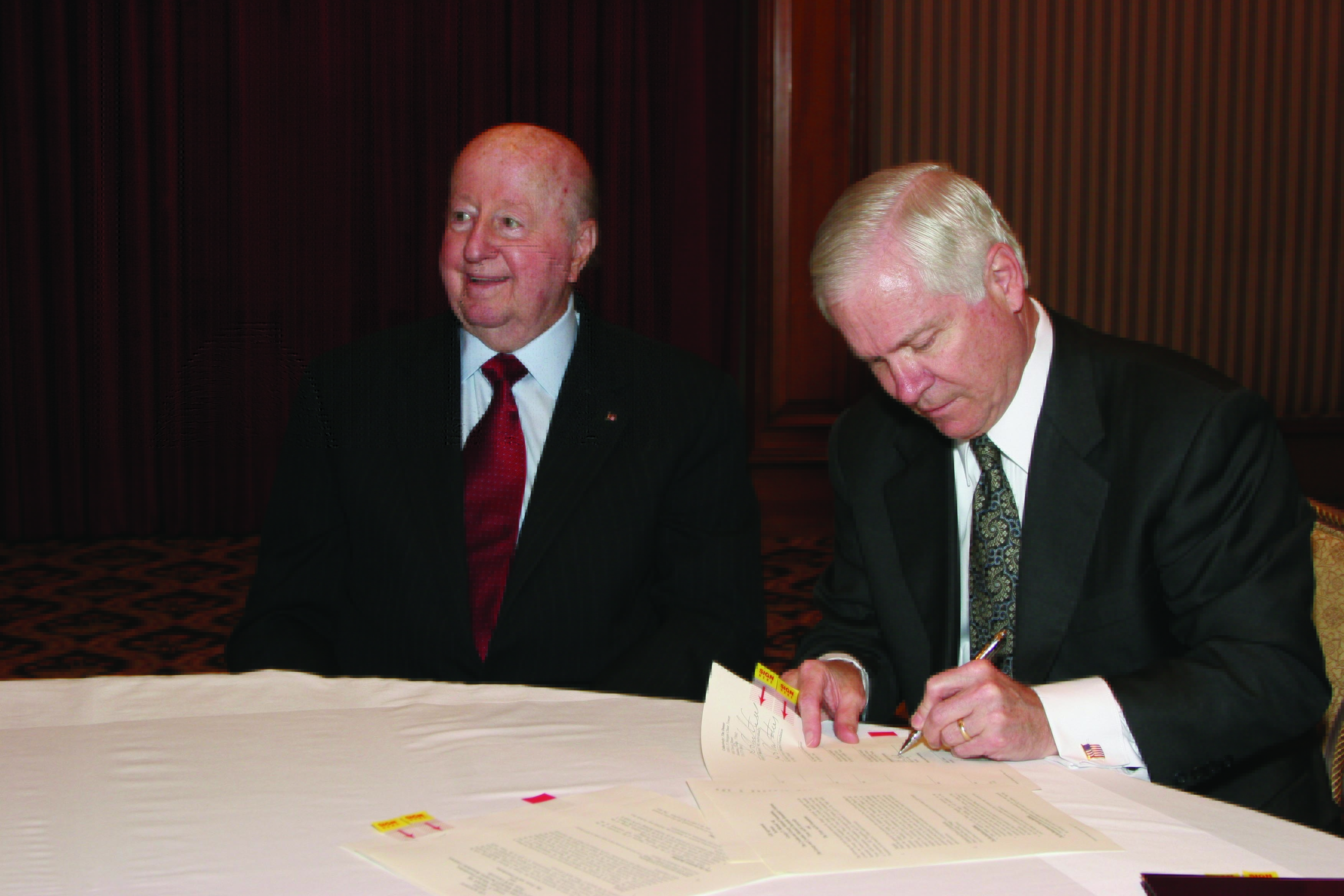
George P. Mitchell '40 and Dr. Robert Gates, signing the historic paperwork to finance construction of two landmark physics buildings at Texas A&M University.

George P. Mitchell ’40 and Dr. Robert Gates, signing the historic paperwork to finance construction of two landmark physics buildings at Texas A&M University.

That admiration was mutual, as evidenced by this quote from Dr. Gates upon hearing of Mr. Mitchell’s death on July 26, 2013:

“George Mitchell was a great man and a great benefactor of Texas A&M University. Through his generosity, dramatic improvements were made possible in many areas, including science research and teaching at Texas A&M, particularly in physics. Thanks to his philanthropy, world-class facilities and significant enhancements for faculty and students alike brought international renown to the university. His gifts also extended to athletics, particularly tennis. Personally, I thoroughly enjoyed working with and learning from him while I was president of the university. He will be greatly missed.”

These two powerful men and their visionary motivations coincided and collided in a
marvelous and near-magical way, creating the best possible hiring world and a climate of excitement and forward momentum that proved so attractive in 2006 as to actually land such an established star as Nick Suntzeff, a 20-year veteran of the U.S. National Optical Astronomy Observatory/Cerro Tololo Inter-American Observatory in Chile, to lead Texas A&M’s new astronomy program.

Thanks in large part to Dr. Gates’ and Mr. Mitchell’s dual dreams, the future is gloriously bright for Texas A&M Physics and Astronomy, Texas A&M University and the overall state of Texas. Despite being gone in vastly different extremes, both will be forever remembered in Aggieland, if not for enabling sweeping recruiting successes and other tangible program-wide gains, then for negotiating two beautiful buildings — architectural showpieces and the first on campus to be built through a unique university-private partnership involving substantial donor funds.

Here’s a bit of the rest of the story on that story, as told by Joe Newton, Dean of Science and inaugural holder of the George P. Mitchell ’40 Endowed Chair in Statistics, who reflects on a pivotal meeting involving Dr. Gates and Texas A&M’s most generous benefactor:

* ~ * ~ * ~ * ~ * ~ * ~ * ~ * ~ *

George P. Mitchell, 1940 Texas A&M University distinguished petroleum engineering graduate, the largest benefactor Texas A&M has ever had, developer of The Woodlands, and the leading figure in hydraulic fracking (among a host of other amazing accomplishments), passed away on July 26 at the age of 94.

Lucky enough to be in the right place at the right time as dean of the Texas A&M College of Science, I was privileged to participate in his philanthropic efforts to build fundamental physics and astronomy at Texas A&M. In the process, he became a friend. I flew on Continental Express with him. I ate at Chick-fil-A with him. Somehow he thought I had power. He would call me to tell me to fix things. Sometimes I even could. His passing has made me very sad. I cannot believe this life force has left us.

George P. Mitchell '40 and Dean of Science Joe Newton at the 2006 Sterling C. Evans Medal ceremony.

George P. Mitchell ’40 and Dean of Science Joe Newton at the 2006 Sterling C. Evans Medal ceremony.

I also had the honor of knowing former Texas A&M President (and CIA Director and Secretary of Defense) Robert M. Gates. These two men came together in Mitchell’s Houston office on Aug. 14, 2005, in a meeting that changed the face of Texas A&M. It was my honor to be there, and I would like to pay tribute to both of them by describing the meeting.

Both men had already played a large role in the development of fundamental physics and astronomy on campus; Gates with his reinvestment program designed to bolster teaching and research efforts by hiring a large number of new faculty, and Mitchell with his philanthropy that created an institute named in his honor, that helped us build a new astronomy program and attract great faculty.

Ed Fry, the department head at the time (and a dreamer of the first order), had developed a remarkably close relationship with Mitchell. Fry thought that Mitchell would be receptive to a request to help fund two buildings on campus. The first would be a “signature building” architecturally to house the Mitchell Institute; the second would for the first time consolidate all of the department’s faculty and classes in one place.

The task of convincing the university to supply the matching funds that Mitchell always required fell largely to me. Mitchell routinely drove a hard bargain, but the driving premise behind his trademark matching requirement was to ensure the maximum benefit of every dollar contributed — his or the university’s — to the broader cause or project. A major component of this particular project was that the department would make no claim on space it would vacate, so that the university would in fact receive a net gain with its matching funds.

After a series of meetings with various university officials, especially Gates, it was agreed that Gates and a few others (including Fry, Texas A&M Foundation President Ed Davis ’67 and College of Science Director of Development Don Birkelbach ’70) would go to Mitchell’s office in downtown Houston to make “the big ask.”

There was a sense of history when we walked into the conference room. Mitchell, as usual, started by asking about projects in which he was interested, including the Giant Magellan Telescope. Then his attorney, Barry Levitt, suggested we talk about the buildings. The rest took perhaps five minutes. Both Gates and Mitchell had great respect for the other. There was a true sense of good will.

Gates began by saying, “I don’t want to insult Ed or Joe, but a physics building has not been one of our top priorities.” In his typical wry manner, Mitchell interrupted Gates with, “Yes, I’ve noticed.” At which point everyone laughed. “But because of all you’ve done,” Gates continued, “we will contribute $2 million toward a building to house the Mitchell Institute, and I have a suggestion for you: I have identified $20 million in cash, and if you agree to the legacy proposal we have prepared for you, we will use the first $20 million of your funds to match what we will do.”

Mitchell responded that there were problems with the proposal, but that perhaps he could do $3 million per year for five years. Gates, without batting an eyelash, countered: “The $20 million really straps me; how about you do 10 years?” Mitchell came right back at him, suggesting, “How about $2 million for 10 years?” After a pause, Gates continued to barter, “$2.5 million for 10 years would split the difference.” Then Ed Fry jumped into the fray with, “It would really help to do it in five years — how about $5 million for five years?” Mitchell said, “Same amount of money, so OK.” The deal was done!

Groundbreaking for the George P. and Cynthia Woods Mitchell Institute for Fundamental Physics and Astronomy and the George P. Mitchell '40 Physics Building. Mr. Mitchell (hard hat), Dr. Gates and Joe Newton are pictured at center, along with several other Texas A&M professors and key administrators.

Groundbreaking for the George P. and Cynthia Woods Mitchell Institute for Fundamental Physics and Astronomy and the George P. Mitchell ’40 Physics Building. Mr. Mitchell (hard hat), Dr. Gates and Joe Newton are pictured at center, along with several other Texas A&M professors and key administrators.

Later, Mitchell’s total contribution for the $82.5 million buildings actually reached just over $36 million.

The rest is history. It took many, many meetings to complete the two beautiful buildings, but I will never forget the day these two legendary men agreed to something that greatly enhanced Texas A&M. Ultimately, with the fundamental work being done in these buildings and the resulting renaissance for Texas A&M physics and astronomy, they have indeed changed the world.

Dean of Science Joe Newton and George P. Mitchell '40 prior to a November 2012 event celebrating his $20 million legacy gift to his namesake George P. and Cynthia Woods Mitchell Institute for Fundamental Physics and Astronomy at Texas A&M.

Dean of Science Joe Newton and George P. Mitchell ’40 prior to a November 2012 event celebrating his $20 million legacy gift to his namesake George P. and Cynthia Woods Mitchell Institute for Fundamental Physics and Astronomy at Texas A&M.