Angel in Flight

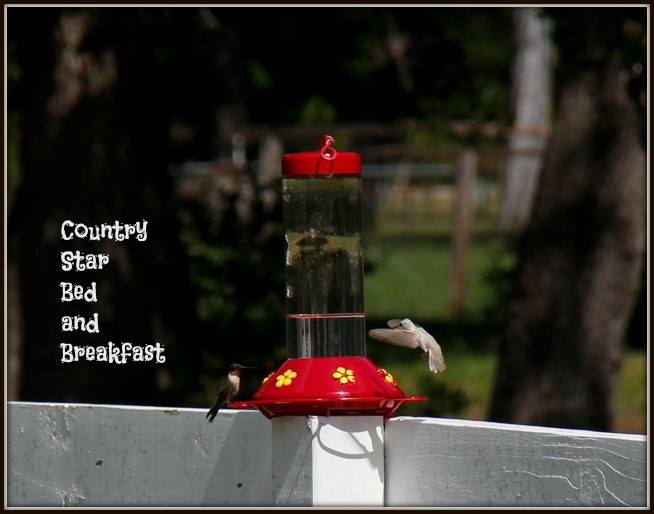
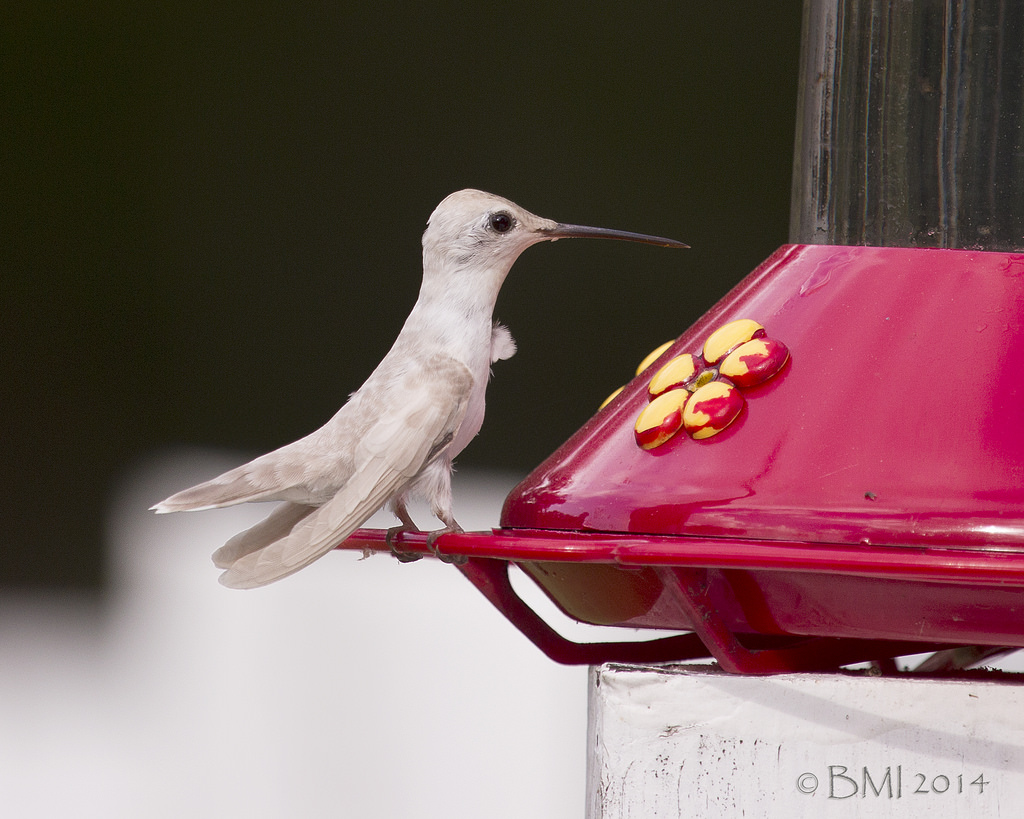
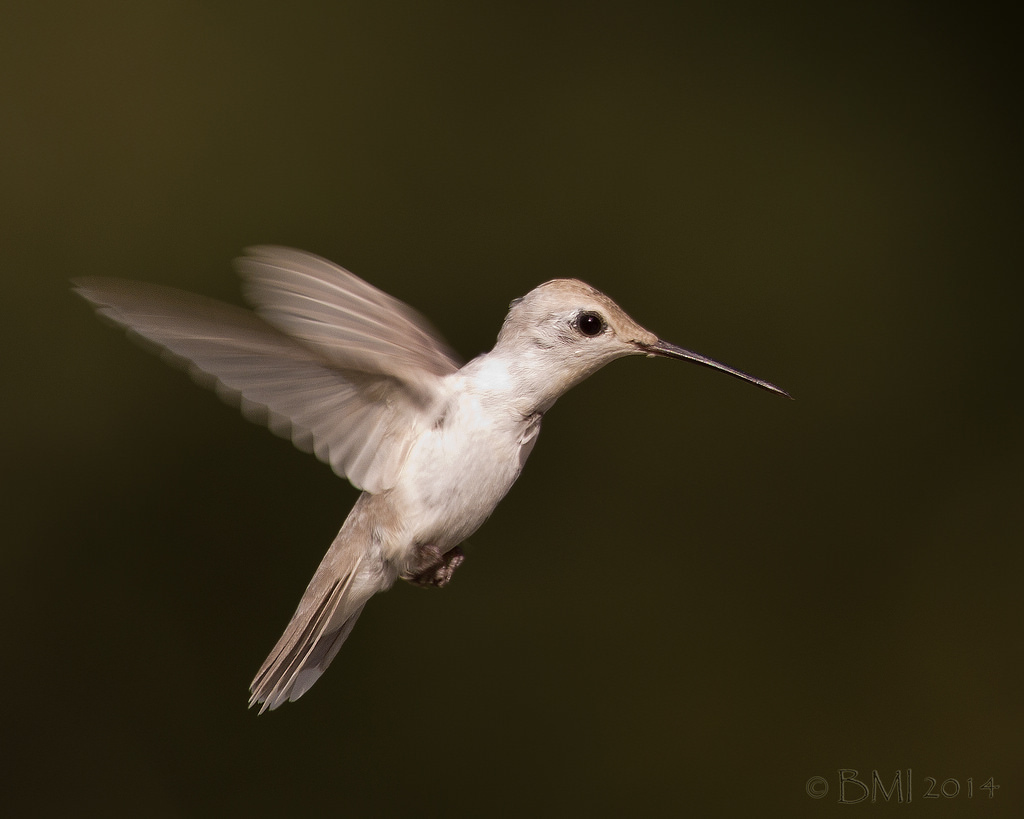
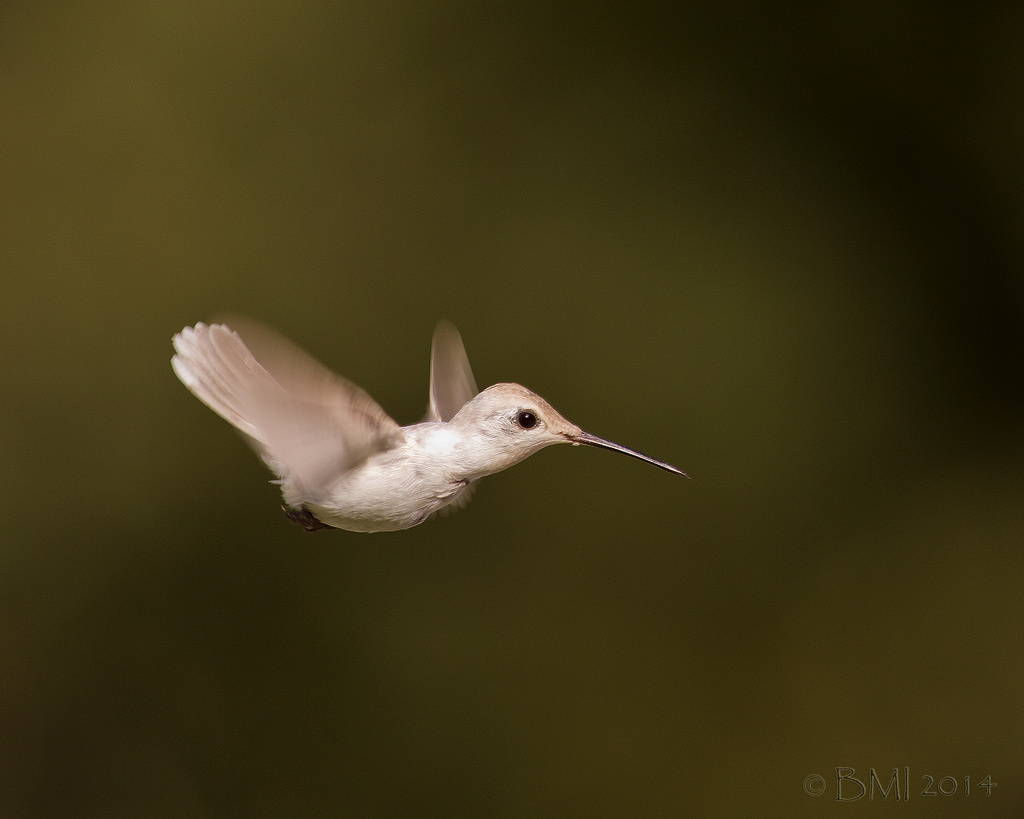
Meet Aggieland’s “Angel,” the rare white hummingbird whose story was chronicled earlier this week, as captured by Waco photographer Dr. Spencer Moore this week at the Country Star Bed and Breakfast. Dr. Moore is one of several Brazos Valley area photographers who have visited the Country Star this week for the opportunity to see this marvelous wonder of nature who has appeared each day since Saturday, August 16. See more photos of Angel and other subjects documented by Dr. Moore at his website, Dr. Spencer Moore Photography, or read his first-person observations as shared with Houston Chronicle science writer Eric Berger.

(Credit: Dr. Spencer Moore, http://www.drspencermoorephotography.com/)

(Credit: Dr. Spencer Moore, http://www.drspencermoorephotography.com/)

(Credit: Dr. Spencer Moore, http://www.drspencermoorephotography.com/)

(Credit: Dr. Spencer Moore, http://www.drspencermoorephotography.com/)

(Credit: Dr. Spencer Moore, http://www.drspencermoorephotography.com/)

(Credit: Dr. Spencer Moore, http://www.drspencermoorephotography.com/)

(Credit: Dr. Spencer Moore, http://www.drspencermoorephotography.com/)

(Credit: Dr. Spencer Moore, http://www.drspencermoorephotography.com/)

(Credit: Dr. Spencer Moore, http://www.drspencermoorephotography.com/)

(Credit: Dr. Spencer Moore, http://www.drspencermoorephotography.com/)

(Credit: Dr. Spencer Moore, http://www.drspencermoorephotography.com/)

(Credit: Dr. Spencer Moore, http://www.drspencermoorephotography.com/)

(Credit: Dr. Spencer Moore, http://www.drspencermoorephotography.com/)

(Credit: Dr. Spencer Moore, http://www.drspencermoorephotography.com/)

(Credit: Dr. Spencer Moore, http://www.drspencermoorephotography.com/)

(Credit: Dr. Spencer Moore, http://www.drspencermoorephotography.com/)

The Beauty of Rare Creatures and Social Networking

Science truly is all around us. The secret lies in being a Noticer — a term I’ve referenced before in this blog. And it’s collaborative by nature, too. (By the way, there’s an intended pun there. Read on to see. Oops, I did it again — ha!)

OK, enough with the cheesy humor and on with the real story. This past Saturday, Country Star Bed and Breakfast owners Cher and Doug McHan were shocked by an amazing sight at one of their property’s bird feeders — a white hummingbird. Albinism, a genetic condition that results in a lack of pigmentation in the skin, hair, scales or feathers of an animal, has been documented in many different species throughout the animal kingdom. When it comes to hummingbirds, most people have seen the more common jeweled-green and ruby-throated varieties, but this guy (or gal) — who’s more specifically a leucistic hummingbird, versus the extremely rare albino version characterized by pink eyes and feet — is novel by any standard, especially here in Aggieland.

Armed with her trusty sidekick — the Canon Rebel T4i camera she regularly uses to document the establishment’s most loyal visitors (deer) and other happenings for the B&B’s Facebook page and website — Cher snapped a few quick shots and posted them on social media. She also reported it to a white hummingbird banding website she found.

(Credit: Cher McHan.)

(Credit: Cher McHan.)

Saturday close-up. (Credit: Cher McHan.)

Saturday close-up. (Credit: Cher McHan.)

In short order, Cher’s Facebook friend David Harkins (a 1984 Texas A&M wildlife and fisheries sciences graduate) advised her to alert iNaturalist.org and the Birds of Texas Facebook group. He also put her in touch with his own friend, photographer Bill Morris, who visited the Country Star Monday to document the exceptional find. Meanwhile, Cher’s cousin, Doreen White, gave it a name: Angel.

(Credit: Bill Morris.)

(Credit: Bill Morris.)

(Credit: Bill Morris.)

(Credit: Bill Morris.)

(Credit: Bill Morris.)

(Credit: Bill Morris.)

Say what you will about social media’s intrusion into society, but so often it uses its powers for good. In this case, it helped put the exclamation point on that extraordinary in the everyday we talk about in our boilerplate. Good bull, er, hummingbird!

See additional images courtesy of Waco photographer Dr. Spencer Moore here.

(Credit: Cher McHan.)

(Credit: Cher McHan.)

Science: There’s a Magic to It

“It’s magic!”

It’s hard to hear yourself think, much less anything else, in a classroom full of sixth-graders, but that excited shriek caught my attention.

YAP_demo_PhysicsI was taking photographs of a Physics Show demonstration for the Youth Adventure Program (YAP) in the Mitchell Physics Building last month. The kids were in awe over a tiny cube-shaped magnet that was floating in midair around a circular disc. And indeed, it gave the appearance of something on the supernormal side of things.

“It’s not magic – it’s physics,” noted Dr. Tatiana Erukhimova, senior lecturer and champion of the Department of Physics and Astronomy’s premier outreach extravaganza.

Technically, that’s true. We actually were witnessing the principles of superconducting levitation at work. Superconductors expel magnetic fields, so when the disc is cooled to its point of superconductivity (with the help of some liquid nitrogen), the repulsion is so strong that the magnet appears to be suspended in air.

Science may be the fabric of what we know as “magic,” but it takes a lot of creativity Tatiana_YAP(and perhaps some charisma, too) to capture an audience’s imagination using only everyday objects, especially when that audience is hyperactive pre-teens. People like Tatiana, and also Dr. James Pennington who spearheads the Department of Chemistry’s Chemistry Roadshow, are masters of this.

To me, there’s a little bit of magic in that.

On the Other Hand

THIS JUST IN: Scientists are normal! For starters, just like you and me, they take the occasional vacation. That being said, I don’t know many whose curiosity ever takes the occasional break.

As proof, I respectfully submit Exhibit A — a Facebook posting from Texas A&M University astronomer Nick Suntzeff, documenting a curious find from his travels in Croatia this month. I’ll let you be the judge, from the history to the actions and their motivations, but for me, there’s no debating that Nick has a wonderful way with words!

* ~ * ~ * ~ * ~ * ~ *

City seal of Trogir, Croatia. (Credit: Nick Suntzeff.)

City seal of Trogir, Croatia. (Credit: Nick Suntzeff.)

“I was intrigued with the city seal of Trogir in Croatia. What’s that comet all about? Well, there was a St. John buried in the city. When the Venetians set out in 1170 or so to fight the Byzantium enemies, the stopped in Trogir and sacked it. They stole all the relics of the saint, except they could not carry the whole damn sarcophagus of St. John — so they cut his hand off because it had the bishop’s ring. The hand was carried back to Venice. But the fleet suffered some divine intervention of a storm or plague or fleas. Anyway, Trogir recouped and demanded their stuff back, which the Venetians gave, except for the hand, which they felt they could care for better. On the eve of the feast of St. John (according to the article by A. Marinkovic), ‘the hand flew back to Trogir followed by a comet and helped by angels, and was found in the cathedral of Trogir, laid on the top of the tomb in clean linen.’

“They don’t make miracles these days like they used to. A dead hand with a ring followed by a comet and a squad of angels? Now, that I would notice as an astronomer. Even using IDL [Interactive Data Language].”

Earth to Teachers

As one of the rotating images within its website header teases, what has 72 feet, covers 3,000 miles in 16 days, can earn 3 graduate hours of credit, and is more fun than summer vacation when you were a kid?

The answer is G-Camp, an outreach program for teachers offered through the Department of Geology and Geophysics in the College of Geosciences at Texas A&M University. As the ultimate in immersive summer extravaganzas, the two-week camp sets off for a variety of sites across Texas, New Mexico and Colorado, teaching the principles of geology in the field by allowing participants to explore and experience first-hand the processes and environments of planet Earth from past to present.

Texas A&M Center for Mathematics and Science Education research scientist Dr. Carolyn Schroeder serves as one of G-Camp’s instructors. Prior to coming to Texas A&M, she taught earth science in Texas public schools for 30 years, earning Texas Earth Science Teacher of the Year honors in 1986. This past year, she returned to the classroom, teaching introductory geology courses at Texas A&M in addition to her duties with CMSE, which include serving as director of the Texas A&M-College Station Regional Collaborative for Science.

Our G-Camp tour guide, Carolyn Schroeder, pictured here at Otto's Point, Colorado.

Our G-Camp tour guide, Carolyn Schroeder, pictured here at Otto’s Point, Colorado.

“Once you have taken a field trip with a geologist, you are hooked for life,” Carolyn says. “That’s what happened to me on my first one with Dr. Mel Schroeder back in 1974, and I continue to love learning about geology and sharing that love with others, both through the classes and workshops that I teach and by informal means as well.”

Consider this your two-part vicarious pictorial education, courtesy of Carolyn and G-Camp 2014! While you’re waiting for Part 2, feel free to stop and smell/see the flowers Carolyn experienced along the way and/or follow the group on Facebook for bonus pictures and information, if not points.

Winning Teams

In a higher education news cycle so often dominated by doom and gloom, it’s nice when messages cross my inbox that clearly illustrate the fact that lifelong learning is a labor of love of both discipline(s) and students of all ages.

Case in point: Each year, our Educational Outreach and Women’s Programs Office hosts about a dozen events designed to increase awareness of and interest in STEM, another major higher education news buzz word. The biggest event, both in terms of sheer number of participants and bragging rights at stake, is the Texas Science Olympiad. Hosted by Texas A&M University for the past 13 years, this rigorous academic contest is part of a broader national competition designed to test students’ individual and collective knowledge in areas spanning the STEM gamut. While problem-solving skills are required, so is teamwork — on our end as much as that of the participants.

Yes, it takes a village of volunteers from across this campus and community as well as from industry. Dedicated people who devote their professional and personal talents to scheduling, setting up, staffing, judging and, in some cases, subsidizing the competition’s 56 events involving nearly a thousand people between students and their coaches. And yes, said students and coaches, along with their other teachers, administrators and families work tirelessly to prepare, but so do the event volunteers in order to ensure that everything comes off without a hitch and proceeds as required per competition rules and regulations.

In the end, the top teams and individuals in each division advance to the Science Olympiad National Tournament, but I like to think they’re all winners, given that each learns something about the representative subjects and themselves in the process. And boy, do they collectively celebrate — participants and volunteers — when one of our state winners takes it all at Nationals, which is just what Beckendorff Junior High did last weekend!

Beckendorff Junior High, 2014 National Science Olympiad Division B Champions. Oh, and it was taken by a nice man/volunteer from Lockheed Martin.

Beckendorff Junior High, 2014 National Science Olympiad Division B Champions. Oh, and it was taken by a nice man/volunteer from Lockheed Martin.

I mentioned an email at the start of this entry, so I’ll leave it to Nancy Magnussen, director of the Educational Outreach and Women’s Programs Office and of the Texas Science Olympiad, to tell the rest of this story behind the story via her update to event volunteers below. Considering that another of the week’s headlines was about leadership being the key difference between success and failure in schools, I’d say the Lone Star State is in pretty good shape with a village the likes of this one.

* ~ * ~ * ~ * ~ * ~ * ~ * ~ * ~ *

Howdy all!

I just returned from the 2014 National Science Olympiad in Orlando, Florida, and I wanted to let you know how proud I am of all of you and your dedication to this program. Your level of commitment and care you displayed in preparing your events definitely was apparent in the rankings of our four Texas teams at the National competition — our students were AMAZING!!

How amazing, you might ask? Well, simply put, they were INCREDIBLE!!!

Our Texas middle school team, Beckendorff Junior High, in a field of 60 teams from across the country, WON!!!!! They are the 2014 National Science Olympiad CHAMPIONS!!! This was no small feat; they beat all the big powerhouse teams that win this competition year after year. The California, Ohio, New York, Michigan teams — all of them!! This is HUGE!!!! Unbelievable! They achieved this by medaling in 11 events, including three 1st place and one 2nd place events!

And the good news doesn’t stop there. The other three Texas teams that went to Nationals also did incredibly well:

— Seven Lakes High School finished 7th, medaling in eight events, including two 1st place and two 2nd place events!
— Clements High School finished 14th, medaling in six events. This is their highest placing (last year they won only one medal).
— Riverwood Middle School finished 21st, medaling in five events for their highest placing in history as well.

I have attached the final rankings from the National Science Olympiad so you can see how the teams placed in the individual events. . . . Again, I want to thank each of you for the part you played in preparing these four teams for National competition. We have come such a long way in Texas with this important science education program in such a short time. I truly mean it when I say that you folks are the BEST!!!

With great pride in our Texas Science Olympiad teams (YOU and the kids!),

Nancy

Texas, Our Texas

“When I moved here to East Texas over three years ago, I was a little homesick. I grew up in California and also worked and lived in Chile most of my life, and I never lived far from the ocean. Last year when I was in West Texas, I met an elderly woman who had grown up on a ranch west of Eldorado. She said that whenever she leaves Texas, she too feels homesick — not for the ocean but for the sky. I asked her why. She said that growing up on a ranch, especially at night, you have the sky from one horizon to the other horizon, and anywhere she goes, she feels penned in by city lights, fences and city buildings.

“The sky is really a part of the history of Texas. It is in our flag. It is in our music. It is really in the soul of Texas. And I am proud to be here at Texas A&M, helping to bring the sky back to this part of Texas.”

* ~ * ~ * ~ * ~ * ~ * ~ * ~ * ~ *

On December 4, 2009, Texas A&M University astronomer Nicholas B. Suntzeff put the icing on the celebratory cake with this absolutely perfect big-picture analogy, an excerpt of his remarks presented as part of the official dedication of the George P. Mitchell ’40 Physics Building and the George P. and Cynthia Woods Mitchell Institute for Fundamental Physics and Astronomy.

Nearly five years later, I think his grandiose words are just as fitting in capturing the magnificence of another stately project, Between Heaven and Texas, executed by another master of observation, Wyman Meinzer, the Official State Photographer of Texas whose life’s work involves appreciating and accentuating the Lone Star State’s beauty and sharing it with the world. If you haven’t already had the pleasure, meet Wyman and his most recent, resplendent take on Texas, our Texas.

Wyman Meinzer – Between Heaven And Texas from Wyman Meinzer on Vimeo.

Moon Dance

By now, I’m reasonably certain you’ve all seen just about all there is to see in the way of beautiful photographs depicting the recent total lunar eclipse. So wonderful that so many not only witnessed one of astronomy’s rare treats but also took the time to document it for posterity. In my case, it was with an iPhone camera to appease sleeping children and more than a little curiosity — theirs and mine. Technological innovation and one’s inner scientist make for a powerfully motivating combination!

But just in case you missed what I’d consider to be among the cream of the crop, here’s a double-shot of Lone Star State perspective, from wildflowers to Aggies. Everything’s bigger in Texas, if not better!

After staying out till 6 a.m. on April 15, photographing the different phases of the eclipse over a spectacular field of bluebonnets near Ennis, Texas, Mike Mezeul II created this fabulous composite that was making the rounds on Facebook, among other places. Prints are available at http://tinyurl.com/nkazyum. (Credit: Mike Mezeul II.)

After staying out till 6 a.m. on April 15, photographing the different phases of the eclipse over a spectacular field of bluebonnets near Ennis, Texas, Mike Mezeul II created this fabulous composite that was making the rounds on Facebook, among other places. Prints are available at http://tinyurl.com/nkazyum. (Credit: Mike Mezeul II.)

With a lot of forward planning and a solid nap the prior afternoon, Matai Chiang Wilson ’13 was able to stay up all night to photograph the five-hour-long eclipse as it occurred in conveniently clear skies over the Clayton W. Williams Jr. ’54 Alumni Center on the Texas A&M University campus. To see more of Wilson’s work, go to https://www.facebook.com/matai.c.wilson?fref=ts. (Credit: Matai Chiang Wilson.)

With a lot of forward planning and a solid nap the prior afternoon, Matai Chiang Wilson ’13 was able to stay up all night to photograph the five-hour-long eclipse as it occurred in conveniently clear skies over the Clayton W. Williams Jr. ’54 Alumni Center on the Texas A&M University campus. To see more of Wilson’s work, go to https://www.facebook.com/matai.c.wilson?fref=ts. (Credit: Matai Chiang Wilson.)

A Royal Reign in Peril

Texas A&M Center for Mathematics and Science Education (CSME) researcher Dr. Craig Wilson made international headlines once again last week with his dire predictions concerning this year’s Monarch butterfly numbers, which are at an all-time low across the Brazos Valley and nationwide.

Ever the idealist, Craig appeals below to the altruistic nature lover in all of us with a personal pitch that harkens back to another resilient Lone Star State crusader, Lady Bird Johnson, whom we have to thank for one of Texas’ proudest, most beautiful and time-honored rites of spring — Texas wildflowers.

* ~ * ~ * ~ * ~ * ~ * ~ * ~ * ~ *Monarch_Resting

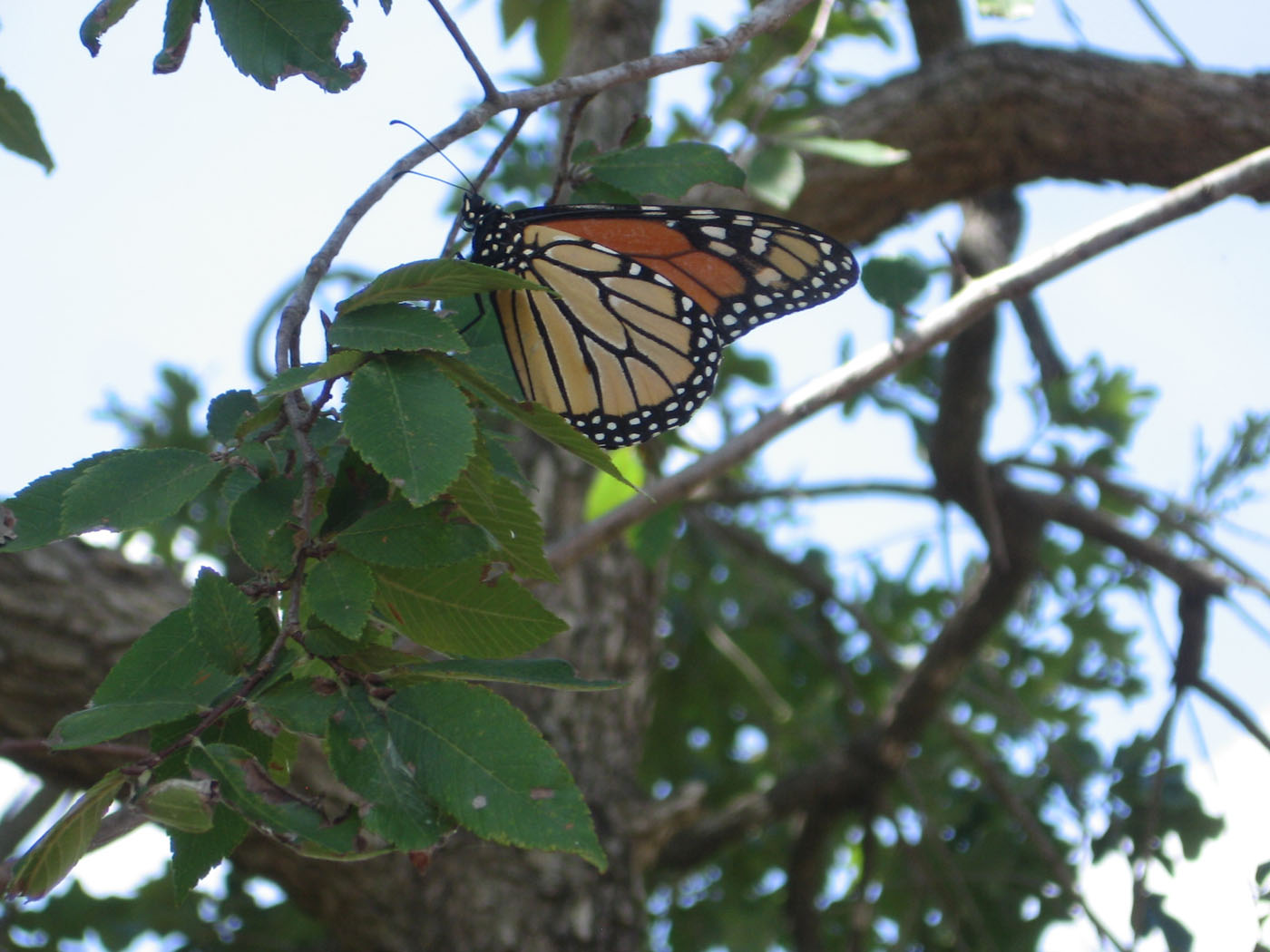
In the fall of 2013, the number of adult Monarchs migrating through College Station that were netted and tagged was one-fifth of the number in 2012, coinciding with the data gathered nationwide showing that numbers were way down. This has been confirmed at the overwintering sites in the state of Michoacan, Mexico, where numbers were at historic lows. The combined areas sheltering Monarchs totalled only 1.65 acres, compared to a high of 45 acres in 1996. We now await the arrival of the first adults of the spring migration north, suspecting that they will be fewer in number. Last year, the first recorded sighting in College Station was on March 19 in the USDA People’s Garden on Holleman Drive that is open to the public.

Monarch Butterflies have reigned supreme amongst insects with a long distance migration that is the marvel of scientists, an increasingly aware population of civilian scientists and the public in general. But their reign is under the severest of threats since records have been kept, with numbers plunging so low that they may have reached a point where recovery may be impossible, in spite of the reproductive resilience of insect species that lay enormous numbers of eggs.

Who or what is to blame? There are a number of culprits. As the adults migrate south, they have to consume large quantities of nectar from wildflowers that are fewer in number because of use of herbicide in large-scale crop farming, especially in the Midwest, the biggest threat. In addition, more land has been brought into cultivation that formerly would have supported wildflowers and other wildlife. Then there is the severe drought and wildfires. Each of these events — individually and in combination — depletes available flowers and their nectar, which the Monarchs drink and then convert into lipids to help the butterflies survive overwintering.

What can be done nationwide? Large-scale farming is not going away, so a practice of leaving some crop acreage free of pesticides (note that this term is inclusive of herbicides and insecticides) needs to be increased. Perhaps interstate wildflower corridors could be established that would extend Lady Bird Johnson’s vision for the verges of Texas nationwide. Likewise, mowing of these same verges should be left until after the wildflowers have bloomed and seeded. This would also help the establishment of milkweed plants that are the sole source of food for Monarch larvae (caterpillars) during the migration north.

What can be done locally? Citizens can plant milkweed and other butterfly attractant plants in their gardens — simple actions viewed by some as futile, but every little bit helps, and it raises awareness. Since last spring, the Cynthia Woods Mitchell Garden (the Texas A&M campus’ first rooftop garden located at the George P. Mitchell ’40 Physics Building and open to the public) has been planted with more than 400 milkweeds, and four Bryan elementary schools also have established Monarch butterfly gardens. Sadly, the harsh winter means that the milkweeds have yet to start growing, so there may not be enough foliage to feed any Monarch caterpillars that do emerge from eggs.

The situation is dire.

THIS JUST IN: There’s an excellent front-page feature story on the subject by John Rangel in today’s Battalion.

Monarch_DamagedWing

What Moves a Monarch Man

A recent Slate.com article reporting the lowest level on record of Monarch butterflies reaching Mexico this year reminded me of a related story Texas A&M Center for Mathematics and Science researcher Dr. Craig Wilson had shared in October prior to agreeing to be a contributing author to this blog. (Incidentally, roughly a month before the Jan. 29 Slate article ran, Craig also had been featured in a PBS piece for his expertise on this very scenario he had forecasted last spring.)

(Credit: Shutterstock.)

(Credit: Shutterstock.)

You see, among oh, so many other things, Craig is a valiant champion of all things nature and educational — subjects he views in constant and quite purposeful tandem. When it comes to butterflies, he is the host and caretaker of his own official Monarch Waystation here in Aggieland, known as the USDA/ARS People’s Garden and created as a outdoor classroom designed to get students interested in science and possible related careers. And last spring, he singlehandedly planted milkweed and other butterfly-friendly varieties in the Department of Physics and Astronomy’s Cynthia Woods Mitchell Garden. Because it’s the right thing to do, for the children and the butterflies.

After watching that PBS clip as 2013 metamorphosized into 2014, I had emailed Craig to tell him I enjoyed seeing that he has a kindred spirit way down south and that I could totally see him (Craig) breathing life into a Monarch here in Texas. His response?

“Funny you should say that, but I revived a frozen Monarch on a playground in El Reno, Oklahoma several years ago and had it flying around a middle school classroom. The kids made a box for it and provided sugar water, and I transported it with me to Corpus Christi, where I had a conference the next week, and released it in a garden there, sending photos back to the students en route. Helping the migration, one Monarch at a time…”

Texas A&M researcher and longtime butterfly enthusiast Craig Wilson recommends taking the long view -- as well as personal steps like planting milkweed -- toward reversing the alarming decades-long decline in overall Monarch numbers.

Texas A&M researcher and longtime butterfly enthusiast Craig Wilson recommends taking the long view — as well as personal steps like planting milkweed — toward reversing the alarming decades-long decline in overall Monarch numbers.

But I digress. I had mentioned having a past story — why don’t I just let Craig tell it in his own inspiring, firsthand words!

* ~ * ~ * ~ * ~ * ~ * ~ * ~ * ~ * ~ *

On Boss’s Day [October 16], we pay homage to our brave and fearless leader. Below is a short essay I wrote in tribute to another Monarch…

From Queen Elizabeth II to other Monarchs including Tim [Scott, Craig’s boss as one of four CMSE co-directors]:

It must be my destiny, to leave one continent behind where I pledged allegiance to a Queen, only to arrive on another where I am again ruled by a Monarch, only this time it is a butterfly.

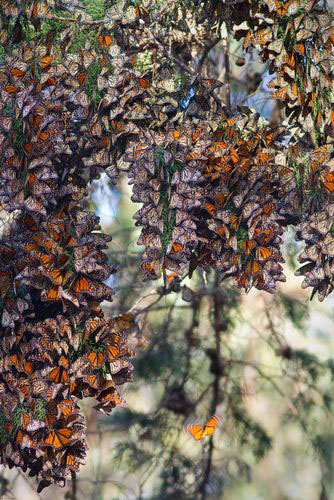
Last Sunday, I was lucky enough to be invited to a showing of “Flight of the Butterflies” in the IMAX theatre in Austin, Texas where I was enthralled by both the Monarch’s flight and plight, tracing its history through the eyes of a young boy (Urquhart) lying in the pastures above Toronto, Canada, wondering just where they flew, to the discovery near the end of his life that it was to a few acres’ nestling at 10,000 feet in the Sierras that transverse the state of Michoacan in Mexico. The wearing of 3-D spectacles was new to me, but it enhanced the experience beyond my wildest dreams as I felt myself flying with the adult butterflies, munching alongside their caterpillars and dicing with death in the form of crop sprayers, predators and loss of my habitat. But the most wondrous magic for me was to be able to watch the four-year-old girl in front of me, sitting on her father’s lap and reaching out continuously in the total belief that a Monarch would land on her tiny, precious hand. Oh, that everyone could believe.
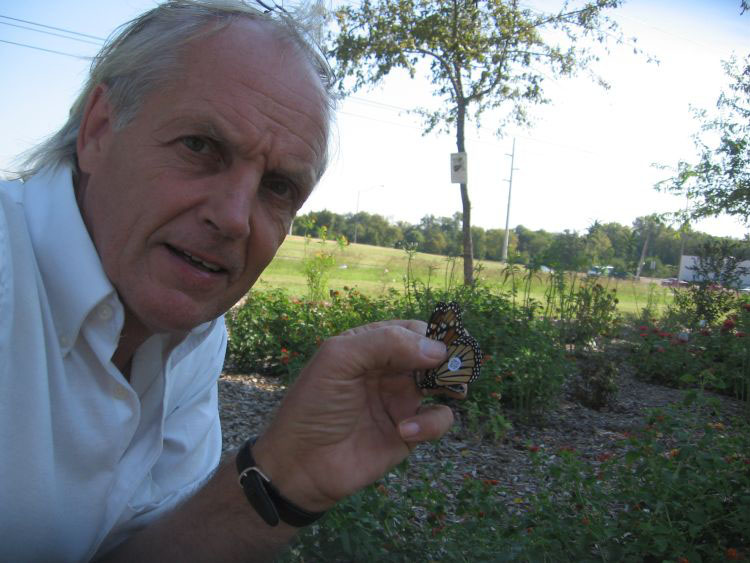
monarchs-nestingI have been enthralled by Monarchs for several years now and take part in the Citizen Science Project out of Kansas University, through which you can receive individual tags to stick on the hind wing of a migrating Monarch as it flies the 2,000 miles south from Canada in the fall to help track their movements. This is one of the world’s great migrations and, hazardous at the best of times, it has become more so of late due to a multitude of factors ranging from climate change where the extreme heat can dessicate their eggs on the journey north in the spring; wildfires that destroy wildflowers that provide nectar; loss of habitat both in U.S. and Mexico; and, perhaps most drastically, the loss of milkweed plants that are the only food source for their caterpillars.

Milkweed search and recovery has become a particular obsession of mine. I can spot a milkweed blooming on a highway verge despite going at 70 mph as I traverse the country. That necessitates a sudden but safe stop and, armed with my trusty sharpshooter, I dig below the deeply seated tuber and carry my prize back to the car to be transplanted into the USDA/People’s Garden in College Station outside my office, where I watched a female Monarch carefully depositing individual eggs on the underside of milkweed leaves yesterday. Two weeks ago, I was able to tag a male and a female — the first to arrive in our garden from Canada on their fall migration — the faded coloration of their wings and less-than-pristine condition suggesting that they did indeed have hundreds of miles on their odometers.

Naively, I do believe that, “If you plant it, they will come” — it being milkweeds that are native throughout the land over which this Monarch, I believe, should rule. It would be sad to see her go the way of George III. Perhaps, taking a literal leaf out of Lady Bird Johnson’s playbook, the north-south interstates could be planted with milkweeds and become corridors to aid the migration, but that requires a degree of cooperation and collaboration we are sorely missing currently. Would it not be ironic if a Monarch could unite this nation?

E pluribus unum…