In a Word

Don’t look now, folks, but science is on the rise, according to Merriam-Webster, which has crowned a new word king for 2013: science.

ScienceRulesRather than settling for the more traditional (not to mention highly subjective) pulse measurement of popular culture method, officials at Merriam-Webster went with metrics a little nearer and dearer to our disciplinary hearts: analytics gleaned from actual online searches at Merriam-Webster.com. The word with the greatest increase in look-ups — a whopping 176 percent, mind you — was science.

We have arrived, but now, the real work toward maximizing this opportunity begins — in true finals week fashion with a pop quiz: What are your ideas on how to get people hooked on science and related lifelong learning? Inquiring minds clearly want to know.

History Worth Repeating

THIS JUST IN: This rest-of-the-story stuff is a universally (pardon the pun) appealing thing.

One of the absolute kingpins of this genre is award-winning author and Guggenheim Fellow Richard Panek, who penned the masterful 2011 book, The 4% Universe: Dark Matter, Dark Energy, and the Race to Discover the Rest of Reality – a detailed, behind-the-scenes story of the 2011 Nobel Prize-winning discovery that the universe’s expansion is accelerating. In the book, Panek saw fit to give due credit to (among others) Texas A&M astronomer Nick Suntzeff for his early work in Chile that essentially began the field of supernova cosmology.

Yesterday, in his Last Word On Nothing blog entry, Panek shares some vintage Nick Suntzeff – precisely the kind of trademark insight Nick is known for and to which I referred in this very blog last week.

History disease. The one chronic condition we could all be so fortunate to contract, sooner rather than later. Wonder if it’s contagious, not to mention as essential to groundbreaking research as masking tape and aluminum foil?

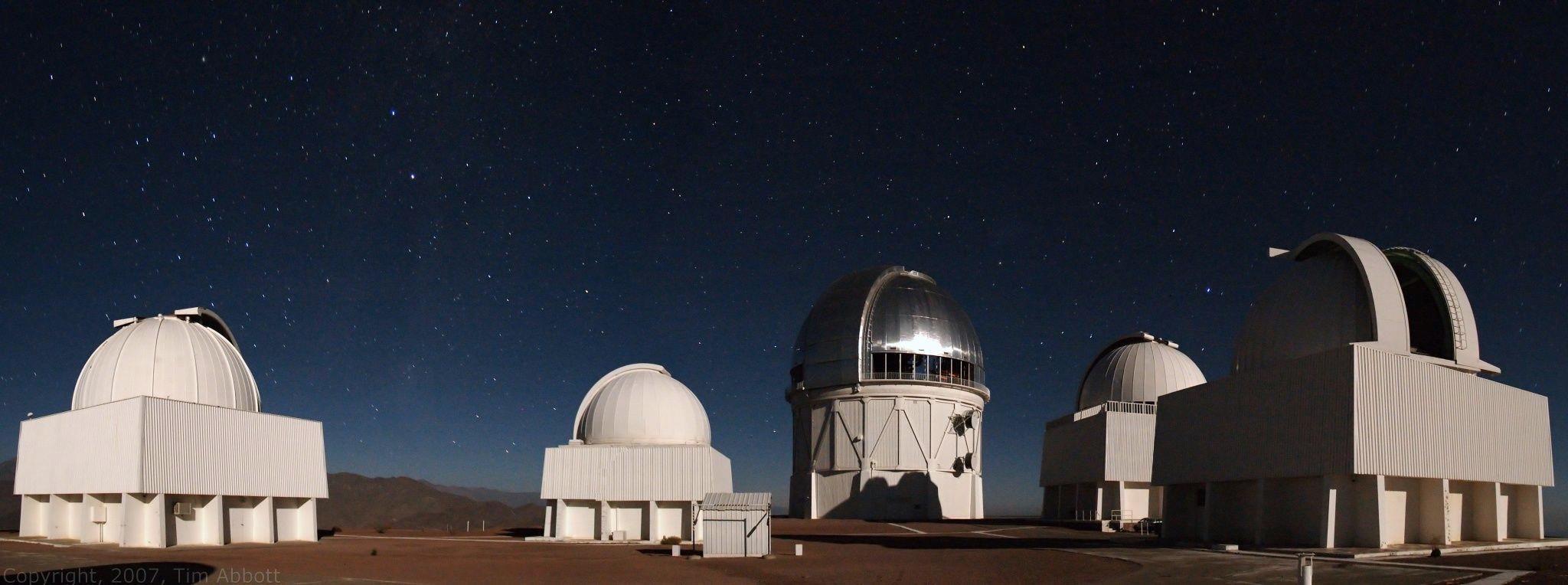
Cerro Tololo Inter-American Observatory (CTIO), Nick Suntzeff's astronomical home for 20 years prior to coming to Texas A&M. (Credit: Tim Abbott, CTIO.)

Cerro Tololo Inter-American Observatory (CTIO), Nick Suntzeff’s astronomical home for 20 years prior to coming to Texas A&M. (Credit: Tim Abbott, CTIO.)

For some additional history on Nick, check out one of the historically significant things he did as an undergraduate at Stanford that continues to educate and inspire to this day.

Yeah, he built that. But here’s how he described his contribution to elite higher education institutional history to me when I originally stumbled across the information:

“It seems not too long ago, a friend and I had no idea what we were doing, but a really supportive physics professor let us believe we could build the thing. He really was the key to this project. It is fun to see it still there at Stanford. I was amused to find out that it is well known as a romantic place on warm evenings. That is, romantic for couples, not astronomers who would be up in the dome cursing whatever is not working and drinking way too much coffee while squinting at a flickering screen and listening to totally forgettable ’60s classic rock. Not a pretty picture.”

Beats the hell outta befriending black widows, in my opinion.

Senses of Wonder

From time to time, Texas A&M Center for Mathematics and Science Education (CMSE) researcher Dr. Craig Wilson emails us about his adventures, experiences and related insights gleaned as both a scientist and a keen observer of life. Anyone who has had the pleasure of meeting (much less working) with Craig will attest to the fact that to know him is to learn from him — a delightful process definitely worth sharing. Given such, we’re pleased and honored that he has agreed to be added to the blog, Here’s hoping you enjoy his musings as much as we do!

* ~ * ~ * ~ * ~ * ~ * ~ *

Most people look but do not actually see. I stress powers of observation when working with teachers and students, explaining that observation in science means using all of their five senses and then asking questions. We need to take full advantage of the gifts we are given at birth that enable us to emerge from the womb as scientists but with an inherent ability to be artistic if we choose to develop those talents. Neither is mutually exclusive, although our education system tends to encourage a divide between left and right brain, science and art, academic and non-academic, success and failure.

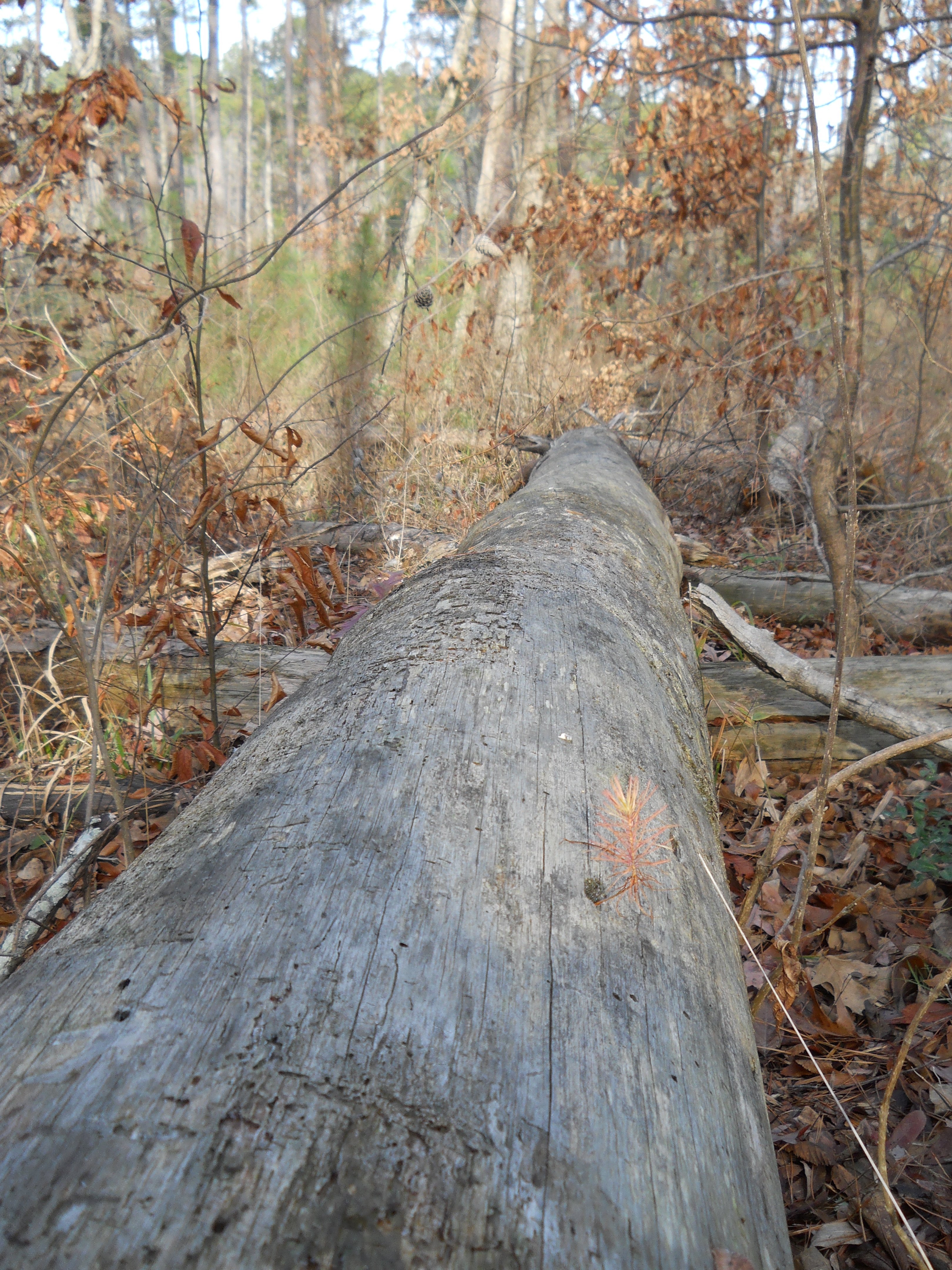
A downed 100-foot yellow pine tree on Craig Wilson's East Texas property, complete with a new pine seedling emerging from a woodpecker hole in the foreground.

A downed 100-foot yellow pine tree on Craig Wilson’s East Texas property, complete with a new pine seedling emerging from a woodpecker hole in the foreground.

For example, if you make the effort to observe it, a rose by any other name would smell as sweet, would prick your finger when you touch it, would look glorious because of its vibrant colors, would taste as delicate as its petals you may eat and would sound as quiet as a whisper as it sways in a gentle breeze, if you had the auditory powers of the greater wax moth. This moth is capable of sensing sound frequencies of up to 300 kHz – the highest recorded frequency sensitivity of any animal in the natural world.

Humans are only capable of hearing sounds of 20 kHz maximum, dropping to around 12-to-15 kHz as we age. But, do we actually listen? I have lain down in the prairie grasses of The Badlands in South Dakota to hear the wind passing through and over them. I have been fortunate to sit on beaches of the Indian, Atlantic and Pacific Oceans and a few days ago, the Caribbean, to hear waves crash or roll gently on shore, each with a distinctive sound.

We can all touch people by our actions, but when we touch or feel, we cannot match catfish that are probably the most finely tuned creatures on Earth, as their smooth skin gives them a heightened sense of touch, and they are rumored to be able to detect earthquakes days in advance. When I have actually felt the most is when I was privileged to hold each of our children as soon as they were born in Serowe, Botswana, for each touched my heart in return.

Craig Wilson, during his descent through the cloud forest at the base of Mt. Kilimanjaro that inspired the following Haiku: Why Climb Trees? Why? To touch the sky! Why? For all the world to see... One must climb a tree!

Craig Wilson, during his descent through the cloud forest at the base of Mt. Kilimanjaro that inspired the following Haiku:
Why Climb Trees?
Why? To touch the sky!
Why? For all the world to see…
One must climb a tree! 

Bloodhounds have the keenest sense of smell of any dogs, as their noses are 10-to-100 million times more sensitive than a human’s. That said, it always intrigues me that when humans encounter certain smells, these odors can trigger a memory perhaps from our youth — for example, the inside of a damp tent that transports me back in time to a hillside in Wales where sheep had invaded our tents while we were away climbing Idwal Slabs. Can a dog do that?

For eyesight, I pick the dragonfly, possibly the most formidable aerial hunter among insects whose eyes are so big that they cover almost the entire head and provide a full 360-degree field of vision. These eyes are made up of 30,000 visual units called ommatidia, each one containing a lens and a series of light sensitive cells. Their eyesight is superb, whereas humans look but rarely see what may be obvious just a few feet in front of them. For example, I can walk down a street in Mayaguez, Puerto Rico and see glorious concrete buildings from the early 1900s with ornate friezes three stories up with ferns growing from cracks but never, ever glance in a shop window to see merchandise.

The average person has about 10,000 taste buds. That number may seem like a lot, but it pales in comparison to, yet again, the catfish that has taste buds not only in its mouth but all over its body, numbering more than 100,000, with some large catfish having as many as 175,000. While in Mayaguez, I tasted pasteles (pork dumplings) for the first time, but I prefer the taste of freedom that my job allows, enabling me to interact with incredible people from friends to research scientists to students with special needs.

DreamFinally, a question for you! Does the seldom-used common sense (7th Sense) negate the existence of extra sensory perception (ESP) or the 6th Sense? I wonder?

If you have a few spare moments, this video appealed to me.

Got a Little Story for Ya, Ags

As a writer, I do so love a good story and those who wield both the appropriate subject matter and the flair for its proper delivery.

One of the best absolute naturals in all above respects is Texas A&M astronomer Nick Suntzeff, who I describe to people as a marketer’s dream for good reason. Beyond his ease with media representatives, administrators and officials, and external visitors and general audiences, he’s also a master at breaking down the subject at hand and explaining why it matters. And in going the extra mile.

I offer a recent example — a follow-up email to Battalion reporter John Rangel, thanking him for a recent story:

John,

I would like to congratulate you on the article in The Batt on the most distant galaxy. You nailed the science and gave a feeling for the excitement of the discovery. Great job!

By the way, there are some points to this discovery that you, as an engineering student, may enjoy. It is difficult to define what is distance in astronomy because the universe is expanding, and the grid by which we measure distances is also stretching at the same time. So for me the best way to understand distance is just what you did — give it in units of how much time it took for light to get here compared to the age of the universe. However, you will see some articles refer to the distance to this object as 30 billion light years or so. This is the way astronomers would measure it, but this distance is not intuitive. Imagine we are in our galaxy in the early universe and we are looking at this distant galaxy. It would be very close to us because the universe is so small. Imagine putting a 3-D grid on this early universe and put our galaxy at one corner and the distant galaxy at another corner. Now run the universe forward to today. The universe has stretched a lot (expanded, if you will). Our galaxy and the other one are still at those corners, but the grid has expanded by a factor of 9 now. That short distant that separated us and that galaxy has now stretched into about 30 billion light years — the co-moving distance we call it. So you will also hear astronomers quote distances that are greater than the age of the universe.

How can something be farther away than the age of the universe (in today’s time) and we can still see it? Well, the weird thing is that we will never see that galaxy when it is today age — 13.8 billion years old. We can only see it now, but as the universe evolves, the galaxy will actually disappear from our universe or perhaps more to the point — will disappear from our vision.

The other point is that although galaxies appear to be moving away from us and this appears as a Doppler shift, it is actually not a Doppler shift. It is space stretching. Nothing is actually moving. The motion looks like a velocity and a Doppler shift, but there is no kinetic energy involved. If there were, galaxies near the edge of the universe would have a ridiculous amount of energy because they are moving close to the speed of light.

Edwin Hubble, who discovered the expansion of the universe, was careful never to call this apparent expansion a velocity — he called it a cosmological redshift which is what astronomers should also call it, and if they don’t, well I will go kick their butts.

Anyway, sorry for the long email about your great article.

cheers, nick

I don’t know about John Rangel, but for this writer, the initial interview is typically a formative experience. I remember well my first trip to Dr. Suntzeff’s Texas A&M campus office — a veritable time capsule spanning the high points of astronomical history as well as his career, which includes 25 years at Cerro Tololo Inter-American Observatory in Chile. I was interviewing him for a piece on Albert Einstein’s cosmological constant — Einstein’s self-described “biggest blunder” which he predicted in 1917 as the proverbial glue holding together the theory of a never-changing universe that Edwin Hubble’s 1929 discovery of the universe’s expansion later debunked. (Incidentally, in a Kevin Bacon-esque six-degrees-of-separation constant, Hubble served as mentor to Allan Sandage, who in turn is the one who encouraged Dr. Suntzeff to focus on Type Ia supernovas — specifically their brightness — to measure precise distances, which is how Dr. Suntzeff came to help discover dark energy and roughly 75 percent of the universe. But that’s a whole ‘nother story!)

After posing a basic equation-type question to gauge my level of astrophysical knowledge (essentially negative infinity), Dr. Suntzeff took great pains to explain not only the equation and the basic physics behind it, but also each and every piece in his collection, in addition to the actual research I was there to discuss. And so began an educational relationship across subsequent visits and stories, typically supplemented with emailed anecdotes and other means of follow-up insight about astrophysics and oh, so much more that has always served to enlighten or entertain. (Ask him sometime about saving Alan Alda’s life while down in Chile or about being school mates with Robin Williams — yes, that Robin Williams — or about the time he made international headlines for discovering nothing! Yeah, I have hundreds of these, as does he.)

Bottom line, it all goes to prove my long-held theory that most professors first and foremost are born educators and — big surprise — people, too. Their areas of expertise are vitally important, but somehow lost amid all that focused excellence and relentless drive is their intrinsic motivation and passion for knowledge generation, big-picture dreams and doing what they love and want you to love, too. Or at the very least understand in some tangible way.

Trust me, it’s a great story well worth the time it takes to read. Even better if you get the chance to hear it in person.

Nick Suntzeff claims no one believes that he knew Robin Williams in high school and that the two hung out together, but this image from the Redwood High School 1969 Yearbook offers actual proof from the days long before fame for both or the invention of Photoshop! Redwood is located in Larkspur, California.

Nick Suntzeff claims no one believes that he knew Robin Williams in high school and that the two hung out together, but this image from the Redwood High School 1969 Yearbook offers actual proof from the days long before fame for both or the invention of Photoshop! Redwood is located in Larkspur, California.

Why I Ask Why

I read the other day that the average 4-year-old asks 437 questions a day.

As a mother of three young children (the youngest being a 3-year-old whom I’d consider advanced for his age, if not so much in potty training, then in this department), I can identify. As a journalist who works day in and day out with scientists who poke, probe and ponder for a living, I can also appreciate.

photoSo much value in simple curiosity and in being persistent enough to follow this innate gift to its fruition, whether the outcome ends up being success, failure or something in between. In recognizing and relating to the beauty in the build-up. The end game in the before, during and after insight. The process in and of the pursuit. The long-term possibility, even in the face of setbacks or sidetracks.

In so many ways, scientists and journalists have a lot in common. Both seek to raise awareness and convey information, ideally answers and solutions. In both worlds, accuracy is paramount – or should be. In absence of it, the product/audience is cheated, as is the profession.

Years ago, I got the opportunity to sit in on a PBS interview with 1986 Nobel Prize in Chemistry recipient Dudley Herschbach, who recounted being asked by a fifth grader whether he thought scientists were made or born. Dr. Herschbach’s answer? “I’m sure scientists are born just like everyone else; however, the difference is, they’re not unmade. Every little kid is a natural scientist because they’re naturally curious. They also want to understand things they see, so they ask lots of ‘why?’ questions. That’s what science is.”

Dr. Herschbach went on to describe research as child’s play, equating it to the way a child first learns a language: “A child isn’t worried about getting the words right or wrong, so they just imitate and they play and they experiment and they learn. That’s the way you need to do science.”

GeniusOut of the mouths of babes, not to mention a Nobel laureate: The world depends on 4-year-olds asking questions. And on us retaining our inner 4-year-old. Well, maybe minus that back-talking part! I bet even Dr. Herschbach’s mother would agree.