Game-Changing Gambles

The Giant Magellan Telescope picked up Texas-sized momentum last month with a $50 million pledge from the University of Texas. Although it wasn’t our announcement, I found myself nearly as excited as I was on July 22, 2011, when I received the following email from Texas A&M astronomer Nick Suntzeff:

Shana, I don’t know if we can announce this yet, but this is a huge achievement! Ask Darren about when this can be made news.

The following news, relayed by Darren DePoy, from the latest GMT Board meeting included the following:

“The GMT1 primary mirror is now at 50nm rms figure. The goal is ~30nm (I think), but even at this level it is the best figured/polished large aspheric optic ever made and probably could be used as is. This is extremely good news!”

This is fantastic! The technology developed by Roger Angel has worked, and we now have a green light to start the other mirrors.

This made my day!

cheers nick

(Credit: Giant Magellan Telescope Organization.)

(Credit: Giant Magellan Telescope Organization.)

I’m definitely no scientist, but I’ve always found the GMT’s design beautifully intriguing and absolutely genius because of its originality and flexibility. The scientists behind it had the forethought (no doubt because they knew just how hard a financial sell it would be) to make it operational in stages, allowing for results (pretty sweet ones) even if it never raises enough funds to be fully completed. The fourth mirror represents that critical stage — the turning point. With UT’s pledge, it’s as good as cast, ensuring that, even if the worst comes to pass, the world at least will have more than leftover parts and a shell of a dream (see Texas Superconducting Super Collider) to show for all the hard work and previous investment.

In January, the GMT cleared two major hurdles, passing both its detailed design review and being approved to enter the construction phase. Of course, approval is one thing; having the financing to do so is quite another.

They say timing is everything, and Texas’ bold move couldn’t have happened at a better one. I can’t help but think of George P. Mitchell ’40 and how happy he would be to finally see the day when his home state got off the dime (figuratively and literally), following his own $33.25 million lead in that vital international leadership regard as he saw it.

Mitchell believed in the GMT when few else beyond the project’s originators did. Thank goodness for people like him — an individual not only with the financial wherewithal but also the vision to see the GMT’s potential just as clearly as the scientists behind it. Truly remarkable and heady stuff. And all the more fitting that it’s a pledge from one of his home institutions that likely puts it over the construction hump. Whoop!

So many said it would never get this far. And that such a risky design relying on not one but seven parabolic mirrors that put the double-capital Ps in precision polishing (in addition to being unprecedentedly huge) would never work.

I think as the GMT enters construction, its marvel will become more apparent. It’s hard to fundraise in the abstract, long-term, but once the project’s partners have a tangible object and definable, measurable progress underway, it will be far easier to visualize the possibility-laden bandwagon onto which these institutions are imploring donors as well as global science to jump.

Oh, and that first mirror and all its precision-polishing-representing-pioneering-scientific-achievement glory that Dr. Suntzeff was so ecstatic about in his email? It’s named for Mr. Mitchell. Oh, the places it will go and things it will help see!

The Giant Magellan Telescope's first two mirrors, pictured last August within the University of Arizona's Steward Mirror Lab. Known as GMT1 and GMT2, they are named for George P. and Cynthia Woods Mitchell, respectively. GMT1/"George" (left) is packaged and ready to head to Chile -- a feat of logistics and exercise in trust by any stretch! Each of the GMT's seven mirrors will travel by truck down Interstate 10 to a port in California, then via ship to a port near Las Campanas, Chile, and finally via another truck up a mountain in the Atacama Desert near the existing twin Magellan telescopes. By comparison, the mirrors for those are 6.5 meters in diameter, while each GMT mirror measures 8.4 meters.

The Giant Magellan Telescope’s first two mirrors, pictured last August within the University of Arizona’s Steward Mirror Lab. Known as GMT1 and GMT2, they are named for George P. and Cynthia Woods Mitchell, respectively. GMT1/”George” (left) is packaged and ready to head to Chile — a feat of logistics and exercise in trust by any stretch! Each of the GMT’s seven mirrors will travel by truck down Interstate 10 to a port in California, then via ship to a port near Las Campanas, Chile, and finally via another truck up a mountain in the Atacama Desert near the existing twin Magellan telescopes. By comparison, the mirrors for those are 6.5 meters in diameter, while each GMT mirror measures 8.4 meters. (Credit: Joe Newton.)

Life Forces and Legacies

Last week Texas A&M University hosted a familiar face and cherished friend in one Robert M. Gates, 22nd United States Secretary of Defense and 22nd President of Texas A&M, who was here on campus to discuss his new book, DUTY: Memoirs of a Secretary at War. As expected, Dr. Gates packed Rudder Auditorium and had his audience hanging on his every warm and oftentimes humorous word.

Two Texas A&M presidents removed and two jobs later, Dr. Gates remains a man much revered in Aggieland, if not for progressive plans like faculty reinvestment, then for more student-centric feats like first-year grade exclusion and the university studies degree. (Or, in my case, as the guy at the helm when journalism died, but that’s another subject, one for which I’ve mostly forgiven him. Mostly. And I even understand the dairy center, given that yesterday marked the 29th anniversary of Dad and Mom selling off our own herd and ending our family’s days in the milking pits. In short, it was time for both.)

His visit reminded me of another revered Aggie, George P. Mitchell ’40, who was a big fan of Dr. Gates and his energy when it came to Mr. Mitchell’s alma mater and its future. Understandably there as well, considering Mr. Mitchell invested as big as anyone in those dreams, adding his monetary muscle to fuel the dream for Texas A&M Physics.

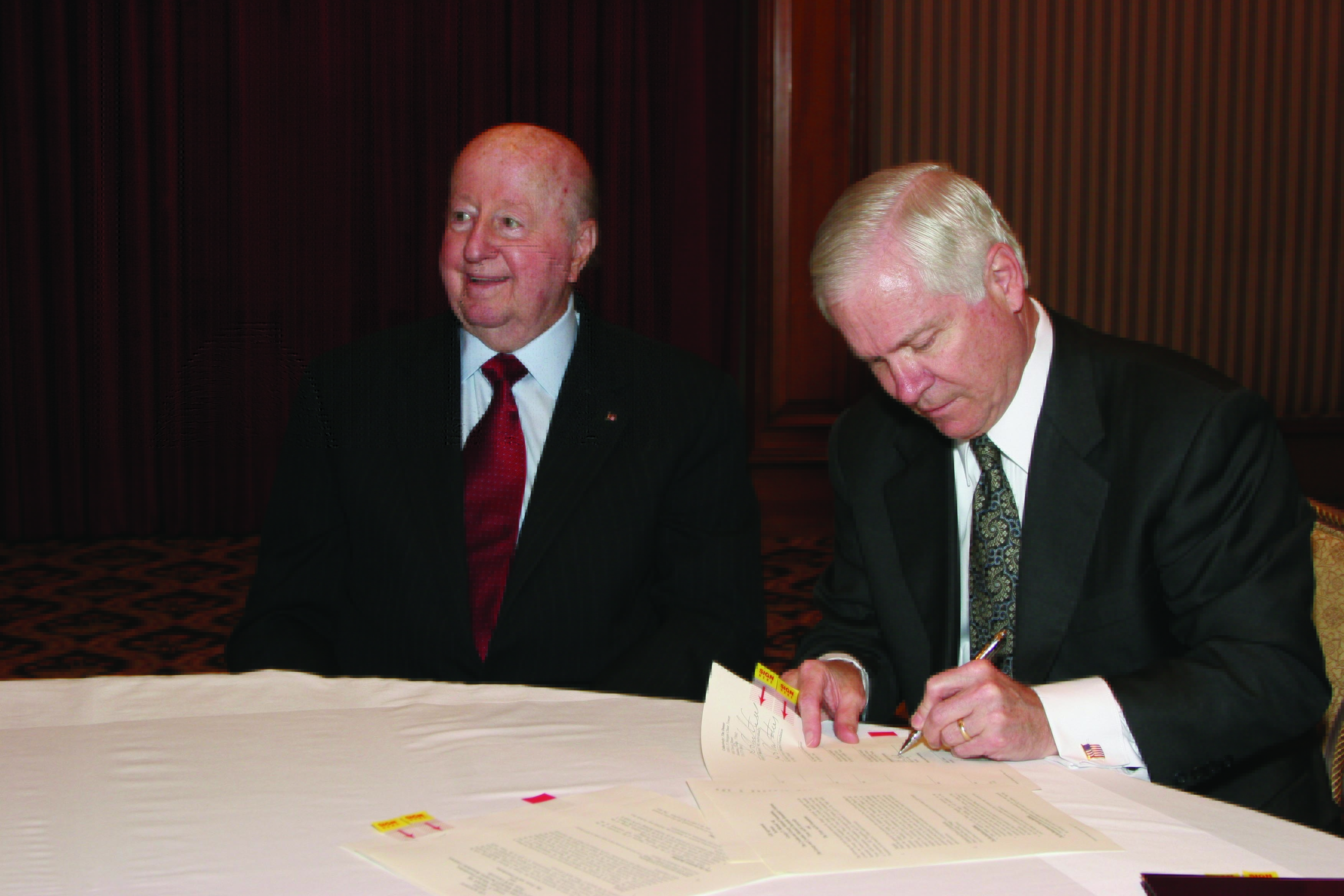
George P. Mitchell '40 and Dr. Robert Gates, signing the historic paperwork to finance construction of two landmark physics buildings at Texas A&M University.

George P. Mitchell ’40 and Dr. Robert Gates, signing the historic paperwork to finance construction of two landmark physics buildings at Texas A&M University.

That admiration was mutual, as evidenced by this quote from Dr. Gates upon hearing of Mr. Mitchell’s death on July 26, 2013:

“George Mitchell was a great man and a great benefactor of Texas A&M University. Through his generosity, dramatic improvements were made possible in many areas, including science research and teaching at Texas A&M, particularly in physics. Thanks to his philanthropy, world-class facilities and significant enhancements for faculty and students alike brought international renown to the university. His gifts also extended to athletics, particularly tennis. Personally, I thoroughly enjoyed working with and learning from him while I was president of the university. He will be greatly missed.”

These two powerful men and their visionary motivations coincided and collided in a
marvelous and near-magical way, creating the best possible hiring world and a climate of excitement and forward momentum that proved so attractive in 2006 as to actually land such an established star as Nick Suntzeff, a 20-year veteran of the U.S. National Optical Astronomy Observatory/Cerro Tololo Inter-American Observatory in Chile, to lead Texas A&M’s new astronomy program.

Thanks in large part to Dr. Gates’ and Mr. Mitchell’s dual dreams, the future is gloriously bright for Texas A&M Physics and Astronomy, Texas A&M University and the overall state of Texas. Despite being gone in vastly different extremes, both will be forever remembered in Aggieland, if not for enabling sweeping recruiting successes and other tangible program-wide gains, then for negotiating two beautiful buildings — architectural showpieces and the first on campus to be built through a unique university-private partnership involving substantial donor funds.

Here’s a bit of the rest of the story on that story, as told by Joe Newton, Dean of Science and inaugural holder of the George P. Mitchell ’40 Endowed Chair in Statistics, who reflects on a pivotal meeting involving Dr. Gates and Texas A&M’s most generous benefactor:

* ~ * ~ * ~ * ~ * ~ * ~ * ~ * ~ *

George P. Mitchell, 1940 Texas A&M University distinguished petroleum engineering graduate, the largest benefactor Texas A&M has ever had, developer of The Woodlands, and the leading figure in hydraulic fracking (among a host of other amazing accomplishments), passed away on July 26 at the age of 94.

Lucky enough to be in the right place at the right time as dean of the Texas A&M College of Science, I was privileged to participate in his philanthropic efforts to build fundamental physics and astronomy at Texas A&M. In the process, he became a friend. I flew on Continental Express with him. I ate at Chick-fil-A with him. Somehow he thought I had power. He would call me to tell me to fix things. Sometimes I even could. His passing has made me very sad. I cannot believe this life force has left us.

George P. Mitchell '40 and Dean of Science Joe Newton at the 2006 Sterling C. Evans Medal ceremony.

George P. Mitchell ’40 and Dean of Science Joe Newton at the 2006 Sterling C. Evans Medal ceremony.

I also had the honor of knowing former Texas A&M President (and CIA Director and Secretary of Defense) Robert M. Gates. These two men came together in Mitchell’s Houston office on Aug. 14, 2005, in a meeting that changed the face of Texas A&M. It was my honor to be there, and I would like to pay tribute to both of them by describing the meeting.

Both men had already played a large role in the development of fundamental physics and astronomy on campus; Gates with his reinvestment program designed to bolster teaching and research efforts by hiring a large number of new faculty, and Mitchell with his philanthropy that created an institute named in his honor, that helped us build a new astronomy program and attract great faculty.

Ed Fry, the department head at the time (and a dreamer of the first order), had developed a remarkably close relationship with Mitchell. Fry thought that Mitchell would be receptive to a request to help fund two buildings on campus. The first would be a “signature building” architecturally to house the Mitchell Institute; the second would for the first time consolidate all of the department’s faculty and classes in one place.

The task of convincing the university to supply the matching funds that Mitchell always required fell largely to me. Mitchell routinely drove a hard bargain, but the driving premise behind his trademark matching requirement was to ensure the maximum benefit of every dollar contributed — his or the university’s — to the broader cause or project. A major component of this particular project was that the department would make no claim on space it would vacate, so that the university would in fact receive a net gain with its matching funds.

After a series of meetings with various university officials, especially Gates, it was agreed that Gates and a few others (including Fry, Texas A&M Foundation President Ed Davis ’67 and College of Science Director of Development Don Birkelbach ’70) would go to Mitchell’s office in downtown Houston to make “the big ask.”

There was a sense of history when we walked into the conference room. Mitchell, as usual, started by asking about projects in which he was interested, including the Giant Magellan Telescope. Then his attorney, Barry Levitt, suggested we talk about the buildings. The rest took perhaps five minutes. Both Gates and Mitchell had great respect for the other. There was a true sense of good will.

Gates began by saying, “I don’t want to insult Ed or Joe, but a physics building has not been one of our top priorities.” In his typical wry manner, Mitchell interrupted Gates with, “Yes, I’ve noticed.” At which point everyone laughed. “But because of all you’ve done,” Gates continued, “we will contribute $2 million toward a building to house the Mitchell Institute, and I have a suggestion for you: I have identified $20 million in cash, and if you agree to the legacy proposal we have prepared for you, we will use the first $20 million of your funds to match what we will do.”

Mitchell responded that there were problems with the proposal, but that perhaps he could do $3 million per year for five years. Gates, without batting an eyelash, countered: “The $20 million really straps me; how about you do 10 years?” Mitchell came right back at him, suggesting, “How about $2 million for 10 years?” After a pause, Gates continued to barter, “$2.5 million for 10 years would split the difference.” Then Ed Fry jumped into the fray with, “It would really help to do it in five years — how about $5 million for five years?” Mitchell said, “Same amount of money, so OK.” The deal was done!

Groundbreaking for the George P. and Cynthia Woods Mitchell Institute for Fundamental Physics and Astronomy and the George P. Mitchell '40 Physics Building. Mr. Mitchell (hard hat), Dr. Gates and Joe Newton are pictured at center, along with several other Texas A&M professors and key administrators.

Groundbreaking for the George P. and Cynthia Woods Mitchell Institute for Fundamental Physics and Astronomy and the George P. Mitchell ’40 Physics Building. Mr. Mitchell (hard hat), Dr. Gates and Joe Newton are pictured at center, along with several other Texas A&M professors and key administrators.

Later, Mitchell’s total contribution for the $82.5 million buildings actually reached just over $36 million.

The rest is history. It took many, many meetings to complete the two beautiful buildings, but I will never forget the day these two legendary men agreed to something that greatly enhanced Texas A&M. Ultimately, with the fundamental work being done in these buildings and the resulting renaissance for Texas A&M physics and astronomy, they have indeed changed the world.

Dean of Science Joe Newton and George P. Mitchell '40 prior to a November 2012 event celebrating his $20 million legacy gift to his namesake George P. and Cynthia Woods Mitchell Institute for Fundamental Physics and Astronomy at Texas A&M.

Dean of Science Joe Newton and George P. Mitchell ’40 prior to a November 2012 event celebrating his $20 million legacy gift to his namesake George P. and Cynthia Woods Mitchell Institute for Fundamental Physics and Astronomy at Texas A&M.

History Worth Repeating

THIS JUST IN: This rest-of-the-story stuff is a universally (pardon the pun) appealing thing.

One of the absolute kingpins of this genre is award-winning author and Guggenheim Fellow Richard Panek, who penned the masterful 2011 book, The 4% Universe: Dark Matter, Dark Energy, and the Race to Discover the Rest of Reality – a detailed, behind-the-scenes story of the 2011 Nobel Prize-winning discovery that the universe’s expansion is accelerating. In the book, Panek saw fit to give due credit to (among others) Texas A&M astronomer Nick Suntzeff for his early work in Chile that essentially began the field of supernova cosmology.

Yesterday, in his Last Word On Nothing blog entry, Panek shares some vintage Nick Suntzeff – precisely the kind of trademark insight Nick is known for and to which I referred in this very blog last week.

History disease. The one chronic condition we could all be so fortunate to contract, sooner rather than later. Wonder if it’s contagious, not to mention as essential to groundbreaking research as masking tape and aluminum foil?

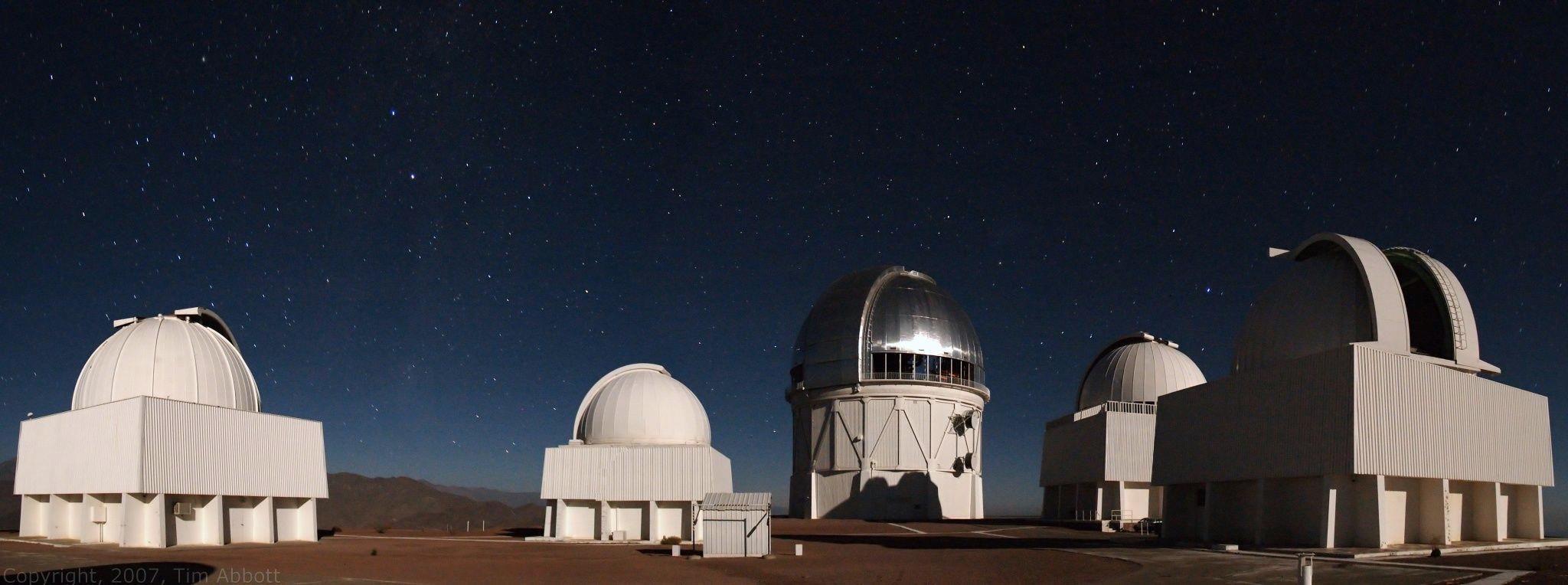
Cerro Tololo Inter-American Observatory (CTIO), Nick Suntzeff's astronomical home for 20 years prior to coming to Texas A&M. (Credit: Tim Abbott, CTIO.)

Cerro Tololo Inter-American Observatory (CTIO), Nick Suntzeff’s astronomical home for 20 years prior to coming to Texas A&M. (Credit: Tim Abbott, CTIO.)

For some additional history on Nick, check out one of the historically significant things he did as an undergraduate at Stanford that continues to educate and inspire to this day.

Yeah, he built that. But here’s how he described his contribution to elite higher education institutional history to me when I originally stumbled across the information:

“It seems not too long ago, a friend and I had no idea what we were doing, but a really supportive physics professor let us believe we could build the thing. He really was the key to this project. It is fun to see it still there at Stanford. I was amused to find out that it is well known as a romantic place on warm evenings. That is, romantic for couples, not astronomers who would be up in the dome cursing whatever is not working and drinking way too much coffee while squinting at a flickering screen and listening to totally forgettable ’60s classic rock. Not a pretty picture.”

Beats the hell outta befriending black widows, in my opinion.

Got a Little Story for Ya, Ags

As a writer, I do so love a good story and those who wield both the appropriate subject matter and the flair for its proper delivery.

One of the best absolute naturals in all above respects is Texas A&M astronomer Nick Suntzeff, who I describe to people as a marketer’s dream for good reason. Beyond his ease with media representatives, administrators and officials, and external visitors and general audiences, he’s also a master at breaking down the subject at hand and explaining why it matters. And in going the extra mile.

I offer a recent example — a follow-up email to Battalion reporter John Rangel, thanking him for a recent story:

John,

I would like to congratulate you on the article in The Batt on the most distant galaxy. You nailed the science and gave a feeling for the excitement of the discovery. Great job!

By the way, there are some points to this discovery that you, as an engineering student, may enjoy. It is difficult to define what is distance in astronomy because the universe is expanding, and the grid by which we measure distances is also stretching at the same time. So for me the best way to understand distance is just what you did — give it in units of how much time it took for light to get here compared to the age of the universe. However, you will see some articles refer to the distance to this object as 30 billion light years or so. This is the way astronomers would measure it, but this distance is not intuitive. Imagine we are in our galaxy in the early universe and we are looking at this distant galaxy. It would be very close to us because the universe is so small. Imagine putting a 3-D grid on this early universe and put our galaxy at one corner and the distant galaxy at another corner. Now run the universe forward to today. The universe has stretched a lot (expanded, if you will). Our galaxy and the other one are still at those corners, but the grid has expanded by a factor of 9 now. That short distant that separated us and that galaxy has now stretched into about 30 billion light years — the co-moving distance we call it. So you will also hear astronomers quote distances that are greater than the age of the universe.

How can something be farther away than the age of the universe (in today’s time) and we can still see it? Well, the weird thing is that we will never see that galaxy when it is today age — 13.8 billion years old. We can only see it now, but as the universe evolves, the galaxy will actually disappear from our universe or perhaps more to the point — will disappear from our vision.

The other point is that although galaxies appear to be moving away from us and this appears as a Doppler shift, it is actually not a Doppler shift. It is space stretching. Nothing is actually moving. The motion looks like a velocity and a Doppler shift, but there is no kinetic energy involved. If there were, galaxies near the edge of the universe would have a ridiculous amount of energy because they are moving close to the speed of light.

Edwin Hubble, who discovered the expansion of the universe, was careful never to call this apparent expansion a velocity — he called it a cosmological redshift which is what astronomers should also call it, and if they don’t, well I will go kick their butts.

Anyway, sorry for the long email about your great article.

cheers, nick

I don’t know about John Rangel, but for this writer, the initial interview is typically a formative experience. I remember well my first trip to Dr. Suntzeff’s Texas A&M campus office — a veritable time capsule spanning the high points of astronomical history as well as his career, which includes 25 years at Cerro Tololo Inter-American Observatory in Chile. I was interviewing him for a piece on Albert Einstein’s cosmological constant — Einstein’s self-described “biggest blunder” which he predicted in 1917 as the proverbial glue holding together the theory of a never-changing universe that Edwin Hubble’s 1929 discovery of the universe’s expansion later debunked. (Incidentally, in a Kevin Bacon-esque six-degrees-of-separation constant, Hubble served as mentor to Allan Sandage, who in turn is the one who encouraged Dr. Suntzeff to focus on Type Ia supernovas — specifically their brightness — to measure precise distances, which is how Dr. Suntzeff came to help discover dark energy and roughly 75 percent of the universe. But that’s a whole ‘nother story!)

After posing a basic equation-type question to gauge my level of astrophysical knowledge (essentially negative infinity), Dr. Suntzeff took great pains to explain not only the equation and the basic physics behind it, but also each and every piece in his collection, in addition to the actual research I was there to discuss. And so began an educational relationship across subsequent visits and stories, typically supplemented with emailed anecdotes and other means of follow-up insight about astrophysics and oh, so much more that has always served to enlighten or entertain. (Ask him sometime about saving Alan Alda’s life while down in Chile or about being school mates with Robin Williams — yes, that Robin Williams — or about the time he made international headlines for discovering nothing! Yeah, I have hundreds of these, as does he.)

Bottom line, it all goes to prove my long-held theory that most professors first and foremost are born educators and — big surprise — people, too. Their areas of expertise are vitally important, but somehow lost amid all that focused excellence and relentless drive is their intrinsic motivation and passion for knowledge generation, big-picture dreams and doing what they love and want you to love, too. Or at the very least understand in some tangible way.

Trust me, it’s a great story well worth the time it takes to read. Even better if you get the chance to hear it in person.

Nick Suntzeff claims no one believes that he knew Robin Williams in high school and that the two hung out together, but this image from the Redwood High School 1969 Yearbook offers actual proof from the days long before fame for both or the invention of Photoshop! Redwood is located in Larkspur, California.

Nick Suntzeff claims no one believes that he knew Robin Williams in high school and that the two hung out together, but this image from the Redwood High School 1969 Yearbook offers actual proof from the days long before fame for both or the invention of Photoshop! Redwood is located in Larkspur, California.

Light Years Ahead and Apart

Every day is a learning experience when you’re covering Texas A&M Science. In many cases, that experience doesn’t end with the finished story — for us as the writers or for the reporters who choose to pick it up.

It should come as no surprise that our professors are natural educators, in and outside their classrooms. Email and social media, along with news outlets that enable and encourage reader comments, offer extended opportunities for those savvy enough to harness them in the ever-broadening realm of public education and outreach.

Take, for instance, the recent most-distant-galaxy discovery. Astronomers Casey Papovich, Vithal Tilvi and Nick Suntzeff went to great lengths to help us get that story not only out but also accurate, from handling initial interviews to helping with multiple revisions and small tweaks to the article in progress as well as to the supporting images and captions.

Galaxy_ArtistRendering_TilviBreathtakingly beautiful, isn’t it? But as good as it is and we thought we did, it turns out people — general readers and even some astronomers — got a bit confused regarding the distance part of that most distant galaxy find. Enter the chance to educate, as illustrated in the following two examples.

In the first, Papovich expands on the 30 billion light years question in response to a direct email from a science writer in Germany:

Technically, the answer is “yes,” but I tend to use the distance the galaxy appears to be (that’s where we “see” it) That distance is only 13 billion light years distant.

The 30 billion light years comes from the following. If you could stop the universe expanding and run a tape measure, then the distance we would measure would be 30 billion light years. But we don’t see the galaxy there. I tend to quote the “light travel distance” because that’s the distance the galaxy “appears” to be (the light left the galaxy 13 billion years ago and has been chasing after us as we are carried away with the expansion). That distance (the light travel distance) is 13 billion light years.

 Now, the galaxy we’re seeing has also been moving in the other direction for 13 billion years, so it has also moved away. That’s why the present-day distance is 30 billion light years (but we can’t see the galaxy at that distance). Because we “see” the galaxy at the light travel distance, I quote that distance (13 billion light years).

Distances are very screwy because the universe is expanding so fast.

Hope that helps, Casey

And here’s the second example, in which Suntzeff responds to a comment on the story featured in the local newspaper, The Bryan-College Station Eagle:

The attentive Eagle readers here have caught an obvious mistake, but let me turn this into a learning moment (hey, give me a break! I am a professor at A&M.) When you measure distances to stuff in the universe, the meaning of distance is ambiguous. It has taken 13 billion years for this light to get to us from this galaxy, and this is one way of measuring distance. Another way, which is often used in astronomy, is asking how much the universe has expanded since that time — sort of how far away is the object in today’s much larger universe. We call this the “scale” distance. That number is more like 30 billion light years for this galaxy. For me, it is easier to think of distance as how long it took the light to get to us, which would be 13 billion years. But the 30 billion year distance is also correct, if not obvious. And yes, this will be on the mid-term.

Any way you slice/write it, I think it’s pretty darned cool we get paid to promote the likes of a discovery of the most distant galaxy known to man (one born only 1 billion years or so after the Big Bang) alongside such great ambassadors for astronomy, Texas A&M University and the state of Texas, and science education as a whole. Welcome to Aggieland!

photo

Of Forests, Trees and Maroon Roses

Ever find yourself so focused on the little things wrong that you miss the big picture of all that’s right? Easy to do when the day-to-day begins to rule not only the day, but also the week, then the month, then the next month, and so on. Sometimes it takes conscious effort to break this vicious cycle, but thankfully, there’s one routine assignment each year in the late spring/early summer that guarantees I stop and smell the maroon roses (so to speak) representative of Texas A&M Science. And boy, were they particularly fragrant in 2013. Or 2012, I should say.

Each year Texas A&M Science Communications compiles an annual report cataloguing our teaching, research and service efforts across all departments for the previous calendar year. Collectively and per individual tenured/tenure-track faculty member. It’s no small endeavor, with the end result being as weighty as the three-ring binder in which it arrives. One of the first pages within said binder is a foreword from Dean of Science Joe Newton summarizing the highest of the year’s high points — my primary contribution to the larger effort, which mostly involves pinning Dr. Newton down and making him focus on the rear-view mirror even as he’s engrossed in all levels of forward-looking responsibilities as our designated driver. Typically each department head also provides a foreword for each respective unit. All in all, it’s pretty impressive information that definitely goes against the Aggie tradition of humility (arguably the eighth core value!) but speaks volumes about what we value as a college and across the fundamental sciences and professions we represent.

Rather than relegate that summary to the binder for another year, I want to share it here so that you, too, can see it’s been a good year for the roses. Congratulations, Texas A&M Science, but your work here isn’t done. We’ll get more binders ordered…

FOREWORD FROM THE DEAN (2012 Annual Report)

As dean of the College of Science at Texas A&M University, it is my obligation and privilege each fall to take stock of our progress toward our three-part university mission — teaching, research, and service — and to reevaluate our collective commitment to ongoing excellence in all respective phases.

I am pleased to report that the Texas A&M College of Science continues to deliver on its unspoken yet inherent promise to advance discovery and solve real-world problems. In the past year alone, our scientific ingenuity has resulted in hundreds of top-notch graduates and more than $56 million in sponsored research projects that create new knowledge and drive economies around the world. Each year despite all economic indicators to the contrary, those awards steadily continue to increase, both in amount and stature, as testament to the strength of our programs and overall reputation for excellence.

Beyond research funding, the past year marked another major milestone in external fundraising — a landmark $20 million legacy gift by George P. Mitchell ’40 and the Cynthia and George Mitchell Foundation toward the George P. and Cynthia Woods Mitchell Institute for Fundamental Physics and Astronomy that followed their $25 million gift (half of which was credited to Texas A&M) to the Giant Magellan Telescope in 2011.

Our individual teaching, research, and service highlights in 2012 were many and magnified, highlighted primarily by big discoveries and major research-related awards in each department. Two faculty, physicists Marlan Scully and Alexander Finkelstein, were honored for lifetime research achievement — Scully with the Optical Society’s highest award, the Ives Medal/Quinn Prize, and Finkelstein with a Humboldt Research Award. Chemist Oleg Ozerov was recognized with The Welch Foundation’s Norman Hackerman Award for Chemical Research, while fellow chemist David Russell earned the American Chemical Society’s Field/Franklin Award for Outstanding Achievement in Mass Spectrometry. Three faculty received National Science Foundation CAREER Awards (Helmut Katzgraber, Wenshe Liu, Grigoris Paouris),

In other notable accolades, Chemistry’s Sherry Yennello was recognized as a Fellow of the American Association for the Advancement of Science (AAAS), while Karen Wooley was named 2012-14 chair of the Nanotechnology Study Section within the National Institutes of Health Center for Scientific Review. Mathematics celebrated 11 inaugural American Mathematical Society Fellows (Harold Boas, Ronald DeVore, Ronald Douglas, Rostislav Grigorchuk, William Johnson, Peter Kuchment, Gilles Pisier, Frank Sottile, Emil Straube, Clarence Wilkerson, and Guoling Yu, who was named the inaugural holder of the Thomas W. Powell Chair in Mathematics), as well as its first Texas A&M Presidential Professor for Teaching Excellence (Boas).

 In global research breakthroughs, our high-energy physicists were part of international experiments at the Large Hadron Collider and Fermilab that confirmed preliminary proof for what is believed to be the Higgs boson particle. The Dark Energy Camera, for which astronomer Darren DePoy serves as the project scientist, captured and recorded its first images high atop the Blanco Telescope in Chile. First blast occurred at nearby Las Campanas Peak, marking the beginning of site preparation for the Giant Magellan Telescope, which also celebrated successful completion of its first mirror. Chemist Joe Zhou received his second Department of Energy grant in as many years to develop more efficient natural gas storage tanks for passenger vehicles. Our faculty (Alexander Finkelstein, Christian Hilty, Oleg Ozerov, Jairo Sinova, Clifford Spiegelman, Renyi Zhang) also are involved in six of the eight joint research projects encompassed in a $1.5 million campus-wide collaboration with Israel’s Weizmann Institute of Science.

 On a campus achievement front, Physics and Astronomy’s David Lee was selected as a university distinguished professor, Texas A&M’s highest academic honor for faculty. Biologist Michael Benedik was named Dean of Faculties, and a record-tying six faculty received university-level Texas A&M Association of Former Students Distinguished Achievement Awards — Tatiana Erukhimova and Sherry Yennello in Teaching, Kim Dunbar and Nicholas Suntzeff in Research, Marcetta Darensbourg in Graduate Mentoring, and Edward Fry in Administration. Physicists Olga Kocharovskaya and David Toback earned Sigma Xi Distinguished Scientist and Outstanding Science Communicator Awards, respectively. Toback and chemist David Bergbreiter also earned their second University Professorships for Undergraduate Teaching Excellence (UPUTE) appointments. Mathematics’ Sue Geller received the Texas A&M Honors and Undergraduate Research Director’s Award, while chemist Kim Dunbar earned the inaugural Texas A&M Women Former Students’ Network Eminent Scholar Award.

Students shared equally in the accomplishment spotlight, none brighter than Mathematics’ Tanner Wilson, who earned one of two Brown-Rudder Awards presented each year at spring commencement to the top Texas A&M seniors. Allyson Martinez (Biology) and Meng Gao (Physics and Astronomy) earned Phil Gramm Doctoral Fellowships, while Charles Zheng (Mathematics) received an NSF Graduate Research Fellowship. Mathematics major Frances Withrow earned a Pi Mu Epsilon/Society for Industrial and Applied Mathematics (SIAM) Award at MathFest 2012, and physics major Daniel Freeman received the 2012 Outstanding Thesis Award for Undergraduate Research Scholars from Texas A&M Honors. In addition, four graduate students merited Distinguished Graduate Student Awards for their exemplary efforts in research, teaching and mentoring (Michael Grubb and Casey Wade, Chemistry, doctoral research; Wenlong Yang, Physics and Astronomy, master’s research; Scott Crawford, Statistics, doctoral teaching).

One of our most cherished former students and longtime External Advisory & Development Council champions, the late Dr. Robert V. Walker ’45, received a Texas A&M Distinguished Alumnus Award, while Statistics’ Jerry Oglesby ’71 and our own chemist Daniel Romo ’86 were inducted into the college’s Academy of Distinguished Former Students.

From an educational outreach perspective, Chemistry hosted the 25th edition of its award-winning Chemistry Open House and Science Exploration Gallery, while record crowds attended both the Math MiniFair and Physics & Engineering Festival. Dozens of women participated in a three-day, national physics conference hosted by our Educational Outreach and Women’s Programs Office, while the Mitchell Institute unveiled the Physics Enhancement Program (MIPEP) to improve high school physics teaching. The Texas A&M Math Circle also was born to engage and encourage bright middle school students, while Houston-based Halliburton put its name and grant support behind a new “Mathematics All Around Us” outreach program. The Greater Texas Foundation committed $50,000 to round out a $150,000 challenge grant started by another big name in Texas industry, Texas Instruments, to benefit aggieTEACH. Finally our Center for Mathematics and Science Education (CMSE) is helping to lead a new $10 million science and technology educational outreach program funded by NASA.

Last but certainly not least, longtime Dean’s Office staff member Carolyn Jaros retired in May, capping 30 years of service to Texas A&M and to three different deans in the College of Science. Biology also saw the retirements of three dedicated career staffers: Tonna Harris-Haller (associate director, Freshman Biology Program), Jillaine Maes (assistant head of the department), and Vickie Skrhak (business coordinator).

In 2012 as in years past, I thank each of you, not only for another year of great achievement, but also for the continued distinction you bring to both Texas A&M University and the College of Science in your efforts to deliver the highest quality of science education, scholarly research, and technical expertise and service to benefit the world.