A Stitch in Time

Even after a decade in the College of Science and going on a (slightly shocking, even to me) combined 24 years as a student and communicator at Texas A&M University, I never cease to be amazed by the absolute care and creativity so many of our professors put into their teaching efforts. Take, for instance, Texas A&M Mathematics’ Jill Zarestky, who each fall since 2009 has taught a first-year seminar course, Arts & Crafts & Maths, that explores the relationship between art, mathematics and a variety of crafting and fiber arts techniques, including knitting, crocheting, needlepoint, embroidery, cross-stitch, weaving and quilting.

Zarestky, who has been knitting and teaching mathematics at Texas A&M since 2007, is active with the Brazos Valley Knitting Guild and regularly teaches knitting workshops and classes. This month, she also is a featured artist with the local Arts Council of the Brazos Valley. If you aren’t able to drop by the ACBV’s College Station headquarters to see some of her knitted works on display as part of the Fiber Arts: All Things Fiber exhibit, then check out her related guest post for their blog describing her insight into the connections between knitting and math.

Jill Zarestky, in front of some of her at the current Arts Council of the Brazos Valley exhibition.

Jill Zarestky, in front of some of her work at the current Arts Council of the Brazos Valley exhibition.

The human element: It’s alive and well in Texas A&M Science faculty and in the many personal touches, obvious and subtle, they bring to their classrooms. What valuable life lessons for us all.

Bring your A game, folks, but don’t forget to pack your P (personality) one as well.
Mathematical Modeling in Biology REU

I’m one of of the faculty mentors for the Mathematical Modeling in Biology REU program, which I originally talked about here. Two of our five students are working with me on a project this summer. We are a three-woman dream team!

We are studying mathematical models of how organisms coexist and compete while using the same resources in an ecosystem. There are a variety of ways that organisms use resources. For example, plants need nitrate and phosphate to grow, and without sufficient quantities of both of these nutrients, the plant will die. On the other hand, humans can get energy for daily activities from carbohydrates, protein or fats. If we don’t have carbohydrates, we can substitute some protein or fat and get by; for the sake of providing us with energy, we need any one of these, but we don’t need all. Modeling has been used with multiple organisms using one type of nutrient utilization, but not a lot with multiple organisms having multiple ways of utilizing nutrients. That’s what we are working on.

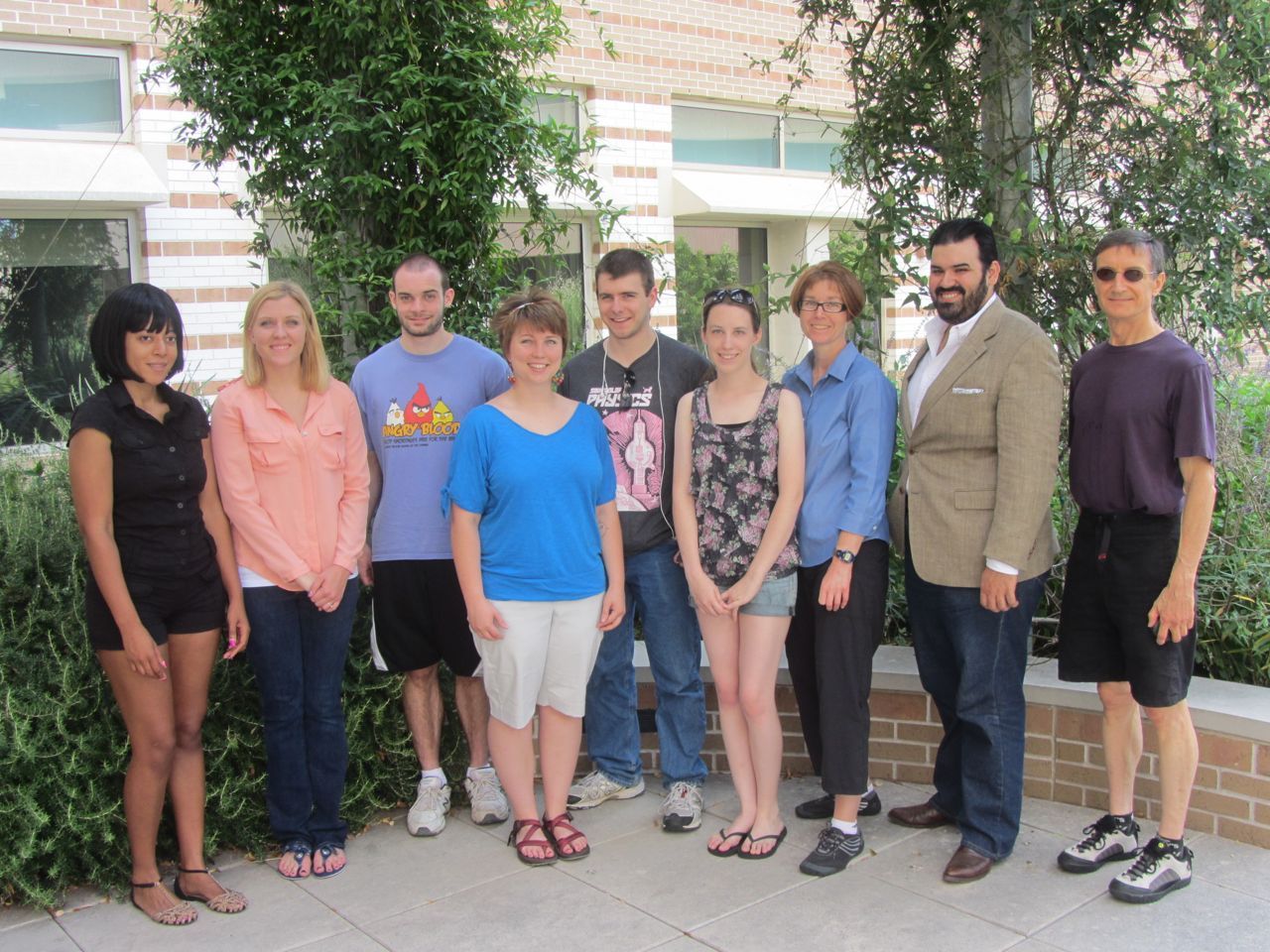
Mathematical Modeling in Biology REU Group

Mathematical Modeling in Biology REU Group

Thus far, we’ve reproduced some results from existing models with a common type of nutrient utilization; in particular, we’ve shown how one organism can outcompete others for the same resources, and how two organisms can coexist even though they both utilize the same resources. We are working on learning some of the background science of how organisms use resources and the equations and mathematics associated with this. We are performing a literature review to familiarize ourselves with what research has been done in the past and has been published recently. We are learning what types of questions scientists are interested in and have answered in the past, and also figuring out where we can make a novel contribution. And, given that we are a mathematics program, it won’t surprise you to learn that we are developing the equations we need to make the modifications required to the model we have so that we can do something new.

The other three students in our program have interesting problems to work on as well. Two are working on mathematical models for how atherosclerosis (hardening of the arteries) occurs and how diet and exercise might improve arterial health. One student is working on mathematical models for controlling invasive species; personally, I am hoping he will find a way to mitigate the spread of fireants.

Research Experiences for Undergraduates

It’s summertime in Aggieland, and one thing that means is an influx of students from across the United States participating in Research Experiences for Undergraduates (REU) grants at the university. The Math Department is only one of many National Science Foundation-funded REU sites at Texas A&M. The Math department has been running an REU site every summer since the program was started in 1999.  This summer, we have 14 students, 8 women and 6 men, with us for 8 weeks.  Five students are participating in the program in Number Theory, five in Mathematical Modeling in Biology, and four in Algorithmic Algebraic Geometry.  The Algebraic Geometry group is supplemented by two local undergraduates.

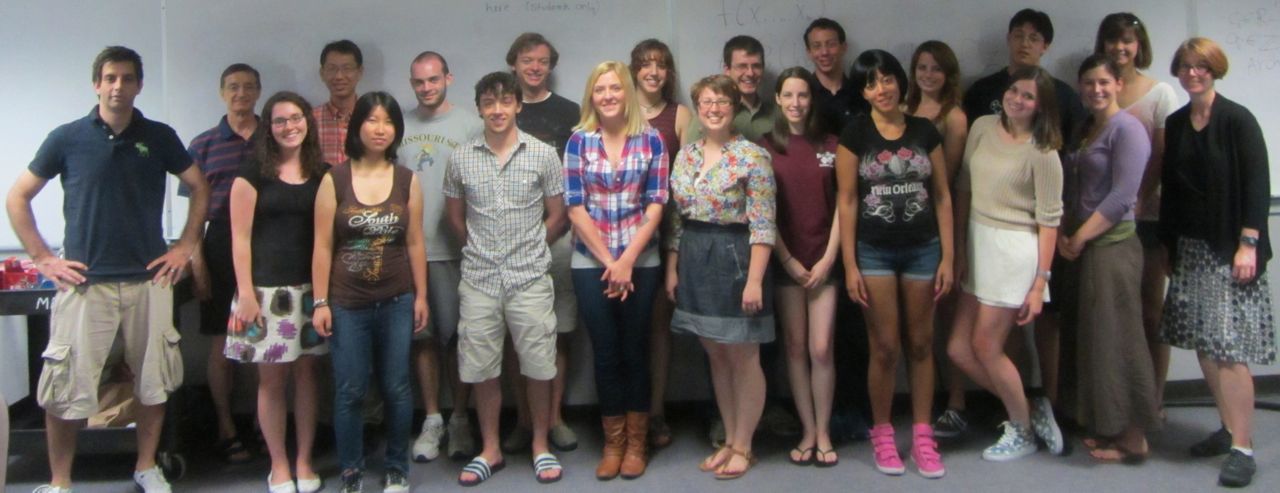
REU students and mentors, summer 2013

REU students and mentors, summer 2013

Students generally have lectures and homework to deal with for the first two weeks of the program. This familiarizes them with the foundational mathematics they will need for the research problems they’ll be working on.  By the middle of the second week, they are given research problems and get started trying to solve them.

This past Friday, the last day of the second week of the program, all the students and mentors in our REU got together for lunch. Students gave short presentations describing their research problems. At the end of the fourth and sixth weeks of the program, we’ll get updates from everyone on their projects. At the end of the eighth week of the program, we have a Minisymposium, where all our REU students present their results.