
Another guest entry from Texas A&M Center for Mathematics and Science Education (CMSE) researcher Dr. Craig Wilson about the importance of seizing not only our days but as many fleeting moments as possible — rather appropriate as we close in on closing out another trip around our Sun:
* ~ * ~ * ~ * ~ * ~ * ~ *
Life is ephemeral…
Just what does that mean? I still retain a dictionary, but nowadays most people turn or click to Wikipedia, which defines ephemeral things (from the Greek word εφήμερος or ephemeros, literally “lasting only one day”) as transitory and existing only briefly. Typically the term is used to describe objects found in nature, although it can describe a wide range of things.
So, it was refreshing and thought-provoking to hear this definition offered by a Native American tribal elder when I recently attended the “closing circle” at the American Indian Science and Engineering Society (AISES) National Conference in Denver, Colorado. Dried sage leaves were burning and smoking (smudging) and cleansing the gathering that, rather incongruously, had attendees seated in a circle of chairs arranged inside a hotel conference room rather than outdoors under an expansive blue sky with the snowcapped Rockies as a backdrop. Nevertheless, once “smudged,” the speaker was allowed to hold the sacred eagle feathers and thus the floor, whereupon the elder said that, “The Plains Indians consider life to be like the fresh breath of a buffalo on a cold morning.” No book nor the Internet could have put it better, and so I immediately became a fan of oral history and the power of a good story — in my case spoken by preference.
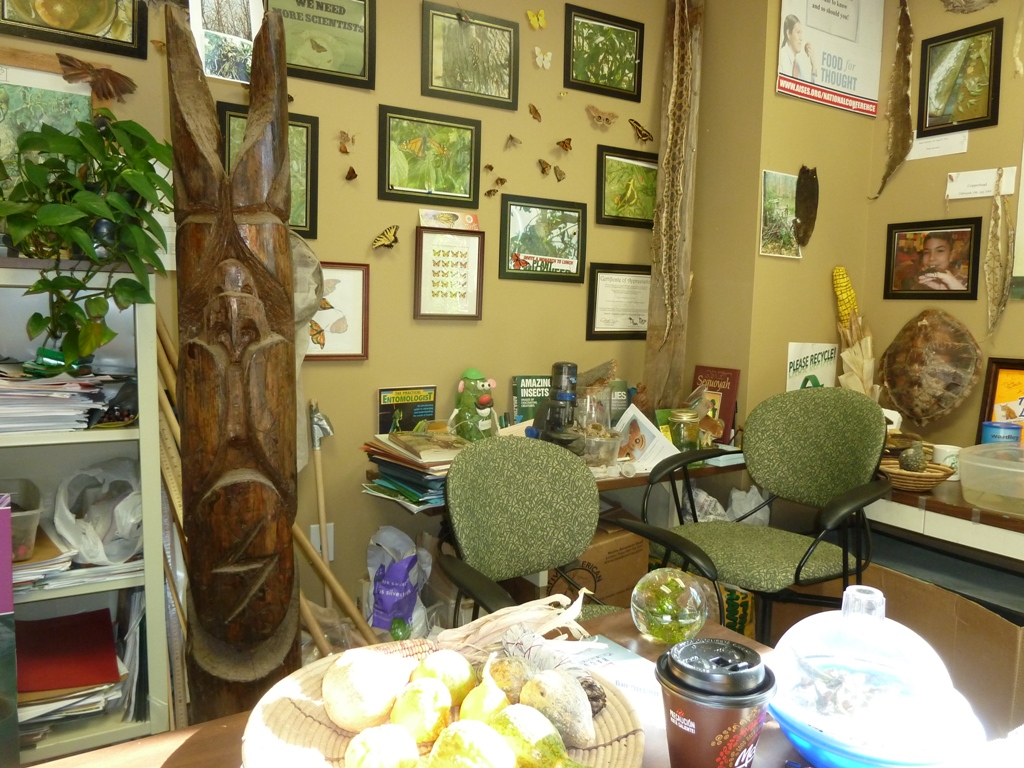
A totem pole carved by an itinerant woodcarver Craig Wilson befriended from Washington State nearly 20 years ago graces his USDA/ARS office. Wilson says he treasures the man’s generous gift, given that members of this particular artisan’s clan of 7th- and 8th-generation First Nations carvers have work in the collections of the Smithsonian and the Royal BC Museum in Victoria, British Columbia.
I have taken to using the phrase “we only pass this way once” (with apologies to any Buddhists and Hindus in my audience) to try to impress on imressionable young minds that they should not be spectators in life but active participants who should try to squeeze out every last drop of juice or aqua viva that is held therein. They should participate. That is, of course, easy for me to say, as I have the luxury in my job of time for thought, while most folks have their noses to the grindstone or, nowadays, to an Ipad/device screen, their thumbs flashing across a miniature keyboard as if their life depended upon reacting or being proactive by text rather than active. There is no thought of taking time out to smell the roses. Why look at or smell an actual rose when you can click on a link and learn that there are Banksianae — white and yellow roses from China — in fact roses from most every continent, of every color, and that they all trace their roots back to slightly more than 100 species? Smell one? What would be the purpose of that?
With that thought in present day, I took myself out of the Howard Johnson — formerly a parochial house for priests and monks — and walked a few hundred yards to the town square in Mayaguez, Puerto Rico where I am currently working. I was there the day before and was immediately struck by the fact that something was missing, different, perhaps untoward. I immediately realized that the fountains had been silenced, the gloriously sparkling pool surrounding the imposing bronze statue in the center of the square emptied and stilled. A magical exercise had been lost to me, given that I have a habit when seated by moving water to focus my eyes on one drop and then to follow its every movement upward and down until it is lost to me, at which point I pick up another water molecule’s path and so on. It is mesmeric. You should try it.

Christopher Columbus statue and fountain in the town plaza in Mayaguez, Puerto Rico.
So instead, I took in my surroundings, where a diminutive, suntanned older lady was sweeping leaves off the marbled square with a passion and effort that was both impressive and disturbing in that she was like an automaton of Autumn only employed when the leaves fall and desperate to have the square leaf-free as if it were a leaf-free zone. That took my eyes skywards to see how much work remained, gauged by the remaining foliage, but then I spotted a humming bird flitting from leaf to leaf, breakfasting on insects to bring up its protein count while burning off the calories from nectar collected elsewhere. Native Americans explain that our Earth is covered by a dark blanket into which the humming bird had pierced holes that are the stars. That sounds good to me and to hell with The Big Bang Theory although it does make me laugh!
My thoughts have drifted as usual, this time like smudging smoke, but I leave you with this analogy from the same tribal elder who said, “The Woodland Indians consider life to be like the flash of a firefly in the darkened forest.”
Beautiful but ephemeral…


 Texas A&M Science